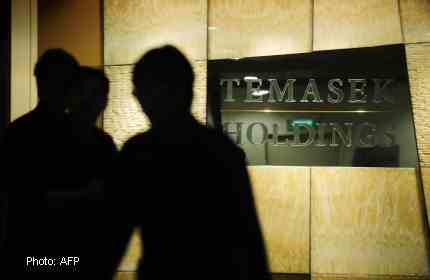
Showing posts with label Temasek Holdings. Show all posts

Monday, July 16, 2012

Temasek Holdings to issue 10.5-year, 30-year US dollar bonds

SINGAPORE: Temasek Holdings plans to launch a dual tranche bond offering, comprising benchmark 10.5-year and 30-year US dollar-denominated bonds, according to a statement released to the Singapore Exchange (SGX) on Monday.

The bonds will be issued under its US$10-billion medium-term note programme and will be fully guaranteed by Temasek.

This is Temasek's first bond sale in two years.

The issue size was not disclosed, but reports said benchmark issues typically exceed US$500 million.

Temasek said the net proceeds from the bonds sale will be used "to fund their ordinary business".

Standard & Poor's and Moody's have rated the bonds AAA.

Earlier this month, Temasek said it was looking to invest in assets in Europe as well as in the energy and commodities sector.

Over its past fiscal year, Temasek said it had invested S$22 billion, snapping up stakes in North Amercian energy-related firms like Clean Energy Fuels and FTS International.

Temasek's year-end portfolio value stood at S$198 billion as at March 2012.

Its group net profit for the fiscal year fell 16 per cent to S$10.7 billion last year.

Thursday, July 5, 2012

Temasek group net profit falls 16% to S$11b

SINGAPORE: Singapore investment firm Temasek Holdings on Thursday said its group net profit in the year ended 31 March fell 16 percent to S$10.7 billion from S$12.7 billion last year.

This was due to lower operating profits from companies in its portfolio. It was also due to a difficult external environment.

The decline comes after a doubling of net profit in the previous year.

Temasek's year-end portfolio value, however, was a record S$198 billion, up from S$193 billion last year.

From the shareholders' perspective, Total Shareholder Return (TSR) for the year was a modest 1.5 per cent.

In the year ended 31 March, Temasek invested a total of S$22 billion and divested S$15 billion. Net investments for the year amounted to S$7 billion.

During the year, Temasek doubled its exposure to the energy and resources sectors from 3 per cent to 6 per cent, including a S$2 billion investment in FTS International, a US shale energy production service provider. Temasek also invested S$1.3 billion on US fertiliser producer The Mosaic Company.

However, Temasek said its portfolio is now firmly anchored in Asia.

It ended the year with an underlying portfolio exposure of 72 per cent in Asia, including 30 per cent in Singapore.

Temasek's exposure in mature economies such as Australia and New Zealand was 14 per cent while North America and Europe accounts for 11 per cent. Latin America and other growth regions such as in Africa, Central Asia and Middle East remained at a steady 3 per cent.

In a statement, Temasek chairman S. Dhanabalan said: "In the 10 years since March 2002, we invested almost S$140 billion, and divested just under S$90 billion as an active investor in Asia.

"In the process, we reshaped our portfolio from one largely focused on Singapore to one riding on the twin transformations of Asia and Singapore, growing it from S$77 billion at end March 2002 to S$198 billion a decade later.

"Investments made since March 2002 delivered over 18% annualised returns to Temasek over the last 10 years, while blue chip investments we held as at end March 2002, such as SingTel and Singapore Airlines, delivered a steady 11% annualised returns to Temasek over the same period.

"Based on a theoretical simulation of key holdings, had we kept our portfolio as at 31 March 2002 unchanged, and not stepped out actively into Asia, it would have grown to a lower S$165 billion in March 2012."

Looking ahead, Temasek expects the investment environment to remain challenging amid heightened volatility in the global economy.

Temasek adds that as an active investor, it remains positive on Asia's potential.

"Asia's long-term growth potential remains healthy, though there will be structural and policy risks along the way, especially in the medium term," said Mr S. Dhanabalan. "In the near term, Europe and the US present significant risks, as well as potential opportunities."

In the statement, Temasek's CEO Ms Ho Ching said: "Urbanisation and middle income population growth continue to underpin the long term transformation of Asia and other growth economies. Sectors such as energy, resources and consumer good and services are proxies to the demographic drivers of growth, while technology in the media, computing and biotech may provide new break-through opportunities."

Amid the slower global economy, Singapore Airlines and Neptune Orient Lines are some of Temasek's portfolio companies that have seen lower earnings.

But the investment firm says it is in a good position to pounce on opportunities.

Loy Wee Khim, Standard & Poor's Director of Asia Pacific Corporate Ratings, said: "Temasek has been in a net cash position for the past eight years."

Tan Chong Lee, Chief Investment Officer and Co-Head of Americas at Temasek, said: "We ended the year with a net cash position, and have full financial flexibility to respond to opportunities ahead. As a long-term investor, we continue to invest in sectors that are proxies for growth economies in Asia and other growth regions."

More than 70% of Temasek's portfolio is invested in Asia, including Singapore.

Over the past year, it has also increased exposure in North American energy companies and Chinese banks.

Chia Song Hwee, Head of Strategy and Head of Credit Portfolio at Temasek, said: "We firmly believe that with the underlying demand for energy and resources, that is a sector that we will have significant exposure.

"Periodically, we will have issues, whether macro or micro at the company level but it is more important for us to focus on the long-term potential of the sector and company, and we will adjust accordingly.

"With regard to financial services, it is the best proxy for the underlying economy. Therefore we continue to have a large part of our portfolio in financial services."

Temasek's total shareholder return for the year was 1.5 percent, down from 4.6 percent in the previous year.

Associate Professor Sundaram Janakiramanan, Head of Finance Programme, School of Business, SIM University, said: "Last year they paid out about 30 percent of the profit as dividends, this year it is reduced to 25 percent. So maybe they are keeping money by paying less dividends in order to make prudent investments in the near future."

That one-year rate of return of 1.5 percent is below Temasek's internal hurdle rate of 8 percent.

Wealth Added (WA) bonuses are awarded to key staff should returns exceed the hurdle.

Dilhan Pillay Sandrasegara, Head of Portfolio Management and Head of Singapore at Temasek, said: "So yes, we would expect no WA bonuses this year for our financial year ended 31 March 2012, but for the other members of the company, there are other parts of the compensation pool available to them."

Over the year, Temasek invested S$22 billion, snapping up stakes in North Amercian energy-related firms like Clean Energy Fuels and FTS International, while divesting S$15 billion, selling stakes in firms like Singapore semiconductor company Avago Technologies and Chinese property developer Kaisa.

Monday, April 16, 2012

Temasek buys $3b ICBC shares

HONG KONG/SINGAPORE - Temasek bought US$2.3 billion (S$3 billion) worth of Industrial and Commercial Bank of China's (ICBC) Hong Kong-listed shares from seller Goldman Sachs, piling into three of China's top four banks and raising its bet on the world's second-biggest economy.

The deal for ICBC takes Temasek deeper into China's banking industry, which has grown from insolvency six years ago to become a sector that holds four of the world's top 10 banks by market value.

Mr Ding Wei, Temasek's China head, told Reuters that it bought into ICBC because the price was reasonable and the investor was positive about the bank and China's long-term development.
Temasek already owns stakes in China Construction Bank and Bank of China.

China assets accounted for 20 per cent of its portfolio as of March last year.

Mr Song Seng Wun, an economist at CIMB, said: "Temasek has laid out its strategy before on where it thinks growth is. Within Asia, China anchors the growth, so Temasek is putting money where its mouth is."

The latest purchase was of 3.55 billion H-shares, or about 1 per cent of ICBC, the world's largest bank by market value.

Temasek now has a 1.3 per cent stake in ICBC, a Temasek spokesman said. This includes ICBC shares that the investor owns directly, as well as various other stakes held by Temasek-linked companies.

China's banking industry has come under fire lately, as customers and politicians have cried out that the sector's massive profits are coming at the expense of citizens.

Low deposit rates, coupled with steady customer fees, are at the heart of the protests.

Goldman's block trade is in line with its plan to reduce its stake in ICBC, which it bought before the Chinese bank's 2006 initial public offering (IPO).

After the sale - its fourth - Goldman has roughly US$3 billion worth of ICBC shares remaining.

Goldman sold the Hong Kong-traded shares of ICBC at HK$5.05 each (S$0.82), or a 3.1 per cent discount to last Friday's closing price.

The other roughly US$200 million worth of shares were sold to other institutional investors, a source said.

Hong Kong shares of ICBC, which has a market value of US$240 billion, fell as much as 1.7 per cent early yesterday but pruned the losses to be down 0.8 per cent in the afternoon, in line with the broader market.

Its shares are up about 12 per cent so far this year, in line with a similar rise on the benchmark Hang Seng Index.

Besides Goldman, American Express (Amex) is the only major foreign financial institution that holds shares in ICBC.

Amex holds about 638 million shares in ICBC, or less than 1 per cent of the bank's Hong Kong-listed shares.

Mr Sanjay Jain, head of Asian financials research at Credit Suisse, said: "The sale does not affect ICBC at all, and the overhang will be removed when Goldman disposes of the remaining (ICBC shares), hopefully in one go."

Temasek's financial-services portfolio includes stakes in DBS Group, Indian lender ICICI Bank and Standard Chartered.

Bank of America, Royal Bank of Scotland and UBS are among the foreign banks that have sold large stakes in Chinese banks over the past few years.

Such sales have been an attractive way to raise capital or reduce earnings volatility.

Goldman first bought 4.9 per cent of ICBC for about US$2.6 billion before the 2006 IPO, which was then the world's biggest public offering.

The latest stake purchase comes after Temasek, which manages about US$150 billion in assets, raised about US$800 million since the start of the year in three significant selldowns in its portfolio companies.

This included a 1.4 per cent stake sale in ICICI Bank.

Temasek is also selling its 67.4 per cent stake in Indonesia's Bank Danamon to DBS in exchange for DBS shares, in a deal that is awaiting regulatory approval.

Friday, March 2, 2012

Risks to S'pore's sovereign wealth funds not excessive: MOF

Minister of State for Finance Josephine Teo said in her Committee of Supply speech that the Government systematically reviews the risk in its overall portfolio when managing the state's sovereign wealth funds.

It does this by monitoring the concentration risks in the whole portfolio of assets invested by Temasek Holdings, the Government of Singapore Investment Corporation (GIC) and Monetary Authority of Singapore (MAS).

But Mrs Teo added the Government does not decide on how each investment entity manages its own portfolio, saying that their respective boards and professional management teams are responsible for those decisions.

She reassured that risks to the portfolio is not excessive as the Ministry of Finance assesses the impact of various adverse global scenarios, across medium to long-term time-frames.

Earlier, MP for Ang Mo Kio GRC Mr Inderjit Singh Ang Mo Kio GRC raised the concern that GIC and Tesmasek Holdings are investing in very similar assets.

He cautioned that it is not a good trend as the two sovereign wealth funds are supposed to target different types of investments.

He said: "We may be overinvesting and lack diversification in our investments, which could come back and haunt us doubly hard if these sectors are hit by problems.

"We have seen this when we were hit by a number of investments in financial institutions by both entities."

He called for greater coordination between the two, by having the Ministry of Finance play a more active role in coordinating their investment philosophies.

Wednesday, December 28, 2011

Temasek looking to sell majority stake in Pakistan bank

SINGAPORE - Singapore state investor Temasek is looking to sell its 88.6 percent stake in Pakistan's NIB Bank after heavy losses, the Business Times reported on Thursday quoting a source.

The paper also said NIB had suffered a cumulative net loss of about 17 billion Pakistan rupees (S$245.6 million) since Temasek first invested in the bank in early 2005.

Business Times quoted a Temasek spokesman as saying the firm did not comment on market speculation. The Singapore state investor could not immediately be contacted by Reuters for comment.
Reuters reported last month that Khawaja Iqbal Hassan, who was instrumental in bringing Temasek as an investor, had stepped down as CEO of NIB and that Singapore was looking at a paper loss of about US$400 million of its US$540 million investment.

Related Posts Plugin for WordPress, Blogger...