SINGAPORE: Singapore's super-rich watched their collective fortunes shrink by 8.8 per cent from August 1, 2011 to July 31, 2012.
According
to industry researcher, Wealth-X, people with more than US$30 million
in investable assets suffered mainly from the poor performance of the
stock markets.
Still, Singapore's so-called ultra high net worth individuals are ranked seventh in Asia as a group.
With
a combined wealth of US$155 billion, they have enough money to build 23
Marina Bay Sands or cover the debt of Hungary, the world's 56th largest
economy.
Overall, the wealth of Asia's ultra rich dropped 6.8 per cent to US$6.3 trillion in the past 12 months.
And
Wealth-X said low-interest rates mean more of Asia's rich will be
driven to invest in property, defying government efforts to cool the
market.
CEO of Wealth-X, Mykolas Rambus, said: "In Asia, there
are almost 43,000 ultra high net worth individuals competing for the
same property whether it's Hong Kong, Singapore, Shanghai - there're
lots of assets that are available so I think we'll see property prices
continue to go up because there is such demand.
"And increasingly
we'll see ultra high net worth individuals invest further afield,
whether it's in residential, commercial or industrial, looking for
opportunities in the US and in Europe."
Monday, September 17, 2012
Carrefour to close both outlets by end of the month
Both branches of French hypermarket Carrefour in Singapore are set to
close by the end of the month in order to restore the premises to its
original state.
Leases for the outlets at Suntec City and Plaza Singapura are scheduled to expire in December and November respectively.
Three weeks ago, Carrefour Singapore announced that it was pulling out of the local market before the end of the outlets' lease.
In its statement, Carrefour had said: "Carrefour Singapore announces the decision to close its Suntec and Plaza Singapura stores before end of 2012, since expansion and growth perspectives do not allow reaching a leadership position in the medium and long term."
It had opened its first store in Singapore in 1997.
According to a Straits Times report, the non-food level of both outlets are already closed. Most of the food shelves have also been cleared out, following a sale last weekend.
Plastic sheets were seen covering the empty shelves, and suppliers of fresh meat and produce have stopped delivery, said the English daily.
The remaining dried goods were packed and moved closer to the cashiers to allow the premises to be cordoned off in stages.
In an earlier interview with AFP when the pullout was announced, a senior executive with an Asian electronics company that supplies appliances to Carrefour, who declined to be named, said: "There was a lot of talk (of closing) from the internal staff and they have been clearing stock for the last two months."
Leases for the outlets at Suntec City and Plaza Singapura are scheduled to expire in December and November respectively.
Three weeks ago, Carrefour Singapore announced that it was pulling out of the local market before the end of the outlets' lease.
In its statement, Carrefour had said: "Carrefour Singapore announces the decision to close its Suntec and Plaza Singapura stores before end of 2012, since expansion and growth perspectives do not allow reaching a leadership position in the medium and long term."
It had opened its first store in Singapore in 1997.
According to a Straits Times report, the non-food level of both outlets are already closed. Most of the food shelves have also been cleared out, following a sale last weekend.
Plastic sheets were seen covering the empty shelves, and suppliers of fresh meat and produce have stopped delivery, said the English daily.
The remaining dried goods were packed and moved closer to the cashiers to allow the premises to be cordoned off in stages.
In an earlier interview with AFP when the pullout was announced, a senior executive with an Asian electronics company that supplies appliances to Carrefour, who declined to be named, said: "There was a lot of talk (of closing) from the internal staff and they have been clearing stock for the last two months."
Bride-to-be reveals how she saved $20,000 on wedding
27-year-old Fenni Wang is unlike any other bride-to-be.
The online entrepreneur is hoping to get everything needed for her wedding, second-hand.
While most brides would spare no expense in getting brand-new items for their all-important wedding day, Ms Wang is happy to receive hand-me-downs.
In an interview with Shin Min Daily News, Ms Wang shared that she has already collected a few accessories she can use for her impending wedding in November.
These include an ang pow box, a pink feathery pen, a box of rose-shaped soap, a brooch, and some pink crystals.
They were all given to her by other former brides, after she posted notices online requesting for items that they no longer had any use for.
Ms Wang says although some of the items she received are old and slightly damaged, it was nothing some DIY handiwork couldn't fix.
For example, the white ang pow box she received had a few scratches, but after decorating it with some pearls and ribbons, it now looks as good as new.
Ms Wang says although weddings are once-in-a-lifetime, she does not see the need to waste money in buying items that you will use only once.
She hopes to receive more hand-me-downs from former brides, and says she will be happy to return them when her wedding is over.
Her money-saving methods even extend to forgoing the usual pre-wedding photoshoot that many bridal couples easily splurge more than a few thousand dollars on.
Ms Wang revealed she felt the photoshoot was a waste of money as most couples end up keeping the albums in "cold storage" after the wedding.
Instead, she says she will set aside two hours on her wedding day for the photographer to take a few posed shots.
Ms Wang reasons that a bride is supposed to be the most beautiful on their wedding day anyway.
When it comes to the all-important wedding ring, Ms Wang has also gone against the grain, rejecting a diamond ring for a simple gold band that costs $300.
Ms Wang says based on what everyone has told her, the "market rate" for a diamond wedding ring is supposed to be at least two months of a man's salary.
Based on her fiance's income, that would be able to net her a 5-carat diamond ring, she says. But after doing some research, the former civil servant says she realised diamonds do not hold their value as much as gold, and opted for a simple band instead.
She reckons she has saved about $15,000, just from the ring alone.
Including the amount saved on the photoshoot and accessories, she estimates the savings come close to $20,000.
But she is still on the look-out for other items that she needs, these include:
- Five bridesmaids' dresses
- Five groomsmen suits
- Two baskets (for the flower girl and page boy)
- One bridal bouquet
- One umbrella (used to shelter the bride from her home)
- Props for photoshoot
Ms Wang says she and her fiance are all for thriftiness and 'green' living, a cause she firmly believes in.
She even left her job in June last year to set up an online peer-to-peer renting portal, renttycoons.com.
The site, with the tagline "make money, save money, and be green", offers a multitude of items for rent.
The most interesting "to rent" and "for rent" notices on the site?
One person paid more than $100 to rent 80 wooden clothes hangers for a week, while another wanted to rent two ovens for a day, says Ms Wang.
Singapore recession risk looms after August exports shrink
SINGAPORE - Singapore's non-oil domestic exports (NODX) in August
fell more than expected, raising the prospect of the city-state entering
into a recession as exports to the European Union plunged.
The trade-dependent Southeast Asian city-state said on Monday non-oil domestic exports (NODX) fell 10.6 per cent from a year earlier, hurt by a 10.4 per cent drop in electronics and a 28.7 per cent plummet in shipments to the EU, its largest market.
On a seasonally adjusted month-on-month basis, NODX shrank 9.1 per cent after contracting 3.6 per cent in July.
Electronics exports contracted 14.8 per cent in August from July after seasonal adjustments, while non-electronics NODX shrank 7.1 per cent, trade agency International Enterprises Singapore said in a separate email.
"Although our baseline case is not for a quarter-on-quarter contraction, the chances are not minute. There is perhaps a 40:60 chance of contraction," said Oversea-Chinese Banking Corp head of treasury research Selena Ling, whose estimate was the closest among the 13 economists polled by Reuters.
The median estimate in a Reuters poll had been for non-oil domestic exports to fall 4.0 per cent year-on-year and 1.8 per cent month-on-month.
Singapore's economy shrank less than anticipated in the second quarter, thanks to a surge in pharmaceutical production in June, gross domestic product (GDP) data showed last month.
But the government warned of continued uncertainties and downside risks and narrowed its 2012 growth forecast to 1.5 to 2.5 per cent from an earlier 1-3 per cent.
Economists expect the Southeast Asian city-state's gross domestic product to grow 2.4 per cent this year, down from a median estimate of 3.0 per cent three months earlier, the central bank's latest quarterly Survey of Professional Forecasters showed.
Singapore's weaker-than-expected trade data follows signs of a slowdown elsewhere in the region, with a survey on Monday showing New Zealand's services sector slowed for a third consecutive month in August to a two-year low. South Korea said on Monday retail sales fell for a third straight month in August.
MONETARY POLICY
Looking ahead, economists said the weak August trade data reinforced the widely held perception that the Monetary Authority of Singapore (MAS), the country's central bank, will likely ease monetary policy slightly in October by slowing the local dollar's rate of appreciation.
"With these kinds of numbers, growth momentum appearing to slow down and inflation less of an issue, MAS could look at a gentler slope of appreciation," said CIMB regional economist Song Seng Wun.
Singapore sets monetary policy by allowing its dollar to rise or fall against a undisclosed basket of currencies. When it issued its last policy statement in April, MAS said it would allow a modest and gradual rise of the Singapore dollar with a slightly sleeper slope of appreciation.
OCBC's Ling warned, however, that MAS along with its regional peers would be cautious about easing policy too rapidly given the risk of asset appreciation fuelled by the US Federal Reserve's latest round of quantitative easing.
"Asian central banks are worried about the QE side of things and what it may do to asset inflation," she said.
The trade-dependent Southeast Asian city-state said on Monday non-oil domestic exports (NODX) fell 10.6 per cent from a year earlier, hurt by a 10.4 per cent drop in electronics and a 28.7 per cent plummet in shipments to the EU, its largest market.
On a seasonally adjusted month-on-month basis, NODX shrank 9.1 per cent after contracting 3.6 per cent in July.
Electronics exports contracted 14.8 per cent in August from July after seasonal adjustments, while non-electronics NODX shrank 7.1 per cent, trade agency International Enterprises Singapore said in a separate email.
"Although our baseline case is not for a quarter-on-quarter contraction, the chances are not minute. There is perhaps a 40:60 chance of contraction," said Oversea-Chinese Banking Corp head of treasury research Selena Ling, whose estimate was the closest among the 13 economists polled by Reuters.
The median estimate in a Reuters poll had been for non-oil domestic exports to fall 4.0 per cent year-on-year and 1.8 per cent month-on-month.
Singapore's economy shrank less than anticipated in the second quarter, thanks to a surge in pharmaceutical production in June, gross domestic product (GDP) data showed last month.
But the government warned of continued uncertainties and downside risks and narrowed its 2012 growth forecast to 1.5 to 2.5 per cent from an earlier 1-3 per cent.
Economists expect the Southeast Asian city-state's gross domestic product to grow 2.4 per cent this year, down from a median estimate of 3.0 per cent three months earlier, the central bank's latest quarterly Survey of Professional Forecasters showed.
Singapore's weaker-than-expected trade data follows signs of a slowdown elsewhere in the region, with a survey on Monday showing New Zealand's services sector slowed for a third consecutive month in August to a two-year low. South Korea said on Monday retail sales fell for a third straight month in August.
MONETARY POLICY
Looking ahead, economists said the weak August trade data reinforced the widely held perception that the Monetary Authority of Singapore (MAS), the country's central bank, will likely ease monetary policy slightly in October by slowing the local dollar's rate of appreciation.
"With these kinds of numbers, growth momentum appearing to slow down and inflation less of an issue, MAS could look at a gentler slope of appreciation," said CIMB regional economist Song Seng Wun.
Singapore sets monetary policy by allowing its dollar to rise or fall against a undisclosed basket of currencies. When it issued its last policy statement in April, MAS said it would allow a modest and gradual rise of the Singapore dollar with a slightly sleeper slope of appreciation.
OCBC's Ling warned, however, that MAS along with its regional peers would be cautious about easing policy too rapidly given the risk of asset appreciation fuelled by the US Federal Reserve's latest round of quantitative easing.
"Asian central banks are worried about the QE side of things and what it may do to asset inflation," she said.
Sunday, September 16, 2012
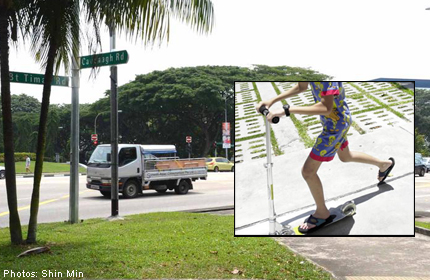
2-year-old boy dies after being hit by lorry
A two-year-old boy of German nationality died after a lorry hit him
when he was crossing the road on his skate scooter on Friday morning.
According to Lianhe Wanbao, the boy and his family's Indonesian maid were crossing the road at the junction of Cavenagh Road and Bukit Timah Road.
The maid, who is in her 20s, was walking next to the boy on their way to a nursery nearby when the lorry, which was turning right, hit them.
She suffered injuries to her back as a result of the crash.
An ambulance had taken the boy to the KK Women's and Children's Hospital (KKH), where he later died from his injuries.
Three people were reported to have turned up at the morgue to identify the boy's body on Saturday morning.
The maid has been given 16 days' medical leave as a result of her injuries.
According to the Chinese paper, a 30-year-old man believed to be the driver of the lorry was arrested, and is aiding the police with investigations.
Witnesses with any information should call the police at 1800-5471818.
According to Lianhe Wanbao, the boy and his family's Indonesian maid were crossing the road at the junction of Cavenagh Road and Bukit Timah Road.
The maid, who is in her 20s, was walking next to the boy on their way to a nursery nearby when the lorry, which was turning right, hit them.
She suffered injuries to her back as a result of the crash.
An ambulance had taken the boy to the KK Women's and Children's Hospital (KKH), where he later died from his injuries.
Three people were reported to have turned up at the morgue to identify the boy's body on Saturday morning.
The maid has been given 16 days' medical leave as a result of her injuries.
According to the Chinese paper, a 30-year-old man believed to be the driver of the lorry was arrested, and is aiding the police with investigations.
Witnesses with any information should call the police at 1800-5471818.
New women's committee to focus on unhealthy lifestyles, cancer screenings
SINGAPORE: Women
below 40 years old need to beware of unhealthy lifestyle issues such as
obesity, binge drinking and smoking while older women should be mindful
of the need for screening for illnesses such as breast and cervical
cancers.
These are the findings by the Health Promotion Board (HPB) together with the newly-formed Women's Health Advisory Committee (WHAC).
And more is being done to raise awareness of these health issues among women.
According to the HPB, 40 per cent of Singaporean women aged 50 to 69 years old undergo regular breast cancer screening.
In Finland, the rate is 84 per cent.
And Minister of State for Health and Manpower, Dr Amy Khor, said that women must make the effort to remain healthy and happy as they play multiple roles and have a longer life expectancy.
"They live longer and it is important for women to take care of their health and adopt good health habits early, so that they do not just live long, but they live well, have a good quality of life, and have peace of mind. Having a healthy lifestyle, regular exercise, healthy eating habits and regular health screenings, will (help women to) avoid or delay the onset of chronic disease," she said.
According to the Department of Statistics, life expectancy for women is 84.3 years while it is 79.6 for men.
So the Women's Health Advisory Committee will champion women's health.
The committee comprises 14 women leaders and will assist the HPB in refining its health programmes for women.
Ang Hak Seng, CEO of the Health Promotion Board, said: "Many of the ideas are bottom up. It's no longer HPB providing or thinking that this is the solution that is best for women's health. Instead, the solution comes from the women's group themselves.
"And that is why the composition of the Women's Health Advisory Committee is so important. It's deliberately chosen so that we can reach out to the people sector, in this case the community, the public sector, government departments so that government operates as one, and also private sectors.
"Because private sector also has resources that we can tap on so that we can encourage and build a community whereby we can have better health for the women," he said.
A comprehensive women's health booklet titled "My Journey to Better Health" was also launched.
HPB aims to distribute 30,000 copies of the booklet by November in a tie up with women's magazines. The booklet is also available online at www.inspiringwomen.sg.
The committee is working with HPB to prepare a Women's Health Plan that will highlight key areas in health promotion programmes for women across their lifespan.
It will also work with organisations and community groups to form a Women's Network to roll out accessible and affordable women's health programmes at workplaces and in the community.
These are the findings by the Health Promotion Board (HPB) together with the newly-formed Women's Health Advisory Committee (WHAC).
And more is being done to raise awareness of these health issues among women.
According to the HPB, 40 per cent of Singaporean women aged 50 to 69 years old undergo regular breast cancer screening.
In Finland, the rate is 84 per cent.
And Minister of State for Health and Manpower, Dr Amy Khor, said that women must make the effort to remain healthy and happy as they play multiple roles and have a longer life expectancy.
"They live longer and it is important for women to take care of their health and adopt good health habits early, so that they do not just live long, but they live well, have a good quality of life, and have peace of mind. Having a healthy lifestyle, regular exercise, healthy eating habits and regular health screenings, will (help women to) avoid or delay the onset of chronic disease," she said.
According to the Department of Statistics, life expectancy for women is 84.3 years while it is 79.6 for men.
So the Women's Health Advisory Committee will champion women's health.
The committee comprises 14 women leaders and will assist the HPB in refining its health programmes for women.
Ang Hak Seng, CEO of the Health Promotion Board, said: "Many of the ideas are bottom up. It's no longer HPB providing or thinking that this is the solution that is best for women's health. Instead, the solution comes from the women's group themselves.
"And that is why the composition of the Women's Health Advisory Committee is so important. It's deliberately chosen so that we can reach out to the people sector, in this case the community, the public sector, government departments so that government operates as one, and also private sectors.
"Because private sector also has resources that we can tap on so that we can encourage and build a community whereby we can have better health for the women," he said.
A comprehensive women's health booklet titled "My Journey to Better Health" was also launched.
HPB aims to distribute 30,000 copies of the booklet by November in a tie up with women's magazines. The booklet is also available online at www.inspiringwomen.sg.
The committee is working with HPB to prepare a Women's Health Plan that will highlight key areas in health promotion programmes for women across their lifespan.
It will also work with organisations and community groups to form a Women's Network to roll out accessible and affordable women's health programmes at workplaces and in the community.
Singapore's non-oil domestic exports down by 11% in August
SINGAPORE: Latest
data by trade agency, I-E Singapore, showed exports declined by 11 per
cent in August, compared to the 5.7 per cent increase in the previous
month.
The figure was worse than expected by economists, who were expecting a drop of 3.3 per cent.
On a month-on-month basis, non-oil domestic exports decreased by 9.1 per cent in August, following the previous month's 3.6 per cent decline.
Exports to the European Union slumped 29 per cent from a year ago, while exports to Taiwan surged 17 per cent.
The contraction in electronic was due to parts of PCs, telecommunications equipment and consumer electronics.
The figure was worse than expected by economists, who were expecting a drop of 3.3 per cent.
On a month-on-month basis, non-oil domestic exports decreased by 9.1 per cent in August, following the previous month's 3.6 per cent decline.
Exports to the European Union slumped 29 per cent from a year ago, while exports to Taiwan surged 17 per cent.
The contraction in electronic was due to parts of PCs, telecommunications equipment and consumer electronics.
Subscribe to:
Posts (Atom)