Showing posts with label singapore. Show all posts

Sunday, April 7, 2013

National Environment Agency (NEA) has observed an increase in the number of dengue cases

We have seen recent report on the rise of Dengue Fever and the trending is hitting a high especially in the early part of the year.

We like to highlight that Dengue Fever is a covered event in our Accident & Health plans.

Contact me to find out more about our Accident & Health Plans

Den-1 Risk Areas

Residents living in the following nine areas with a higher risk of DEN-1 virus transmission are advised to step up dengue prevention measures by checking for stagnant water in their homes at least once a week. Our population has lower immunity of the DEN-1 virus serotype which could mean quicker transmission of dengue in these neighbourhoods if effort is not taken to remove all mosquito breeding habitats. NEA on its part will work together with members of the Inter Agency Dengue Task Force to step up checks in the public areas in these neighbourhoods.

The areas are:
• Jurong West Ave 1 / Jurong West Street 51
• Fernvale Road / Fernvale Link
• Lorong 5 Toa Payoh / Lorong 7 Toa Payoh
• Claymore Hill
• River Valley Close / River Valley Road
• Serangoon Road
• Bedok Reservoir Road
• Lorong 6, 8, 10, 12 Geylang
• Lorong 22, 24, 24A, 26, 28, 30, 32 Geylang

Latest Dengue Data
http://www.dengue.gov.sg/cms/ehd/newgraph.gif

http://www.dengue.gov.sg/cms/ehd/MOHtable.jpg

Contact me to find out more about our Accident & Health Plans

Tuesday, January 22, 2013

Singapore Dec inflation likely edged up to 3.85% y-o-y

SINGAPORE - Singapore's inflation likely edged higher to 3.85 per cent year-on-year in December, quickening from November's 3.6 per cent as car prices rose at a faster pace, according to the median estimate of 12 economists polled by Reuters.

Singapore's central bank forecast is for headline inflation to come in slightly above 4.5 per cent in 2012 and to slow in the following year to between 3.5 and 4.5 per cent.

The city-state's inflation averaged 4.6 per cent in the first 11 months of 2012.

Earlier, when the poll involved 10 economists, the median forecast for December inflation was 3.8 per cent year-on-year. With two more economists, the median rose to 3.85 per cent.

Tuesday, January 1, 2013

How to be happy

The results of the recent Gallup poll, as well as other surveys, seem to indicate that Singaporeans are an unhappy people. This surprises me because, objectively, we should be a happy people.

I consider myself a happy person. I would therefore like to share with my fellow Singaporeans 10 rules which may help to make them a more happy people.

RULE NO. 1

Be a positive, optimistic and kind person.

Whether you are a happy or unhappy person depends largely on yourself.

Negative and pessimistic people are generally unhappy people. Be kind to others. Kindness begets kindness. Try to do a good deed every day.

You will find that by brightening the lives of others, you will brighten your own life.

RULE NO. 2

Have a happy family.

Be good to your parents. If they are elderly and living by themselves, try to visit them at least once a week and share a weekly meal with them. One of the problems encountered by our older folks is loneliness.

Be on excellent terms with your spouse. Whenever I am asked to speak at wedding dinners, I always advise the groom to do three things: Be faithful to his wife, treat her as if they were still courting and give her all his money. The last advice does not apply in cases where the wife is a spender and not a saver.

As for how to behave towards one's children, I have always liked the advice given by Kahlil Gibran: "And though they are with you yet they belong not to you. You may give them your love but not your thoughts. For they have their own thoughts."

If you are lucky enough to have grandchildren, love them with all your heart.

RULE NO. 3

Find a job you enjoy doing.

I think one of the reasons so many Singaporeans are unhappy is that they do not like their jobs. Since we spend so much of our lives at work, it is important to find a job which is not a chore to endure but a pleasure to do.

In recent years, I have noticed a trend of many Singaporeans leaving their jobs for other jobs which pay them less but give them greater satisfaction. This is a good thing.

RULE NO. 4

Treasure your friends.

In your life journey, you will make many friends - at school, at university, in sports or other activities and at work. I hope you will develop a small circle of very good friends, friends who will stand by you in good times and bad times.

RULE NO. 5

Exercise regularly.

My wife and I try to swim every day. Exercise not only makes you healthier, it also makes you feel better. Therefore, make regular exercise a part of your lifestyle.

You can't be a happy person if you are not in good health.

RULE NO. 6

Enjoy eating but eat healthily and avoid the sin of gluttony.

Singapore is a culinary paradise. Food is abundant, diverse and affordable.

You can eat well on any budget. Let us enjoy our food but let us also exercise some discipline when choosing what to eat. I have always tried to follow the ancient Asian wisdom of stopping when I feel 80 per cent full.

RULE NO. 7

Be a volunteer and support philanthropy.

I once heard a speech by Mrs Barbara Bush, the wife of the 41st President of the United States. She said there was a period in her life when she suffered from depression. Instead of seeing a psychiatrist or taking medication to overcome her depression, she decided to be a volunteer. She found that by helping others less fortunate than herself, her depression gradually disappeared.

Whether we are rich or poor, we should contribute to a cause or causes close to our hearts. In spite of our favourable tax regime and the presence of many wealthy people in our society, I was very disappointed to see how lowly Singapore ranked in the table of countries for philanthropy.

A wise man once said that no man could be truly happy if he lives only for himself.

RULE NO. 8

Read books and listen to music.

Reading is an excellent habit. Books keep me company when I am alone. Books transport me to another country, another culture, another time and into the lives of other people. Reading is an endless source of happiness.

So is music. I listen to music every day. I thank 92.4 FM for bringing me so much joy every day.

RULE NO. 9

Take pleasure in the little things in life.

My wife and I love our regular walks in the Botanic Gardens. I love to watch the sunset.

I find joy in meeting an old friend, attending a concert at the Esplanade and visiting a wonderful exhibition at one of our museums.

Most of all, I enjoy being with my grandson.

RULE NO. 10

Don't envy others.

I received this good advice from a wise man, Dr Wee Kim Wee, our sixth President.

Dr Wee once told me that one of the reasons which caused people to be unhappy was that they were envious of others. Dr Wee said he never envied his friends who had a better education or earned more money or lived in bigger houses or owned more expensive cars.

His rule was to be contented with what he had. I think this is a good rule.

Philosophically, it would be even better if you could feel vicariously happy when you see your friends and former students doing well in life.

Professor Tommy Koh is Ambassador-at-Large with the Ministry of Foreign Affairs, Singapore.


Sunday, December 2, 2012

Singapore to deport Chinese bus drivers in strike

SINGAPORE - Singapore will deport 29 mainland Chinese bus drivers and prosecute five others for taking part in the city-state's first strike since the 1980s, the government said Saturday.

The Ministry of Manpower said in a statement that 29 drivers' work permits had been revoked and immigration officials "will be repatriating them" for involvement in a two-day stoppage to demand better pay and working conditions.

"The strike was planned and premeditated. It disrupted our public transport which is an essential service, and posed a threat to public order," the statement said.

A fifth driver has been arrested and will be charged in addition to four others who have been brought to court for allegedly instigating the November 26-27 work stoppage at state-linked transport firm SMRT.

If found guilty of involvement in an illegal strike, they could be jailed for up to a year or fined a maximum of S$2,000 - the equivalent of two months' wages for a driver.

Strikes are illegal in Singapore for workers in "essential services" such as transport unless they give 14 days' prior notice and comply with other requirements.

Full statement from the Ministry of Home Affairs and Ministry of Manpower

December 1 - The Government acts against instigators and key participants involved in illegal strike.

The Police have substantially completed their investigations into the illegal strike on 26 and 27 November 2012 involving SMRT bus drivers who deliberately failed to turn up for work as required.

The strike was planned and premeditated. It disrupted our public transport which is an essential service, and posed a threat to public order.

The Public Prosecutor has decided to charge a total of 5 bus drivers who instigated or participated in the illegal strike. Between 28 and 29 November 2012, the Police arrested 4 bus drivers who were subsequently charged in Court for engaging in a conspiracy to instigate others to participate in the strike.

On 1 December 2012, the Public Prosecutor obtained a summons for one more person involved in the strike to be charged in Court on Monday, 3 December, under section 9(1) of the Criminal Law (Temporary Provisions) Act (Chapter 67). If convicted, the drivers will face a fine not exceeding $2,000 or imprisonment for a term not exceeding 12 months or both on each charge.

In addition, 29 SMRT bus drivers have been sternly warned by the Police for participating in the strike. The Controller of Work Passes has revoked their work permits, and the Immigration & Checkpoints Authority will be repatriating them. These bus drivers who persisted in the strike were absent on either or both days of the illegal strike without reason. Some had medical certificates, but notwithstanding this, there is evidence of their involvement in the strike. Barring any new developments, we do not expect further arrests or repatriations related to this illegal strike. The Police will be issuing warnings to the others who were involved, but no further action will be taken against them and they will be allowed to remain and work in Singapore, so long as they continue to abide by our laws.

The actions of these SMRT bus drivers disrupted an essential service and Singapore's industrial harmony. While the SMRT bus drivers may have had grievances, these should have been raised through the legal and proper means available. 5 persons will face charges in court for the offences committed, and will be dealt with in accordance with the law. 29 persons who were blatant and persistent in their unlawful acts have had their Work Permits revoked and will be repatriated. Those who returned to work upon realising that this action was illegal will be issued warnings by the Police.


Monday, November 26, 2012

60 bus drivers did not turn up for work today

SINGAPORE - 60 bus drivers did not turn up for work today and some bus services may be affected as a result.

Statement from SMRT:

This morning (27 Nov), some 60 Service Leaders (SL) did not turn up for work in the morning, some of whom have valid medical reasons.


Some bus services may have been affected this morning as a result, and we have activated other SLs to assist.

We continue to keep our communications open with the Service Leaders, and are also working with the relevant authorities to find an amicable resolution.

Saturday, November 24, 2012

Singapore inflation likely eased slightly in October

SINGAPORE - Singapore's inflation probably slowed slightly in October as the cost of housing rose at a slower pace, a Reuters poll showed, indicating rising prices will remain a challenge for policymakers even if the economy slips into a recession this quarter.

According to the median forecast of 14 economists, Singapore's consumer price index (CPI) likely rose by 4.5 per cent in October from a year ago, slightly below September's 4.7 per cent pace but well above historical levels of 2-3 per cent.

Core inflation, which excludes the cost of cars and housing as these are more influenced by government policy, probably edged down to 2.3 per cent year-on-year from September's 2.4 per cent.
Singapore has been suffering from higher-than-usual inflation over the past two years, mainly due to a spike in housing rents and car prices even as the economy slows.

A tight job market resulting from measures to make it harder for firms to hire low-cost workers from abroad also contributed to inflation by pushing up the cost of services such as healthcare and cleaning services.

Singapore's economy contracted by 5.9 per cent in the third quarter from April-June on an annualised and seasonally adjusted rate, and banks such as Citigroup said the economy could contract again this quarter amid continued poor demand for its exports, pushing the small city-state into recession.

According to the central bank, Singapore's headline inflation is likely to come in slightly above 4.5 per cent this year before slowing to 3.5 to 4.5 per cent next year, as rising rents and car prices continue to push up the cost of living.

For the first nine months of this year, inflation averaged 4.8 per cent, stronger than most Asian countries.

China, for instance, earlier this month reported October inflation of just 1.7 per cent, the slowest pace in nearly three years.

UOB cuts Keppel target price 

UOB Kay Hian cut its target price on Keppel Corp Ltd , the world's largest rigbuilder, to $12.30 from $12.80, but kept its 'buy' rating, citing lower operating margin assumptions.

By 0208 GMT, Keppel shares were up 0.1 per cent at $10.56, and have risen 13.5 per cent since the start of the year, compared with the Straits Times Index's 12.9 per cent rise.

UOB lowered its offshore and marine margin estimates for Keppel in 2013 and 2014, which resulted in a 4 per cent lower net profit forecast for next year.

However, higher infrastructure earnings will help to support earnings in 2014.

Higher operating margins seen from 2010 to mid 2012 were mainly due to lucrative contracts secured during the boom years of 2007-2008, UOB said.

"We believe Keppel stands a good chance of registering higher offshore and marine margins than Sembcorp Marine as it is building semi-submersible rigs for Brazil," which are not new to the company, the brokerage said.

Civil servants to get year-end bonus of 0.7 month

SINGAPORE: Singapore's 77,000 civil servants will get a year-end Annual Variable Component (AVC) of 0.7 month.

Lower-wage officers will get an AVC of at least S$1,000, signalling the government's continued commitment to help low-wage workers.

The Public Service Division in the Prime Minister's Office announced the bonus in a statement on Thursday.

The statement said the bonus amount was decided against the backdrop of a "more subdued global economic outlook".

It said: "Singapore's economic growth is expected to remain subdued for the rest of 2012, with the economy expected to grow by around 1.5%.

"The electronics manufacturing cluster would continue to be weighed down by tepid external demand. On the other hand, expansion in the construction sector could provide modest growth support to the overall economy.

"In addition, growth may be slightly lower than forecast if the weakness in the externally-oriented sectors persists into the final quarter of 2012."

The year-end AVC payment was decided in consultation with the unions.

Some 2,000 civil servants earning less than S$1,430 will benefit from the minimum AVC payment of S$1,000. For example, an officer drawing a monthly salary of S$1,200 will get a year-end AVC of S$1,000, instead of S$840 based on 0.7 month of his salary.

About 96% of these 2,000 civil servants are Division IV officers.

All civil servants will also get the Non-Pensionable Annual Allowance (NPAA) of one month, to be paid in December along with the AVC.

Last year, civil servants got a 0.75-month year-end AVC.

In a statement, the labour movement says it is happy that the government has supported its proposal to have a higher dollar quantum to help the low-wage workers.

The National Trades Union Congress (NTUC) says this is also in line with the National Wages Council's (NWC) recommendations for 2012/2013 to help low-wage workers with higher dollar quantum.

Mr Stephen Lee, President of the Singapore National Employers Federation, said: "Most of the export sectors are not doing very well. Some of the domestic sectors like construction and healthcare are still doing okay. So I think the demand for labour, the low GDP growth and the negative productivity are the forces that would decide this year's bonus.

"For the private sector, the bonus should depend on their annual result and if some companies do well they should reward their workers fairly."

Tuesday, November 20, 2012

Olam hits back after Muddy Waters attack

SINGAPORE - Singaporean commodities trader Olam said an attack on its prospects and accounting practices by Carson Block, the founder of shortseller Muddy Waters, was "baseless and unsubstantiated".

Shares in Olam, 16 per cent-owned by Singapore state investor Temasek Holdings - which would not comment on th matter, closed down 7.5 per cent in heavy volume on Tuesday.

Muddy Waters, best known for targeting North American-listed Chinese companies, questioned Olam's capital expenditure and goodwill writedowns.

"We are unable to reconcile its capex (from last year) with announced projects," Block told a conference in London on Monday. He said his investigators had looked at Olam's investments in Africa, Asia and the United States.

"They have been very active in the public debt market. There is a lot of paper to short," he said.
Olam has $4.125 billion outstanding debt, including bonds and loans, according to Thomson Reuters CreditViews. The bulk of its bonds are held by retail investors who can be quick to unload paper, making for volatile prices.

Olam's 5.75 per cent bonds due 2017 fell 5 percentage points to 91/92 cents on the dollar.
Started by the Kewalram Chanrai Group in Nigeria, Olam has grown into a diverse agricultural commodities trading company with interests ranging from cocoa and coffee to nuts and sugar.

Chief executive Sunny Verghese has led an expansion that has seen it take on larger commodity players such as Noble Group and Wilmar International.

Olam also has an industrial raw materials segment which includes cotton, rubber and wood.

"We are dismayed at the nature and lack of substance of these assertions and opinions about Olam's financial position, particularly as we were not contacted in advance by Carson Block or anyone else from Muddy Waters," Olam said.

SHORTING

Olam is the most borrowed stock among Singapore's top 30 companies, suggesting heavy demand from short sellers.

Nearly 80 per cent of Olam's shares that can be borrowed were out on loan, compared with an average of about 6 per cent for the index constituents, according to Markit Securities Finance.

Also at the conference on Monday, John Armitage, chief investment officer of London-based Egerton Capital, said he was short Olam shares, saying the stock was "a great short".

Olam said its annual financial accounts were audited by Ernst & Young, which said the statements gave "a true and fair view of the state of affairs and financial results of the group and the company".

Company officials said in a conference call it would be able to fund operations for 18 months even if it were shut out of the debt markets as a result of the allegations by Muddy Waters, and it would now consider share buybacks after its price fell.

Past reports from Muddy Waters have hit shares in several Chinese companies including Sino-Forest Corp, which filed for bankruptcy protection early this year 10 months after the shortseller said the company had exaggerated its assets.

Muddy Waters has a mixed track record, however, and the share prices of some companies in its reports have bounced back.

"Muddy Waters seems to target companies with quite complex business models and accounting structures. So, it is difficult to get a handle on what is exactly happening in the company," said David Smith, head of corporate governance at Aberdeen Asset Management Asia.

"Given the complexity of the companies that they target, it means that there is always that lingering doubt regardless of what the company says," he said.

In February 2011, Olam denied there were inaccuracies in its accounts after a CLSA analyst raised concerns about internal controls, citing multiple and sometimes significant differences between Olam's audited and unaudited statements.

Olam said CLSA analyst Swati Chopra used examples which were incorrect. Chopra left CLSA a few months after the report was published and now works at a rival.

Olam reported a 26 per cent rise in quarterly net profit last week. Out of 21 analysts tracking the stock, 15 have "buy" or "strong buy" ratings, five have "hold" recommendations, and one has a "sell" call, Thomson Reuters data showed.

Monday, October 29, 2012

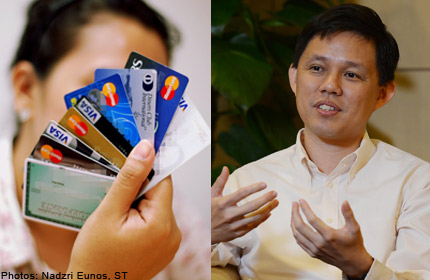
Family who earned $16k a month complained the most: Chan Chun Sing

Providing help, building families 

Mr Chan Chun Sing will never forget the three families who turned up to ask for help at his Meet-the-People Sessions.

One of them earned just $2,000 a month, but managed to raise three children. Another had double that income, of $4,000 to $5,000, and had no children.

But it was the third, a family that earned $16,000 and had two children, who complained the most, saying the Government was not doing enough to help them.

The incident, says Mr Chan, illustrates the rising expectations that Singaporeans have and the challenge that policymakers face as they try to work out who should get more help.

"It's not an easy question to answer and we will have to find the answer as a society going forward," he says.

It is also a challenge Mr Chan's new ministry, the Ministry of Social and Family Development (MSF), will have to grapple with as it streamlines its responsibilities to focus more on policies affecting Singaporean families.

On Thursday, the Ministry of Community Development, Youth and Sports (MCYS) will be renamed the MSF and pass on its youth and sports portfolios to the newly created Ministry of Culture, Community and Youth.

That will give Mr Chan's ministry more time and space to look at longer-term challenges such as meeting the needs of singles when they age in 20 years' time and finding ways to tap the energies of healthy elderly people to serve other senior citizens.

At an hour-long interview at the MCYS headquarters in Toa Payoh this week, the Acting Minister laid out the priorities for his new ministry.

One of them will be to strengthen the social safety net - which will require the ministry to factor in Singaporeans' changing expectations. Another is to improve the delivery of social services, and a third is to strengthen families.

Mr Chan notes that it is no longer only those at the bottom of the ladder who need help. Those in the middle are starting to feel unsettled by the growing income gap too.

"They wonder whether they can meet their aspirations because of the people at the top end," he says.

"The question for us is, as a society, to what extent we can actually help this group of people beyond the people at the bottom of the socio-economic scale."

As economic cycles become shorter and more volatile, people are also more likely to be in and out of jobs, he observes. They will have to relearn their skills at a much faster rate as well.

"If I use my mother as an example, she was a machine operator, stamping metal plates. She did that for at least 30 years."

With just one set of skills, notes Mr Chan, his mother, a divorcee, was able to raise him and his sister single-handedly.

But no longer.

The churn in jobs and the instability of people's incomes today pose a serious challenge and could even disrupt the way children are brought up and their education.

Another concern for Mr Chan is Singapore's changing demographics: More people are staying single, marrying later, having fewer children and living longer.

As he looks into the next 10 to 15 years, he foresees a shrinking of the support that extended families can now give in raising children and caring for sick relatives.

"So that is where you see us... not just building the nursing homes, which are institutional care, but growing the community care sector and the home care services," he says.

Strengthening elderly care services in the community and at home will allow people to grow old in familiar settings, he explains.

Longevity will pose another challenge as people in their 80s and 90s will be increasingly cared for by those in their 50s and 60s.

But Mr Chan also sees these healthy retirees as a source of volunteers and helpers to beef up the delivery of social services at the local level, as is being done in Japan.

Singapore is now trying out this idea: Lions Befrienders, for instance, is getting the old to befriend the old, while a seniors' activity centre in Choa Chu Kang pays elderly folk a stipend to run activities.

As for the larger challenge of strengthening families, Mr Chan thinks measures should be targeted at people's four life stages: when they are young, when they marry, when they have children and when they are maintaining a family.

He believes that a central plank of the efforts - besides helping couples with housing, health care, childcare and education - should be to inculcate from young values for marriage, parenthood and family.

"If we bring up our children appreciating the joy of a family, then I think when they grow up, chances are that they will also aspire to have their own family," he says.

It means getting people not to see their career as an obstacle to starting a family, helping them to appreciate the joy of parenthood, and maintaining healthy relationships between parents and teenagers.

Such values can be transmitted through schools and the media, he says, especially as children may not live with their grandparents and parents may be working. Positive role models are also needed, he adds.

The 43-year-old says his own values were shaped by his family and the people he met. Watching Hong Kong sword-fighting drama serials and movies helped, he quips.

The former army chief married his colleague in Mindef in 1997 at the age of 28 - the median age then. They have three children, aged 11, three and one.

Recalling their decision to wed and have children, he cites a senior's advice: "He told me that there's never a perfect time to get married or to have a child... The perfect time is when you have the commitment to overcome life's challenges with your partner.

"But through the whole journey, you find a new sense of joy and purpose beyond just the pursuit of material well-being for yourself."


Friday, October 19, 2012

3,500 ILTC staff to get government-funded pay rise

SINGAPORE: The government will help to fund salary increments of 10 to 24 per cent for more than 3,500 administrative, ancillary and support care staff in the Intermediate and Long Term Care sector (ILTC).

This will apply to staff in Voluntary Welfare Organisations (VWOs) who make up more than half of the manpower in the ILTC sector.

The funding support will apply from September 2012, as part the pay review conducted by the Ministry of Health to better recruit and retain staff.

This was announced by Minister of State for Health and Manpower, Dr Amy Khor, at a healthcare awards ceremony on Friday.

Sunday, October 14, 2012

Singapore workers have highest burnout rate in region

The good news is that the vast majority of employers here are either upbeat or neutral over their staff numbers for the rest of this year.

However, the bad news is that Singapore is also seeing the highest levels of employee burnout in the region.

These were the findings of the latest quarterly employment trends report released yesterday by global recruitment firm Hudson.

The firm surveyed a total of 426 Singapore employers in August on their views for the October-December period for the report.

An overwhelming 93.2 per cent of employers say they will increase or maintain headcount in the remaining months of 2012.

But Singapore workers are also seeing the highest levels of employee burnout in the region, with nearly a third, or 32.6 per cent, of employers here reported an increase in staff burnout.

Local employees are also having rising workload, the highest figure in all Asia-Pacific markets studied, said Hudson.

Nearly two thirds, or 60.8 per cent of employees here said their workload has increased over the last year and almost half, or 45.5 per cent, now work 51 hours a week or more.

Keeping a work-life balance is one of the key issues being explored by the Government as it looks for solutions to arrest the falling birth-rate.

Mr Wilson Wong, Senior Lecturer at UniSIM's School of Business , said that Singapore employers need to realise that employee burnout not only has a social cost but could affect their bottomlines too.

"It is also about time that employers realise that longer working hours do not necessarily translate into greater productivity. For instance, France with its 35-hour work week, has ironically one of the highest productivity rates in the industrialised world," he said.

"Further, government organisations such as SPRING could also promote greater awareness of the social and economic cost of burnout among local employers."


Thursday, October 11, 2012

Free message apps "to cost telecom firms US$23b this year"

SINGAPORE: Global telecom operators are expected to have lost US$23 billion in SMS revenues by the end of 2012 as smartphone users shift to free messaging applications, an industry report said Thursday.

Technology research company Ovum forecast the losses would more than double to US$54 billion by 2016 as the traditional Short Messaging Service (SMS) gives way to Internet-based platforms such as WhatsApp.

This compares with estimated losses of US$8.7 billion in 2010 and US$13.9 billion in 2011.

"Social messaging is becoming more pervasive and operators are coming under increased pressure to drive revenues from the messaging component of their communications business," said Neha Dharia, consumer telecoms analyst at Ovum.

"Operators need to understand the impact of social messaging apps on consumer behaviour, both in terms of changing communication patterns and the impact on SMS revenue, and offer services to suit."

Ovum cited the increasing popularity of WhatsApp, which allows smartphone owners to exchange messages for free using wireless Internet links, bypassing SMS gateways that charge users per message or for a monthly quota.

"Ovum believes this level of growth will continue as smartphone and mobile broadband penetration increases and expects smaller players such as 'texPlus', 'Pinterest' and 'fring' to cause further disruption in the messaging space," the report said.

Urging telecom operators to innovate, Ovum said the increase in the number of players offering social messaging services is not a short-term trend but a sign of a "shift in communication patterns."

Text messaging started as a way to use spare telecoms capacity but became a key cash generator for operators while offering users a cheap way to keep in touch with friends and family without having to spend on phone calls.

Dharia told AFP on Thursday that SMS contributed 49 percent of non-voice revenues for telecom companies globally last year, but is expected to fall to 45 percent this year and to 35 percent by 2016.

Monday, October 1, 2012

1 in 2 S'porean adults will have Type 2 diabetes by 2050

SINGAPORE - By 2050, one in two adults in Singapore will suffer from Type 2 diabetes in their lifetime.

These projected figures were obtained from a pilot project conducted by the National University of Singapore (NUS) Saw Swee Hock School of Public Health (SSHSPH) earlier this year.

The project is based on a simulation model called the Demographic Epidemiological Model of Singapore (Demos).

The model forecasts the impact of diseases which affect the country and how public-health intervention can mitigate it.

About 400,000 Singaporeans, or 11.3 per cent of the population, were diabetic in 2010, said NUS. Type 2, or adult-onset, diabetes is linked to a person's diet and lifestyle.

It occurs when the body becomes more resistant to insulin - a hormone produced by the pancreas that allows the body's cells to use blood glucose for energy - and the cells that store and release insulin start to fail.

Demos takes into account aspects that have been found to have a link to diabetes, such as obesity and genetics.

The launch of Demos was announced yesterday at the inaugural two-day Singapore International Public Health Conference, jointly organised by SSHSPH and the Chapter of Public Health and Occupational Physicians, Academy of Medicine, Singapore.

The conference, held yesterday at the Grand Copthorne Waterfront Hotel Singapore, was attended by over 400 health-care workers, researchers and academics from 15 countries.

A $15-million research grant for the next five years, called the Communicable Diseases-Public Health Research Grant, was also announced. It will be used to support evidence-based public-health risk assessment and policy formulation, besides other areas.

The Health Sciences Authority and SSHSPH also signed a Memorandum of Understanding (MOU) at the event.

The MOU is aimed at encouraging knowledge exchange and enhancing academic and professional competencies to promote the protection of public health and advancement of public-health science.

Sunday, September 30, 2012

S'pore becomes conduit to lucrative black market after iPhone 5 launch

SINGAPORE: As one of the first countries where Apple's iPhone 5 has been launched, Singapore's become a conduit to a lucrative black market for the coveted product.

As Channel NewsAsia finds out, overseas traders are flocking to the country to buy the phones for resale, in their home countries.

On 20 September, the night before Apple's iPhone 5 official launch in Singapore, some in the crowd were foreign buyers - all players in a thriving iPhone black market.

Demand is especially high in countries where the smartphone hasn't been launched.

Channel NewsAsia has learnt the traders come from around the region, including Thailand and Vietnam.

And they make quick work of buying the phones.

Trader "Martin" said: "People fly to Singapore and Hong Kong and they queue for the iPhone 5 then they gather some Vietnamese youngsters in those countries and they get together and queue at the Apple stores. You have to hand carry the iPhone 5 into Vietnam. You can only buy four or five pieces."

To amass enough iPhone 5s, "Martin" revealed he has friends who fly to Singapore every day to buy the phones.

Back in Vietnam, an auction is held with the phones going for as high as double the original price.

A 64gb iPhone5 without contract retails for about S$1,200 in Singapore.

Such trading is also taking place within Singapore, as one iPhone buyer says.

Lee Jun Kiat says: "I was actually approached by this couple who offered to take over my iPhone 5 which I had just acquired from the launch event for S$1,100. They asked if I was keen to sell my iPhone and told me I could make quick cash out of it."

But one lawyer warns that such activity may be unlawful, especially when it involves unauthorised dealers.

George Hwang says: "When you're going to buy the hand phone yourself from an authorised dealer, and after one day, decide to sell it, there is no problem. However, when you buy it from third parties, and resell them, you could fall under the Secondhand Goods Dealers Act."

Mr Hwang says there is a list of items under the Act which requires a person to be licensed, to re-sell them.

This is to prevent the trading of stolen goods.

It gets tricky once the phones are overseas, as Singapore does not have jurisdiction in other countries.

A check with several retailers shows that there are safeguards in place, to prevent black market trading.

For example, limiting the number of handsets a customer can buy.

Thursday, September 27, 2012

No more freebies for home-buyers

Does the purchase price of a home include the legal fees, valuations and fire insurance?

Some banks here say yes, and have calculated them as part of the purchase price. When a loan is given out, it then covers the three items.

But that's wrong, reminded the Monetary Authority of Singapore (MAS) in a letter sent to banks about two weeks ago. They pointed to Notice 632 which spells out the items banks can no longer include as part of the purchase price.

Among them - stamp duty.

On monday, some home buyers hunting for bank loans were told legal fees, valuations and fire insurance will no longer be absorbed. The New Paper understands banks are going to make an announcement on this on tuesday.

The end of subsidies were part of a series of cooling measures, introduced by MAS that came into effect in January last year.

Depending on the value of the property, these legal fees can range from S$2,400 for an HDB flat to a few thousand dollars for a landed property.

Valuation for private property can range between S$200 and S$500, while for HDB it is S$180, property agents told TNP.

A senior bank executive said: "Individually, the sum may be small per customer. But in total, they can be quite a hefty sum. It is a saving for the bank.

"It's not that banks were not complying with Notice 632. We have compliance officers to ensure we do.

"But it was a question of how to interpret purchase prices."

Last January, MAS told banks to grant loans on the price of the property contingent on the borrower declaring any "discount, rebate or any other benefit from the bank or any other party (including the payment of legal or stamp fees for the purchase) which has the effect of reducing the true purchase price".

Another senior bank executive said the subsidies were only introduced recently to attract customers.

So what would be the impact of banks announcing an end to such subsidies?

A spokesman for mortgage broker Advance Partner said: "The outcome is that customers might switch to another bank which still offers these freebies, even though this other bank is charging a higher interest rate (on its housing loan).

"At the moment not all banks have done away with the freebies and we're looking at a transition period in which customers could be motivated to take up a loan with a bank which still has these offers." .

Low profit margin 
 
While the interest rate of these other banks "might be higher, it is not that significantly higher", she added.

Mortgage Supermart Singapore's Keff Hui, said interest rates are projected to remain low until 2015.

Property loans would yield "low profit margin" for banks and cutting freebies could give them an "opportunity to review and streamline their costs", he said.

Property experts say removing these freebies would have minimal impact on the hot property market.

OrangeTee head of research and consultancy Tan Kok Keong said: "The cost is not a big proportion of the purchase price, hence it will have minimal impact.

"In the past, when some developers were offering cars to home buyers, the cost of freebies were deducted from the actual cost when you took a housing loan. This measure may just be about tying up the loose ends."

PropNex's associate branch director Ron Lim agreed: "Initially, it will affect the buyers. But people will get used to it after a while and adjust accordingly."

According to a Colliers International report released on monday, the property market is set to heat up even more.

One major factor which may come into play is the US move to print more money, a measure also known as Quantitative Easing 3 (QE3).

The report said the US government's move could drive up property prices here.The weak US economy might drive investors to put their money here.

But Chesterton Suntec International's director of research and consultancy Colin Tan told TNP that he does not think the additional capital flowing into the property market here will have minimal impact because there is "enough supply to dampen pressure on price increases".


Monday, September 17, 2012

Singapore's rich become poorer: report

SINGAPORE: Singapore's super-rich watched their collective fortunes shrink by 8.8 per cent from August 1, 2011 to July 31, 2012.

According to industry researcher, Wealth-X, people with more than US$30 million in investable assets suffered mainly from the poor performance of the stock markets.

Still, Singapore's so-called ultra high net worth individuals are ranked seventh in Asia as a group.

With a combined wealth of US$155 billion, they have enough money to build 23 Marina Bay Sands or cover the debt of Hungary, the world's 56th largest economy.

Overall, the wealth of Asia's ultra rich dropped 6.8 per cent to US$6.3 trillion in the past 12 months.

And Wealth-X said low-interest rates mean more of Asia's rich will be driven to invest in property, defying government efforts to cool the market.

CEO of Wealth-X, Mykolas Rambus, said: "In Asia, there are almost 43,000 ultra high net worth individuals competing for the same property whether it's Hong Kong, Singapore, Shanghai - there're lots of assets that are available so I think we'll see property prices continue to go up because there is such demand.

"And increasingly we'll see ultra high net worth individuals invest further afield, whether it's in residential, commercial or industrial, looking for opportunities in the US and in Europe."

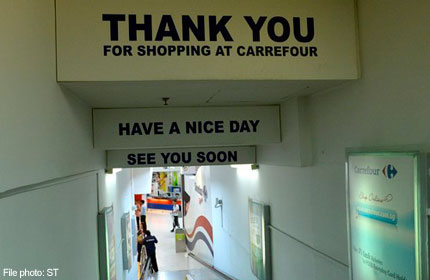
Carrefour to close both outlets by end of the month

Both branches of French hypermarket Carrefour in Singapore are set to close by the end of the month in order to restore the premises to its original state.

Leases for the outlets at Suntec City and Plaza Singapura are scheduled to expire in December and November respectively.

Three weeks ago, Carrefour Singapore announced that it was pulling out of the local market before the end of the outlets' lease.

In its statement, Carrefour had said: "Carrefour Singapore announces the decision to close its Suntec and Plaza Singapura stores before end of 2012, since expansion and growth perspectives do not allow reaching a leadership position in the medium and long term."

It had opened its first store in Singapore in 1997.

According to a Straits Times report, the non-food level of both outlets are already closed. Most of the food shelves have also been cleared out, following a sale last weekend.

Plastic sheets were seen covering the empty shelves, and suppliers of fresh meat and produce have stopped delivery, said the English daily.

The remaining dried goods were packed and moved closer to the cashiers to allow the premises to be cordoned off in stages.

In an earlier interview with AFP when the pullout was announced, a senior executive with an Asian electronics company that supplies appliances to Carrefour, who declined to be named, said: "There was a lot of talk (of closing) from the internal staff and they have been clearing stock for the last two months."

Sunday, September 16, 2012

2-year-old boy dies after being hit by lorry

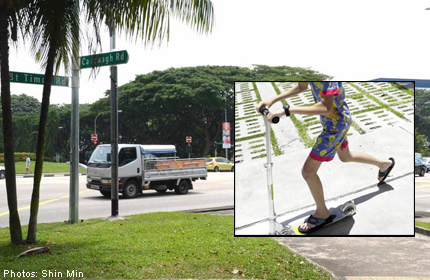
A two-year-old boy of German nationality died after a lorry hit him when he was crossing the road on his skate scooter on Friday morning.

According to Lianhe Wanbao, the boy and his family's Indonesian maid were crossing the road at the junction of Cavenagh Road and Bukit Timah Road.

The maid, who is in her 20s, was walking next to the boy on their way to a nursery nearby when the lorry, which was turning right, hit them.

She suffered injuries to her back as a result of the crash.

An ambulance had taken the boy to the KK Women's and Children's Hospital (KKH), where he later died from his injuries.

Three people were reported to have turned up at the morgue to identify the boy's body on Saturday morning.

The maid has been given 16 days' medical leave as a result of her injuries.

According to the Chinese paper, a 30-year-old man believed to be the driver of the lorry was arrested, and is aiding the police with investigations.

Witnesses with any information should call the police at 1800-5471818.

Singapore's non-oil domestic exports down by 11% in August

SINGAPORE: Latest data by trade agency, I-E Singapore, showed exports declined by 11 per cent in August, compared to the 5.7 per cent increase in the previous month.

The figure was worse than expected by economists, who were expecting a drop of 3.3 per cent.

On a month-on-month basis, non-oil domestic exports decreased by 9.1 per cent in August, following the previous month's 3.6 per cent decline.

Exports to the European Union slumped 29 per cent from a year ago, while exports to Taiwan surged 17 per cent.

The contraction in electronic was due to parts of PCs, telecommunications equipment and consumer electronics.

Need to keep careers in healthcare sector attractive: Gan Kim Yong

SINGAPORE: Singapore's Health Minister Gan Kim Yong has spoken of the need to keep careers in the healthcare sector attractive.

He said there's a need to compete with other sectors for manpower especially in a tight labour market in the country.

Speaking to the media at a community event on Sunday morning, Mr Gan said one way is to create multiple career pathways for nurses as this would make their jobs exciting and fulfilling.

On Friday, it was announced that the public sector healthcare support staff would be getting a pay rise this month of between 4 and 10 per cent.

16,000 workers will benefit from the salary review.

Lower wage workers can expect another increase of up to 20 per cent by the end of 2014.

"Even as we improve the employment conditions in the healthcare sector, we also see other sectors improving their salaries and wages and other conditions as well because they too are competing for manpower. For Singapore, manpower has always been a challenge... so therefore it is important for us to focus on how to reach out and engage them and provide more career opportunities for them in the sector," said Mr Gan.
Related Posts Plugin for WordPress, Blogger...