Showing posts with label SMRT. Show all posts

Monday, November 26, 2012

60 bus drivers did not turn up for work today

SINGAPORE - 60 bus drivers did not turn up for work today and some bus services may be affected as a result.

Statement from SMRT:

This morning (27 Nov), some 60 Service Leaders (SL) did not turn up for work in the morning, some of whom have valid medical reasons.


Some bus services may have been affected this morning as a result, and we have activated other SLs to assist.

We continue to keep our communications open with the Service Leaders, and are also working with the relevant authorities to find an amicable resolution.

Wednesday, August 29, 2012

Thomson Line to open from 2019 with 22 stations

SINGAPORE: Singapore's sixth rail network -- the Thomson Line (TSL) -- will open from 2019, instead of the indicative timeline of 2018 announced in the Land Transport Master Plan.

Minister for Transport Lui Tuck Yew, who gave an update on the Thomson Line on Wednesday, said the change in timeline is to accommodate some adjustments made to the original plan.

Under the final rail alignment plan of the Land Transport Authority (LTA), the TSL will be longer and have more stations.

It will be 30 kilometres long -- 3 kilometres longer than envisaged -- and have 22 stations, four more than originally planned.

One of them is Springleaf station, sited in Nee Soon Group Representation Constituency (GRC).

Ms Lee Bee Wah, an MP for the area, said: "(At) Springleaf, most of the residents there are living in private estates, landed properties as well as some condominiums. Currently, the nearest station is Khatib MRT and the complaint is that it is so near and yet so far, because there is no direct bus service. (With the TSL)...we don't need to have direct bus service, there will be a station there."

Another two stations are Woodlands North and Woodlands South in Sembawang GRC.

Ms Ellen Lee, an MP for the area, said: "It (TSL) will facilitate transfer, especially within the estate itself and it will solve the crunch that my residents feel whenever they take the MRT and when they take the buses."

TSL will run from Woodlands in the north to Marina Bay in the south and is expected to be built at an estimated cost of around S$18 billion.

It is expected to have a daily ridership of 400,000 commuters.

Six of the 22 stations will be interchanges, enabling commuters to reach their destinations in the shortest possible time.

For example, a resident of Sin Ming travelling to Republic Polytechnic in Woodlands will halve his or her commute time from 50 minutes to 25 minutes.

Another at Woodlands Regional Centre heading to Marina Barrage will take 55 minutes instead of 70.

With six interchange stations, the TSL will connect to all existing lines and the future Downtown Line (DTL).

"All in, about 160,000 households will be within 10- to 12-minute walk from one of these stations. So you will have an additional option. Instead of having to take a feeder bus or find a way to get to one of the stations on the North-South Line, these 160,000 households can choose to walk to one of the Thomson Line's stations as an alternative," said Mr Lui.

TSL will connect to the North-South Line at Woodlands and Orchard stations.

Caldecott Station will connect to the Circle Line.

Residents of the Bukit Timah stretch can change trains at the future DTL Stevens Station to connect to the TSL.

The Outram Park Station will connect the TSL to the East-West Line and North-East Line, while the Marina Bay Station will connect the TSL to the North-South Line and Circle Line.

TSL will open in three stages from the north to the south.

Phase One, which will have three stations from Woodlands North to Woodlands South, will open in 2019.

Phase Two will be ready in 2020, with stations from Springleaf to Caldecott.

The final stretch of 13 stations from Mount Pleasant to Gardens by the Bay will open in 2021.

When fully operational, an estimated 60,000 households will be within 400 metres of one of the TSL stations.

The line, which will be fully underground, will run on a four-car instead of a three-car system.

Mr Lui said this will give it additional capacity to cope with any increase in long-term demand.

He was speaking during a visit to Telok Ayer Station of Downtown Line One, which will open by the end of next year.

Mr Lui also said: "During the construction phase (of the TSL), there will inevitably be a certain amount of inconvenience, noise pollution. We will try our best to minimise this as much as possible. We will of course want to engage the residents, dialogue with them, find ways to meet as much as possible some of the points that they raise."

LTA, Singapore Land Authority (SLA) and the Urban Redevelopment Authority (URA) said in a joint statement that while all efforts have been made to minimise land acquisition, the government will acquire four full lots.

They include Pearls Centre in Eu Tong Sen Street, a post office along Upper Thomson Road and two landed properties along Stevens Road and Robin Close.

Pearls Centre will be affected by the construction of the TSL as a tunnel will run under part of the building.

To optimise land use around the future TSL station at Outram Park, Pearls Centre will be acquired and integrated with the adjoining state land for a high-density mixed-use development.

Five other part lots will also be acquired but will not affect the main building structure.

Affected parties will be compensated and the amount will run into a few hundred million dollars, said SLA. The money will come from the S$18b budget to built the line.

The SLA gazetted the land affected by acquisition on Wednesday.


Saturday, August 4, 2012

Cost of COI hearings amount to $10 million

SINGAPORE - The total cost of the Committee of Inquiry (COI) hearings have amounted to nearly $10 million, the Lianhe Zaobao reported on Friday.

The COI was set up to investigate the disruption of MRT train services on December 15 and 17 last year, which affected more than 200,000 people.

Over the course of six weeks, between April 16 and May 25, the COI heard in court the evidence of 116 witnesses, including ground staff, experts and former SMRT chief executive Saw Phaik Hwa.

According to a spokesperson from the Land Transport Authority (LTA), the total cost of the hearings is close $10 million.

The cost will be split between SMRT and the LTA, with SMRT paying $5.9 million, and LTA bearing the rest of the cost of about $4 million.

LTA's $4 million will be included in its expenses incurred for the 2011 to 2012 fiscal year, said the spokesperson.

The total sum of $10 million will go towards payment of lawyer fees as well as consultation fees for the panel of experts.

But the spokesperson stressed the importance of the COI however, and the need to engage a team of highly-qualified experts as well as lawyers.

After an eight-week inquiry, the COI found, among other issues, that the incidents were preventable.

In addition to the cost of the COI, train operator SMRT will also have to pay a fine of $2 million for the breakdowns.

The $2 million will be donated to the Public Transport Fund to help needy families with transport fares.

Monday, July 16, 2012

SMRT fined S$2m for December train disruptions

SINGAPORE: The Land Transport Authority (LTA) will impose the maximum fine of S$2 million on transport operator SMRT for the two train disruptions along the North-South Line on December 15 and 17 last year.

Over 200,000 commuters were affected during the disruptions.

LTA said its investigations have found that SMRT had failed to meet its licensing obligations for the North-South and East-West Lines.

It has failed, among other things, to exercise due diligence and vigilance expected of a public transport operator, and to maintain its network in good and efficient working condition.

In both incidents, SMRT was also found to be in breach of the Operating Performance Standards for the North-South and East-West lines.

Under Section 19 of the Rapid Transit Systems Act, a public transport operator can be fined up to S$1 million per incident if it fails to comply with the Operating Performance Standards and other regulatory requirements.

In assessing the penalty amount, LTA said it considers the facts of the case, severity of the incident and any relevant mitigating factors that may apply. It will also consider any representations which the operator may make.

A statement from LTA said the S$2 million will be donated to the Public Transport Fund to help needy families with transport fares.

The penalty comes on the back of the Committee of Inquiry's report, which was submitted to the Transport Minister on July 3.

Chairman of the Government Parliamentary Committee for Transport, Cedric Foo, felt LTA is imposing the maximum fine as the disruptions had massive impact on commuters and occurred in quick succession.

He said "The disruptions in December has massive impact on commuters. They occurred in quick succession and the COI found they were preventable. That, I felt was why LTA meted out the maximum fines under the framework."

Others felt the fine will send a clear signal to operators.

Associate Professor Lee Der-Horng of the National University of Singapore said: "Imposing the penalty is definitely the last option. I'm sure SMRT will receive a very strong signal that they would definitely have to improve -- right from the fundamentals to improve their service to ensure that in the future, a similar incident will not happen again."

LTA is now reviewing the current maximum penalty amount following the disruptions, to strengthen its regulatory regime.

Dr Park Byung Joon, Head of Urban Transport Management at UniSIM's School of Business, said: "What I want to see from the LTA now is whether they are going to introduce another fine for less major disruptions. Is LTA going on a case-by-case basis like now? Or are they going to introduce a more structured fine scheme?"

In a separate statement, SMRT said it has been informed of the fine, and added that the investigations into the incidents have provided the company with valuable insights into enhancements needed in its previous maintenance regime, which was regularly validated by LTA.

SMRT said since the two incidents, it has been implementing various initiatives to prevent a recurrence, and improve service reliability and incident response in collaboration with LTA.

The operator said it will implement further improvements and work closely with the LTA to enhance its reliability and service levels for the benefit of commuters.

An analyst said that the penalty will send a message to operators that such incidents should not be repeated.

The disruptions have already cost the private operator some S$4.4 million in additional costs for financial year 2012. Part of this money went towards legal and professional fees.

The company also reported a lower full-year net profit of S$119.9 million for its fiscal year ending March 30, 2012, which is 25.6 per cent lower than the previous year.

Saturday, July 7, 2012

We have gone beyond COI recommendations: SMRT

SINGAPORE - SMRT says that in some areas, it has gone beyond the Committee of Inquiry's (COI) recommendations regarding December's MRT breakdowns.

In a statement released to the media today, the transport provider responded to and addressed key recommendations the COI submitted on Monday.

Promising to further follow up on the findings, SMRT said it is reassured the COI recognised that the critical safety systems performed as intended, and commuter safety was not compromised.

SMRT stated that it has followed a maintenance regime that has worked well for past 25 years but recognised that clear challenges arise from the ageing of the MRT system and higher strains from increased train runs and system usage.

However, SMRT maintained that in some areas it has gone beyond the recommendations.

Regarding third rail claws, the committee had recommended that SMRT and LTA review the current design of the Third Rail Support Assemblies (TRSA) with a view to develop a more robust fastening system.

A spokesperson from SMRT said that all third rail claws at floating slab tracks will be changed out to the positive-locking fifth generation claw by the end of August 2012, while new designs are being evaluated for the rest of the system.

SMRT also said that it is now in the evaluation and testing stage of installing sensors on trains to detect sags and "steps" (vertical misalignment) in the third rail.

The company revealed that it commissioned an internal investigation team, independent of management, to help identify improvements. Working closely with the Land Transport Authority (LTA), the company also began a programme to improve service reliability and incident response capabilities.

Stating that a number of improvements have been completed, SMRT also said that some are in the midst of implementation, with final completion awaiting the arrival of equipment or materials, or pending successful outcome of trial solutions.

Backup power supply

Earlier this week the COI recommended that SMRT could increase the frequency of checks on the battery of the back up power supply as it was found that the capacity of the battery had deteriorated since the last check about two years earlier.

COI also advised SMRT to consider replacing the existing batteries, which are more than 10 years old, in the first generation trains with new ones.

SMRT said it has already increased the frequency of checks to two years from the three and a half years.

Multi-Function Vehicle (MFV) 

The COI recommended that SMRT replace the existing MFV and enhance the Standard Operative Procedure (SOP) for MFV operation to ensure that staff members operate it in a manner that ensures accurate track measurements.

In response SMRT said it has already improved SOP and is currently in the process of procuring additional vehicles equipped with the latest available technology. It is expected to get the vehicles by 2015.

The company has also scheduled a feasibility study in August this year to upgrade current the MFV with the latest software.

SMRT said it will implement further improvements to the system in order to enhance the reliability and service levels for commuters.

Mr Tan Ek Kia, Executive Director and Chief Executive Officer of SMRT, said that SMRT is proactively changing the way it operates, and working to improve all areas of its organisation and processes.

"We are confident that this will improve our rail system and service," he said.

Wednesday, July 4, 2012

Inquiry report shows SMRT's defects, shortcomings

Old equipment, defects, and shortcomings in maintenance work culture at train operator SMRT were some of the factors that the Committee of Inquiry (COI) identified in their final report on the two major train disruptions in December last year.

The report, along with recommendations and measures to counter these lapses, was submitted to Transport Minister Lui Tuck Yew on Tuesday.

SMRT said that they are reviewing and looking into the feasibility of the recommendations given by the COI before making the required implementations.

The COI was appointed to inquire into the disruption of MRT train services on December 15 and 17 last year, which affected more than 220,000 people and disrupted the train services for at least 10 hours in total over the two days.

It has since been found that there were several contributing factors and reasons that caused the disruptions.

Aside from the shortcomings in maintenance and monitoring of the ageing assets, there was also an inefficiency in the maintenance work culture at SMRT, stated the report.

However, it was stressed that the incidents was an issue of reliability of the train systems and not a safety issue.

Among the several recommendations listed, COI believed that SMRT could look into making improvements to their backup power supply in trains, examine the feasibility of equipping older trains to provide real-time information to detect train faults, and also to have better detection and monitoring of defaults in the train tracks and on the train itself.

Backup power supply 

During the evening rush hour of December 15, four trains lost traction power and stalled on the north-bound track between City Hall and Braddell stations.

One of the trains' backup power system failed prematurely and passengers were left in the darkness and with limited ventilation before the train was hauled to a nearby station.

Another train had to detrain onto the track and passengers were made to walk through the tunnel.

COI recommended that SMRT could have improved on the trains' backup power supply as it was found that the capacity of the battery had deteriorated since the last check about two years earlier.

An increase in the frequency of such checks would have remedied the problem.

COI further notes that the batteries in the first generation trains are more than ten years old and the battery technology may have improved tremendously over the last few years.

If so, SMRT is recommended to consider replacing the existing batteries with news ones.

Multi-Function Vehicle 

Another major fault was the lack of efficiency in SMRT's Multi-Function Vehicle (MFV).

The MFV conducts rail checks on various sections and it was sent out during engineering hours in the early morning of Dec 17, 2011.

However, because of a failure of the dated software of the MFV and reactive work processes, SMRT staff failed to detect and remedy the sag.

Four noth-bound and south-bound trains were stalled on their tracks and another train was pre-emptively detrained.

About 94,000 commuters were affected by the ensuing seven-hour disruption.

Besides an additional MFV that SMRT will be purchasing, COI recommends that SMRT replace the existing MFV and enhance the Standard Operative Procedure (SOP) for MFV operation to ensure that staff operate it in a manner that ensures accurate track measurements.

This incident could have been prevented if the existing MFV had been given a long-overdue software upgrade.

Hence a number of trains again encountered power supply problems on the morning of Dec 17.

Installation of steel caps 

Expert witnesses have also concluded that the incident on Dec 15 was initiated by a defective fastener in the Third Rail Support Assembly (TRSA) which had a latent crack in its tongue.

Further investigation found that the TRSA claws had been dislodged and caused a sag in the third rail, which supplies electrical power to the trains.

This sagging caused damage to the trains' Current Collector Device (CCD) "shoes" and the trains were not able to draw electricity from the third rail, hence causing the disruption.

The third rail initially sagged by 40mm but the spring-mounted CCD shoes have a tolerance for sagging of up to 60mm. However, the sag caused the two adjacent

TRSAs to be more vulnerable to vibration and they gradually started to fail.

This caused the third rail to progressively sag further.

Although these material defects took time to develop, they were not identified and remedied under SMRT's maintenance regime.

It is believed that one or more trains had passed by the incident site just before the onset of the Dec 15 incident and they experienced some damage to their CCD shoes.

This then led to the Dec 17 incident.

The damaged CCD shoes from the trains rubbed against the third rail covers and further destabilized the third rail system elsewhere along the network.

This has led the COI to conclude that the design of the current third claw rail is also ineffective as it makes the claw susceptible to dislodgement.

They recommended installing steel caps to reduce the likelihood of dislodgements.

SMRT should also study if the design of the TRSA covers and claws can be improved to facilitate inspection.

Maintenance 

COI also mentioned that SMRT should consider strengthening maintenance regime for the third rail system, train wheel defects and CCD's maintenance regime.

The COI concludes that the December incidents could have been prevented had adequate maintenance measures and checks been carried out.

COI's view is that SMRT exercised due prudence with regard to commuter safety, however, they paid inadequate attention to the well-being of passengers in stalled trains and stations.

The Committee has expressed confidence that the likelihood of similar occurrences in the future will be better managed if SMRT carries out the recommendations in the report.

Since the incidents, LTA and SMRT has been working together to implement measures to enhance the system's reliability. LTA said they will "carefully go through the findings and recommendations" and will provide a response when ready.

Mr Lui will make a Ministerial Statement at the July Parliament sitting to give the Government's response to the COI's report.


Thursday, June 21, 2012

Granny, 82, suffers bloodied face after falling on SMRT bus

SINGAPORE - An 82-year-old grandmother suffered a bloodied face and bruises on her arm and shoulders after she fell on board an SMRT bus, reported the Lianhe Wanbao.

The incident occurred on June 14, at about 4.10pm.

Madam Chan Lan Ching was seated on board bus 178 when she took a tumble. She was travelling from Boon Lay interchange to Woodlands, where she was to meet her daughter.

Madam Chan told Wanbao that the bus had accelerated before turning right, causing her to fall from her seat to the floor of the bus.

She said she was flustered and did not know what she had knocked into, but there was blood streaming from her nose and lips. Her face, neck and arms were also aching.

Madam Chan said many people crowded around her to help, but the blood did not stop flowing even after they used up three packets of tissues.

Miss Julie Ann Marie Amen Sigue, 29, a childcare teacher who was on board the bus, told The New Paper that the driver was "very reckless".

"He made a very sharp turn to the right. The bus was almost flying," said Miss Sigue.

Miss Sigue, a Filipino, said there were five passengers on board the bus, including Madam Chan.
 
When the bus turned, Madam Chan's right cheek and mouth bumped into the seat across the aisle.

"There was so much blood on the floor. I looked for tissue paper and the tissue paper was soaked," said Miss Sigue, who tried to comfort Madam Chan.

The bus stopped 20 metres away from the junction. Two male passengers left, while another woman apologised for not being able to help as she was in a rush.

Miss Sigue said the driver looked worried and called the ambulance after an elderly passenger told him to do so.

Madam Chan was sent to the National University Hospital for emergency treatment and was warded briefly before being transferred to Alexandra Hospital.

When reporters from the Chinese evening daily visited her in hospital on Tuesday, Madam Chan's face was still swollen and bruised, especially around the eye and lip area.

She suffered a gash above her upper lip, which required 17 stitches, a fractured hand as well as bruising on her chest, and neck area. She complained of body aches as well.

The grandmother of 14, who has high blood pressure and diabetes, is not sure when she can be discharged, but hopes for compensation from SMRT.

But she was still able to crack a joke with reporters, saying that it is lucky she is 82-years-old and not 28, "otherwise, if I get disfigured, no one will marry me".

Madam Chan's daughter, Ms Christina Wu, 56, a civil servant, said she cried after seeing her mother in such a sorry state.

She could not recognise her mother at first as her face was swollen and there were blood clots all over it.

She told The New Paper: "I wanted to cry but I didn't want to cry in front of her in case I upset her. So I hid in a corner and cried."

An SMRT spokesperson said they are aware of the incident, after its service leader alerted SMRT's bus operations control centre. The company has been in touch with Mrs Tan's family to render their assistance and have visited her in hospital.

Investigations into the case are ongoing, said the spokesperson.

Monday, April 30, 2012

SMRT's Q4 profit drops 59%

SINGAPORE - Singapore's main subway operator SMRT Corp Ltd reported on Monday a 59 percent drop in fiscal fourth-quarter net profit, hurt by higher operating expenses and impairment of goodwill on its bus operations.
 
The company earned S$13.9 million in the three months ended March, down from S$34 million a year earlier.

SMRT declared a reduced final dividend of 5.70 Singapore cents compared with 6.75 cents a year ago.

SMRT shares have fallen around 7 percent since it said last week it would spend S$900 million to overhaul the train system following numerous breakdowns in recent months. Part of the cost will be borne by the government's Land Transport Authority (LTA).

"We are still in discussion with LTA on cost-sharing arrangements," interim CEO Tan Ek Kia said in a statement.

Under Singapore's regulatory framework for public transport, LTA owns the assets but SMRT is responsible for the operation and maintenance of the train system.

Looking ahead, SMRT said it expects revenue to rise in the next 12 months due to the expected rise in train and bus ridership. But earnings will be hurt by higher repair and maintenance costs, as well as expenses on energy and staff.

Several analysts have downgraded the stock or cut their price targets on concerns such as higher operational costs, regulatory risks and uncertainty surrounding the appointment of a new chief executive.

Out of 17 analysts covering the stock, 10 have sell or strong sell ratings, four have hold recommendations, while the remaining three have buy or strong buy calls, according to Thomson Reuters data.

SMRT shares fell 0.3 percent to close at S$1.68 on Monday.

Wednesday, April 18, 2012

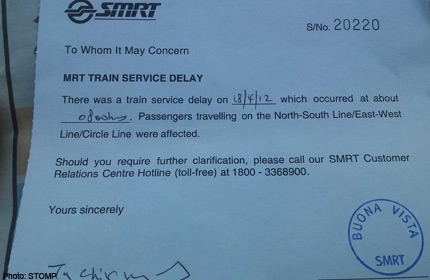
Late? Get a chit from SMRT

Commuters who get delayed as a result of train disruptions can ask for excuse slips to present to their bosses or teachers to explain their lateness.

These official slips - or excuse chits, as they are called - can be obtained at customer-service counters at any MRT station operated by SMRT, the transport operator said. They come complete with the date and time of a disruption, as well as a station stamp and staff signature.

An SMRT spokesman told my paper yesterday: "We provide an excuse chit to passengers who request one from our station staff, as official proof that they were delayed because of a service disruption."

Commuters who require one can also write in to SMRT Customer Relations at corpcomms@smrt.com.sg or call the transport operator's hotline on 1800-3368-900.

SMRT said it introduced the excuse chit in the early 2000s.

While the transport operator was unable to provide the total number of chits given out since, it said that fewer than 100 have been issued for disruptions over the past two weeks.

Stomp contributor Mansoor, 42, said he was stranded at Buona Vista Station yesterday morning, due to the disruption on the Circle Line.

He had been heading to one-north Station, just one stop away. The assistant merchandising manager approached staff at station control, who told him they could issue him a chit.

He finally made it to work by bus, arriving over half an hour late. He later posted a photograph of the chit on citizen-journalism website Stomp.

Mansoor said: "In the end, my boss was late too, so he accepted my lateness."

Wednesday, March 28, 2012

Woman burned by liquid on seat of MRT train

A 27-year-old Malaysian woman sustained a burn wound on her buttocks after she sat on a wet seat on board an MRT train last Saturday.

The unknown liquid on the seat left her with a 7cm wound, reported Chinese evening newspaper Lianhe Wanbao yesterday.

The report said that the woman, known only as Ms Law, boarded the northbound train at Raffles Place Station.

Ms Law, who works as a hairdresser in Tiong Bahru, had been on her way home to Yishun at the time.

She said she spotted an empty seat and proceeded to sit on it, but switched seats immediately after she felt a wet spot on her pants.

Less than a minute later, Ms Law felt a burning sensation on her buttocks, which quickly intensified and became a searing pain.

She alighted at Dhoby Ghaut Station to check and found a burn wound, about the size of her palm, on her right buttock.

She was so shocked by what she saw that she started crying.

She approached an SMRT staff member for help and was rushed to the Singapore General Hospital for treatment.

Ms Law was given 10 days of medical leave and is scheduled to go for a check-up on Monday, said Lianhe Wanbao.

“We are sorry about Ms Law’s experience. We have been calling her since the incident to make sure she is fine, and to find out how this might have happened,” said an SMRT spokesman.

The case has been reported to the police and investigations are ongoing.

Wednesday, February 22, 2012

Govt's move to fund bus purchases sparks public concern

SINGAPORE: The government's move to spend S$1.1 billion over the next 10 years to fund the purchase of 550 SBS Transit and SMRT buses has sparked concerns among some Singaporeans.

A few have written to the government's feedback portal REACH, questioning why the government is using public funds to help profit-driven companies.

SBS Transit and SMRT are public-listed private enterprises.

Analysts said the government's move to help the two public transport operators grow their bus fleet does not mean a free lunch for them. They said commuters would stand to benefit from higher service standards, which are likely to be imposed on SBS Transit and SMRT.

Observers said the government's move is not unique. In affluent cities in Europe and Australia, private operators receive public-funded buses in order to achieve a more efficient transport network.

Assistant Professor Paul Barter from the Lee Kuan Yew School of Public Policy said: "In Singapore, if the government is going to be helping a private sector operator in this way, we would not do it in an open-ended way.

"We will need to set higher service standards. If we are giving money for the buses, we expect higher service in return. It would not just be a gift. There would be expectation of improved service."

Analysts said although the two operators are making profits overall, they have been weighed down by bus operations.

Latest data showed SBS Transit incurring an operating loss of S$6 million due mainly to increased fuel and staff costs.

Meanwhile, SMRT said it incurred a higher operating loss of S$1.7 million due to the same reasons.

So the assistance will come in handy to help boost capacity and meet the anticipated growth in demand.

Analyst John Rachmat from the Royal Bank of Scotland said: "The situation is such that the bus operations are not generating enough profits for the operators.

"In fact, in many cases, (they) are incurring losses. So if this continues, there will be no new investments in buses in Singapore and as a result, the public will suffer from more overcrowding."

With the government's funding for additional buses, "hopefully, what we will see is a lot more frequent bus services, a lot lesser overcrowding and more profits for the operators because that will be the reason for them to deliver the better services," said Mr Rachmat.

"In a way, they will earn more profits but in exchange for that, the public will see a lot better bus service in Singapore."

Observers believe the S$1.1 billion fund will not only go towards helping operators grow their fleet.

Given the big sum of money, there are indications it could also help operators get the manpower they need to run the buses.

They could increase salaries to make the job more attractive, particularly to Singaporeans.

Minister of State for Transport Josephine Teo said with the government chipping in to buy new buses, public transport operators must improve their service standards.

Mrs Teo on Wednesday defended the government's move to co-fund new buses at a post-Budget dialogue organised by feedback unit REACH.

"What Singaporeans want is quicker solutions," she said.

"They don't want to wait so long. So it's with Singaporean needs in mind that we assessed that the better way to do it, the faster way to do it, the more efficient way of doing it, is to partner the existing public transport operators to deliver the increased capacity."

Charles Chong, a member of the Government Parliamentary Committee (GPC) for Transport, said: "With the grant, I think this eliminates some of their excuses...that they can't get drivers (because) they can't pay them enough."

"This grant should not be used to bump up profits for shareholders -- it is meant really to help serve the public better, because you are using public funds for this; the expenditure should benefit the public," he added.

Mr Chong said operators are expected to bump up bus frequencies and serve more areas.

Analysts said they believe the operators will see operating costs going up in the short run. But the higher costs are unlikely to be transferred to commuters as higher fares.

Details on the S$1.1 billion fund are expected in the upcoming Budget debate.

Monday, December 12, 2011

Revised fares hit cabbies' takings

COMFORTDELGRO taxi drivers reported a drop in daily takings of at least 20 per cent yesterday, the first day the company's revised fares kicked in.

Cabbies my paper spoke to lamented that some passengers avoided getting into their taxis as a result of the fare revision.

"Even though they see that our cabs are empty, they choose to board those of other companies," said cabby S. L. Chua.

The 50-year-old, who has been a taxi driver for more than a decade, said his earnings yesterday had been "significantly" affected by the fare changes.

"Typically, I could easily make up to 20 trips in a day. But this morning, I had to go around hunting for passengers," he said.

Cabby Teh Kok Wah, 58, said he barely made enough money yesterday to cover the daily rental of his taxi and diesel costs of about $120.

"It is a lose-lose situation for both the passengers and us. They end up having to pay more while we see fewer people taking our cabs," he explained.

Even during the evening rush hour, cabbies said they faced similar difficulties.

When asked how business had been affected yesterday, ComfortDelGro spokesman Tammy Tan said that it was "too early to say".

ComfortDelGro's taxi companies, Comfort Transportation and CityCab, manage a fleet of about 15,700 taxis. Drivers of other taxi operators, too, reported a drop in earnings yesterday.

Trans-cab cabby H. W. Wong, 58, said: "When the biggest player increases prices, the passengers assume that all the cabs are charging higher fares and so avoid them altogether."

However, cabbies said they expect the situation to stabilise within the next two weeks, once passengers get used to the changes.

They also pointed out that December has traditionally been a slow period due to the school holidays, when people go on vacation.

However, it being the festive season, "people are in a festive mood and won't mind spending, so a clearer picture will emerge after Chinese New Year next year", said Mr Teh.

Yesterday, SMRT, the third-largest operator with some 4,000 taxis, also announced changes to its fare structure.

When contacted, two of the four other taxi companies said they are monitoring the situation.

Trans-cab and Smart Taxi said they are in discussions with their drivers to review their fares.

Tuesday, December 6, 2011

Association urges other taxi operators to follow fare revision

The National Taxi Association (NTA) has urged the five other taxi operators in Singapore -- Trans-Cab, SMRT, Premier, Smart and Prime, to follow ComfortDelGro's fare revision, The Straits Times said on Tuesday.

The NTA represents taxi drivers here and currently has more than 11,000 members.

It said this would help to defray rising costs of operation, for example, higher diesel prices, and increase the annual income of taxi drivers.

NTA president Wee Boon Kim said drivers are expected to make about $6 or $7 more under the new fare structure.


Other firms say they have not decided whether to revise their fares, and will make a decision after seeking feedback from their drivers.

The report added that SMRT Taxis will consider a fare revision as drivers' operating costs have increased since the last fare revision in 2007.

ComfortDelGro explained the reason behind the revision by pointing to how "strong population growth and an increase in tourist arrivals" have led to a significant increase in demand for taxis throughout the day -- even during "off-peak" hours, The Straits Times said.
Related Posts Plugin for WordPress, Blogger...