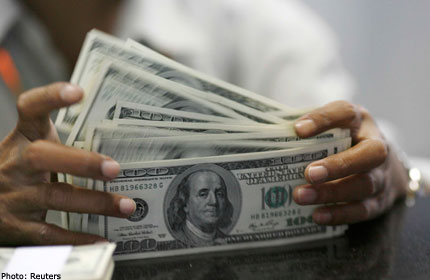
HONG KONG: The
dollar slipped in Asian trade on Wednesday, while share markets rose
after President Barack Obama was re-elected in a knife-edge US
presidential election.
As a hard-fought campaign came down to the
wire Obama was declared winner after picking up crucial swing states,
wiping away uncertainty that had pervaded markets for the past few days.
But
in afternoon foreign exchange trade the greenback slipped against the
euro and yen as dealers bet that under Obama the Federal Reserve would
continue with the loose monetary policy that has seen it flood markets
with billions of dollars.
The European single currency bought
$1.2861 in Tokyo, well up from $1.2788 earlier Wednesday and $1.2814 in
New York late Tuesday. The greenback was also at 80.05 yen compared with
80.34 yen in New York.
The greenback was also broadly lower
against other Asia-Pacific currencies, including the Australian, Taiwan
and Singapore dollars, and the Indian rupee.
A clear victory had
been the overriding hope as it will now allow the government to move on
fixing the austere "fiscal cliff" of tax hikes and spending cuts that
sits on the horizon and could hammer the economy.
In afternoon trade Asian shares were higher.
Sydney
gained 0.71 per cent, or 31.7 points, to end at 4,516.5, and in the
afternoon Hong Kong rose 0.30 per cent, Seoul gained 0.33 per cent and
Shanghai was up 0.16 per cent while Tokyo was flat.
"An Obama
victory ensures the continuity of the US monetary policy, which is
likely to be kept loose," SHK Financial strategist Daniel So told Dow
Jones Newswires.
He added that a Romney win would likely see him
"launch policies to incentivise fund flow back to the US, so in terms of
liquidity inflow an Obama win also favours the Asian markets".
Wall
Street ended with impressive gains ahead of the election results. The
Dow rose 1.02 per cent, the S&P 500 climbed 0.79 per cent and the
Nasdaq added 0.41 per cent.
However, regional traders were still
concerned about Europe's debt woes, which were stoked on Tuesday after
data showed a bigger-than-expected slump in factory orders in Germany,
the eurozone's biggest economy.
Berlin said industrial orders
declined 3.3 per cent in September from August after already falling 0.8
per cent the previous month.
That is much steeper than expected. Analysts polled by Dow Jones had been pencilling in a fall of 0.5 per cent.
The drop was largely due to a decline in export orders, particularly from the eurozone, where they plummeted 9.6 per cent.
Eyes
are also on the upcoming 18th congress of the Chinese Communist Party
that begins on Thursday and which will see the country's leaders for the
next 10 years anointed.
Oil prices were lower, with New York's
main contract, light sweet crude for delivery in December, down 29 cents
to $88.42 a barrel and Brent North Sea crude for December delivery
shedding 52 cents to $110.55.
Gold prices rose thanks to the weaker dollar, sitting at $1,710.40 by 0545 GMT compared with $1,679.75 late Monday.
Showing posts with label asian trade. Show all posts
Wednesday, November 7, 2012
Thursday, October 11, 2012
Dollar rises against yen in Asia
TOKYO - The dollar rose against the yen in Asian trade on Friday,
lifted by news that Japanese mobile carrier Softbank is in advanced
talks on a multi-billion-dollar buyout deal with Sprint Nextel.
The dollar was at 78.45 yen in Tokyo trade against 78.33 yen in New York late Thursday.
The European common currency was changing hands at $1.2943 against $1.2926, while it firmed to 101.52 yen from 101.25 yen.
Softbank is eyeing a monster $25 billion buy-in to the US telecom market including the takeover of Sprint Nextel in what could be one of Japan Inc.'s biggest-ever overseas acquisition, reports said Friday.
Sprint Nextel said it was talking to Softbank on a possible takeover by Japan's third largest mobile carrier, while Softbank also confirmed on talks with the US firm but noted no decisions had been made yet.
"The way of financing varies," Daisuke Karakama, market economist at Mizuho Corporate Bank, told Dow Jones Newswires. "The firm may have some dollar holdings. Still, there should be dollar-buying to a certain extent."
Banks, asked by the telecom firm, will likely purchase dollars over a certain period of time, he added.
The dollar was also supported against the yen after Japanese finance minister Koriki Jojima expressed at the Group of Seven meeting in Tokyo concerns about the high levels of the currency, dealers said.
The direction of the single currency may well depend on the stock market's movement, said a senior dealer at a major Japanese bank, as risk appetite rose despite worries over Spain's path forward after another S&P ratings downgrade.
The Standard & Poor's downgrade of Spain seemed to have had little impact, despite the risk of rendering the country's debt burden unsustainable.
"You don't have to be too pessimistic about the euro," he said.
While the downgrade could hit Madrid's borrowing costs, the European Central Bank's promise to buy up the debt of troubled economies if they agree to accept certain conditions.
The dollar was at 78.45 yen in Tokyo trade against 78.33 yen in New York late Thursday.
The European common currency was changing hands at $1.2943 against $1.2926, while it firmed to 101.52 yen from 101.25 yen.
Softbank is eyeing a monster $25 billion buy-in to the US telecom market including the takeover of Sprint Nextel in what could be one of Japan Inc.'s biggest-ever overseas acquisition, reports said Friday.
Sprint Nextel said it was talking to Softbank on a possible takeover by Japan's third largest mobile carrier, while Softbank also confirmed on talks with the US firm but noted no decisions had been made yet.
"The way of financing varies," Daisuke Karakama, market economist at Mizuho Corporate Bank, told Dow Jones Newswires. "The firm may have some dollar holdings. Still, there should be dollar-buying to a certain extent."
Banks, asked by the telecom firm, will likely purchase dollars over a certain period of time, he added.
The dollar was also supported against the yen after Japanese finance minister Koriki Jojima expressed at the Group of Seven meeting in Tokyo concerns about the high levels of the currency, dealers said.
The direction of the single currency may well depend on the stock market's movement, said a senior dealer at a major Japanese bank, as risk appetite rose despite worries over Spain's path forward after another S&P ratings downgrade.
The Standard & Poor's downgrade of Spain seemed to have had little impact, despite the risk of rendering the country's debt burden unsustainable.
"You don't have to be too pessimistic about the euro," he said.
While the downgrade could hit Madrid's borrowing costs, the European Central Bank's promise to buy up the debt of troubled economies if they agree to accept certain conditions.
Sunday, September 23, 2012
World oil prices down in Asian trade
SINGAPORE: Oil
prices eased in Asian trade on Monday, weighed down by a fall in
regional equities and on lingering concerns over the eurozone debt
crisis, analysts said.
New York's benchmark contract, West Texas Intermediate crude for November delivery, was down $1.01 to $91.88 a barrel in the morning, while Brent North Sea crude for November dipped 94 cents to $110.48.
Victor Shum, an analyst with Purvin and Gertz energy consultancy in Singapore, said the drop in the oil prices "is not surprising given that Asian stock markets are also coming down".
He said differences between France and Germany on how to deal with the eurozone debt crisis remains a worry for investors.
"Concerns over Europe have caused some selling in Asian equities, and in connection to that also in oil futures," he told AFP.
The leaders of Germany and France at a meeting on Saturday clashed over plans to monitor Europe's crisis-hit banks.
Despite affirmations that European unity was the only way out of the debt turmoil, German Chancellor Angela Merkel and French President Francois Hollande differed over a key plank of crisis-fighting: tighter checks on the European banking sector.
Shum also said comments by top crude producer Saudi Arabia that it will take steps to keep prices from rising too high should press down on prices.
"It looks like on the supply front there's no need for worry," he said.
New York's benchmark contract, West Texas Intermediate crude for November delivery, was down $1.01 to $91.88 a barrel in the morning, while Brent North Sea crude for November dipped 94 cents to $110.48.
Victor Shum, an analyst with Purvin and Gertz energy consultancy in Singapore, said the drop in the oil prices "is not surprising given that Asian stock markets are also coming down".
He said differences between France and Germany on how to deal with the eurozone debt crisis remains a worry for investors.
"Concerns over Europe have caused some selling in Asian equities, and in connection to that also in oil futures," he told AFP.
The leaders of Germany and France at a meeting on Saturday clashed over plans to monitor Europe's crisis-hit banks.
Despite affirmations that European unity was the only way out of the debt turmoil, German Chancellor Angela Merkel and French President Francois Hollande differed over a key plank of crisis-fighting: tighter checks on the European banking sector.
Shum also said comments by top crude producer Saudi Arabia that it will take steps to keep prices from rising too high should press down on prices.
"It looks like on the supply front there's no need for worry," he said.
Sunday, July 15, 2012
Crude lower in Asia
SINGAPORE - Oil prices sank in Asian trade Monday after Saudi Arabia
and the United Arab Emirates opened crude pipelines bypassing the Strait
of Hormuz, which Iran has repeatedly threatened to close, analysts
said.
New York's main contract, light sweet crude for August delivery, shed 34 cents to $86.76 a barrel and Brent North Sea crude for delivery in August retreated five cents to $102.35.
Alternative crude transport routes created by the UAE and Saudi pipelines alleviated supply concerns which had been held hostage by Iran in negotiations with the West over its nuclear program, IG Markets said in a report.
"Very quietly and strategically Saudi Arabia and UAE have opened up pipelines that allow it to bypass the Strait of Hormuz which up until now has been the trump card for Iran in its bargaining with the West," it stated.
"This fresh transport oil link should help weaken the threat of supply disruption coming out of Iran and force it back to the negotiating table."
The UAE on Sunday inaugurated its newest pipeline, which demonstrated its ability to bypass the Strait of Hormuz by pumping 500,000 barrels of oil from the emirate to Fujairah oil terminal on the Gulf of Oman.
The pipeline will be fully operational in August, and will have an initial capacity of 1.5 million barrels per day rising to a maximum 1.8 million bpd, officials said.
Meanwhile, Saudi Arabia converted a natural gas pipeline running from the country's eastern province to a terminal near the Red Sea to enable it to pump crude.
Reports estimated that the new links will more than double the total pipeline capacity bypassing the Strait of Hormuz to 6.5 million barrels per day, almost 40 percent of the 17 million barrels that transits Hormuz.
New York's main contract, light sweet crude for August delivery, shed 34 cents to $86.76 a barrel and Brent North Sea crude for delivery in August retreated five cents to $102.35.
Alternative crude transport routes created by the UAE and Saudi pipelines alleviated supply concerns which had been held hostage by Iran in negotiations with the West over its nuclear program, IG Markets said in a report.
"Very quietly and strategically Saudi Arabia and UAE have opened up pipelines that allow it to bypass the Strait of Hormuz which up until now has been the trump card for Iran in its bargaining with the West," it stated.
"This fresh transport oil link should help weaken the threat of supply disruption coming out of Iran and force it back to the negotiating table."
The UAE on Sunday inaugurated its newest pipeline, which demonstrated its ability to bypass the Strait of Hormuz by pumping 500,000 barrels of oil from the emirate to Fujairah oil terminal on the Gulf of Oman.
The pipeline will be fully operational in August, and will have an initial capacity of 1.5 million barrels per day rising to a maximum 1.8 million bpd, officials said.
Meanwhile, Saudi Arabia converted a natural gas pipeline running from the country's eastern province to a terminal near the Red Sea to enable it to pump crude.
Reports estimated that the new links will more than double the total pipeline capacity bypassing the Strait of Hormuz to 6.5 million barrels per day, almost 40 percent of the 17 million barrels that transits Hormuz.
Subscribe to:
Posts (Atom)