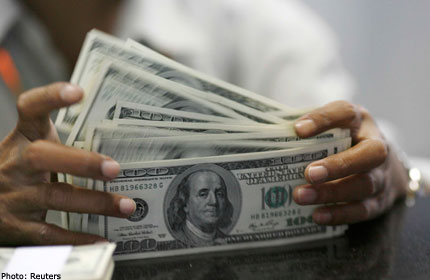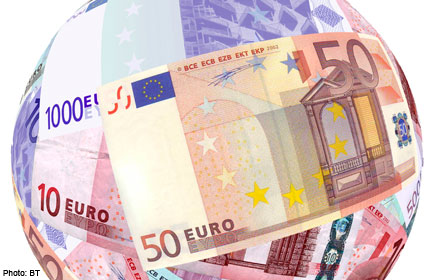
SINGAPORE - The euro surged against the dollar on Wednesday as
traders flocked to the riskier single currency with the US Congress
poised to endorse a deal to avert the "fiscal cliff" budget crisis.
The euro strengthened to US$1.3262 (S$1.62) in morning Asian trade
from US$1.3192 on Monday.
The euro was at 115.28 yen (S$1.62) from
114.45 yen. The dollar rose to 86.95 yen from 86.69 yen.
The fiscal cliff deal was spurring traders to shift their investments
from the safe-haven greenback to riskier currencies, said Jason Hughes,
head of premium client management for IG Markets Singapore.
The deal passed the Senate on Tuesday but its fate hung in the
balance for hours as House conservatives sought to amend it to include
big spending cuts, which would likely have killed its chance of passage.
The House of Representatives was due to vote late Tuesday Washington time.
Had the deal splintered, all Americans would have been hit by tax
increases and the spending cuts would have kicked in across the
government, in a combined US$500 billion shock that could have rocked
the fragile recovery.
"We saw risk currencies react positively to the fact that a deal has
gone through the Senate and is likely to find its way through the
House," Hughes told AFP.
"Despite the development in the US that should be US dollar positive,
it actually lends support to the risk currencies at the moment," he
added.
Showing posts with label dollar. Show all posts
Tuesday, January 1, 2013
Wednesday, November 7, 2012
Dollar down, markets up in Asia after Obama win
HONG KONG: The
dollar slipped in Asian trade on Wednesday, while share markets rose
after President Barack Obama was re-elected in a knife-edge US
presidential election.
As a hard-fought campaign came down to the wire Obama was declared winner after picking up crucial swing states, wiping away uncertainty that had pervaded markets for the past few days.
But in afternoon foreign exchange trade the greenback slipped against the euro and yen as dealers bet that under Obama the Federal Reserve would continue with the loose monetary policy that has seen it flood markets with billions of dollars.
The European single currency bought $1.2861 in Tokyo, well up from $1.2788 earlier Wednesday and $1.2814 in New York late Tuesday. The greenback was also at 80.05 yen compared with 80.34 yen in New York.
The greenback was also broadly lower against other Asia-Pacific currencies, including the Australian, Taiwan and Singapore dollars, and the Indian rupee.
A clear victory had been the overriding hope as it will now allow the government to move on fixing the austere "fiscal cliff" of tax hikes and spending cuts that sits on the horizon and could hammer the economy.
In afternoon trade Asian shares were higher.
Sydney gained 0.71 per cent, or 31.7 points, to end at 4,516.5, and in the afternoon Hong Kong rose 0.30 per cent, Seoul gained 0.33 per cent and Shanghai was up 0.16 per cent while Tokyo was flat.
"An Obama victory ensures the continuity of the US monetary policy, which is likely to be kept loose," SHK Financial strategist Daniel So told Dow Jones Newswires.
He added that a Romney win would likely see him "launch policies to incentivise fund flow back to the US, so in terms of liquidity inflow an Obama win also favours the Asian markets".
Wall Street ended with impressive gains ahead of the election results. The Dow rose 1.02 per cent, the S&P 500 climbed 0.79 per cent and the Nasdaq added 0.41 per cent.
However, regional traders were still concerned about Europe's debt woes, which were stoked on Tuesday after data showed a bigger-than-expected slump in factory orders in Germany, the eurozone's biggest economy.
Berlin said industrial orders declined 3.3 per cent in September from August after already falling 0.8 per cent the previous month.
That is much steeper than expected. Analysts polled by Dow Jones had been pencilling in a fall of 0.5 per cent.
The drop was largely due to a decline in export orders, particularly from the eurozone, where they plummeted 9.6 per cent.
Eyes are also on the upcoming 18th congress of the Chinese Communist Party that begins on Thursday and which will see the country's leaders for the next 10 years anointed.
Oil prices were lower, with New York's main contract, light sweet crude for delivery in December, down 29 cents to $88.42 a barrel and Brent North Sea crude for December delivery shedding 52 cents to $110.55.
Gold prices rose thanks to the weaker dollar, sitting at $1,710.40 by 0545 GMT compared with $1,679.75 late Monday.
As a hard-fought campaign came down to the wire Obama was declared winner after picking up crucial swing states, wiping away uncertainty that had pervaded markets for the past few days.
But in afternoon foreign exchange trade the greenback slipped against the euro and yen as dealers bet that under Obama the Federal Reserve would continue with the loose monetary policy that has seen it flood markets with billions of dollars.
The European single currency bought $1.2861 in Tokyo, well up from $1.2788 earlier Wednesday and $1.2814 in New York late Tuesday. The greenback was also at 80.05 yen compared with 80.34 yen in New York.
The greenback was also broadly lower against other Asia-Pacific currencies, including the Australian, Taiwan and Singapore dollars, and the Indian rupee.
A clear victory had been the overriding hope as it will now allow the government to move on fixing the austere "fiscal cliff" of tax hikes and spending cuts that sits on the horizon and could hammer the economy.
In afternoon trade Asian shares were higher.
Sydney gained 0.71 per cent, or 31.7 points, to end at 4,516.5, and in the afternoon Hong Kong rose 0.30 per cent, Seoul gained 0.33 per cent and Shanghai was up 0.16 per cent while Tokyo was flat.
"An Obama victory ensures the continuity of the US monetary policy, which is likely to be kept loose," SHK Financial strategist Daniel So told Dow Jones Newswires.
He added that a Romney win would likely see him "launch policies to incentivise fund flow back to the US, so in terms of liquidity inflow an Obama win also favours the Asian markets".
Wall Street ended with impressive gains ahead of the election results. The Dow rose 1.02 per cent, the S&P 500 climbed 0.79 per cent and the Nasdaq added 0.41 per cent.
However, regional traders were still concerned about Europe's debt woes, which were stoked on Tuesday after data showed a bigger-than-expected slump in factory orders in Germany, the eurozone's biggest economy.
Berlin said industrial orders declined 3.3 per cent in September from August after already falling 0.8 per cent the previous month.
That is much steeper than expected. Analysts polled by Dow Jones had been pencilling in a fall of 0.5 per cent.
The drop was largely due to a decline in export orders, particularly from the eurozone, where they plummeted 9.6 per cent.
Eyes are also on the upcoming 18th congress of the Chinese Communist Party that begins on Thursday and which will see the country's leaders for the next 10 years anointed.
Oil prices were lower, with New York's main contract, light sweet crude for delivery in December, down 29 cents to $88.42 a barrel and Brent North Sea crude for December delivery shedding 52 cents to $110.55.
Gold prices rose thanks to the weaker dollar, sitting at $1,710.40 by 0545 GMT compared with $1,679.75 late Monday.
Thursday, October 11, 2012
Dollar rises against yen in Asia
TOKYO - The dollar rose against the yen in Asian trade on Friday,
lifted by news that Japanese mobile carrier Softbank is in advanced
talks on a multi-billion-dollar buyout deal with Sprint Nextel.
The dollar was at 78.45 yen in Tokyo trade against 78.33 yen in New York late Thursday.
The European common currency was changing hands at $1.2943 against $1.2926, while it firmed to 101.52 yen from 101.25 yen.
Softbank is eyeing a monster $25 billion buy-in to the US telecom market including the takeover of Sprint Nextel in what could be one of Japan Inc.'s biggest-ever overseas acquisition, reports said Friday.
Sprint Nextel said it was talking to Softbank on a possible takeover by Japan's third largest mobile carrier, while Softbank also confirmed on talks with the US firm but noted no decisions had been made yet.
"The way of financing varies," Daisuke Karakama, market economist at Mizuho Corporate Bank, told Dow Jones Newswires. "The firm may have some dollar holdings. Still, there should be dollar-buying to a certain extent."
Banks, asked by the telecom firm, will likely purchase dollars over a certain period of time, he added.
The dollar was also supported against the yen after Japanese finance minister Koriki Jojima expressed at the Group of Seven meeting in Tokyo concerns about the high levels of the currency, dealers said.
The direction of the single currency may well depend on the stock market's movement, said a senior dealer at a major Japanese bank, as risk appetite rose despite worries over Spain's path forward after another S&P ratings downgrade.
The Standard & Poor's downgrade of Spain seemed to have had little impact, despite the risk of rendering the country's debt burden unsustainable.
"You don't have to be too pessimistic about the euro," he said.
While the downgrade could hit Madrid's borrowing costs, the European Central Bank's promise to buy up the debt of troubled economies if they agree to accept certain conditions.
The dollar was at 78.45 yen in Tokyo trade against 78.33 yen in New York late Thursday.
The European common currency was changing hands at $1.2943 against $1.2926, while it firmed to 101.52 yen from 101.25 yen.
Softbank is eyeing a monster $25 billion buy-in to the US telecom market including the takeover of Sprint Nextel in what could be one of Japan Inc.'s biggest-ever overseas acquisition, reports said Friday.
Sprint Nextel said it was talking to Softbank on a possible takeover by Japan's third largest mobile carrier, while Softbank also confirmed on talks with the US firm but noted no decisions had been made yet.
"The way of financing varies," Daisuke Karakama, market economist at Mizuho Corporate Bank, told Dow Jones Newswires. "The firm may have some dollar holdings. Still, there should be dollar-buying to a certain extent."
Banks, asked by the telecom firm, will likely purchase dollars over a certain period of time, he added.
The dollar was also supported against the yen after Japanese finance minister Koriki Jojima expressed at the Group of Seven meeting in Tokyo concerns about the high levels of the currency, dealers said.
The direction of the single currency may well depend on the stock market's movement, said a senior dealer at a major Japanese bank, as risk appetite rose despite worries over Spain's path forward after another S&P ratings downgrade.
The Standard & Poor's downgrade of Spain seemed to have had little impact, despite the risk of rendering the country's debt burden unsustainable.
"You don't have to be too pessimistic about the euro," he said.
While the downgrade could hit Madrid's borrowing costs, the European Central Bank's promise to buy up the debt of troubled economies if they agree to accept certain conditions.
Sunday, August 21, 2011
Dollar up from historic low against yen
TOKYO: The dollar
clawed back ground against the yen on Monday after hitting a historic
low last week, as Tokyo upped its rhetoric over the domestic unit and
indicated its willingness to intervene to stem its rise.
The dollar firmed to 76.62 yen in Tokyo morning trade from 76.50 yen in New York late Friday, after the greenback fell to a post-war low of 75.95.
The euro eased to $1.4380 from $1.4398. The European common currency was almost flat at 110.18 yen against 110.15 yen.
The dollar's slump on Friday beat its previous post-World War II low of 76.25, which it reached days after the March 11 earthquake and tsunami hit Japan.
The Japanese currency, seen as a safe-haven unit together with the Swiss franc, have attracted purchases amid deepening concern about faltering growth in the United States and the eurozone's debt crisis, dealers said.
Against the Swiss unit, the greenback firmed to 0.7866 francs from 0.7849 in New York.
The Swiss currency strengthened to 1.1308 per euro, compared with 1.1381 francs late Friday in Tokyo.
Local media reported over the weekend that Japanese authorities are ready to take action against a further surge in the yen, including market intervention to sell the unit.
The reports said the Japanese central bank is also considering further monetary easing.
Because a strong yen hurts Japanese exporters leading the nation's recovery from the impact of the March 11 earthquake and tsunami, Japan stepped into the foreign exchange market earlier this month to sell yen and buy dollars.
Tokyo has previously signalled that it may do so again.
Finance Minister Yoshihiko Noda stepped up his rhetoric Monday against the yen's rise. "I'm worried that recent one-sided yen moves have been strengthening," Noda said, according to Dow Jones Newswires.
"I will take decisive actions if necessary without excluding any possible measures, while watching even more closely if there are any speculative movements," he told reporters.
"Investors remain jittery following media reports about the authorities' possible countermeasures," against the strong yen, said Tomohiro Ishikawa, dealer at Chuo Mitsui Trust and Banking.
"While they are cautious about the Japanese authorities' stance, the dollar's underlying weakness is unlikely to be reversed" ahead of Federal Reserve Chairman Ben Bernanke's speech later this week, Ishikawa said.
The dollar came under renewed pressure after the Fed pledged earlier this month to hold interest rates near zero for two more years to counter an economy facing increased risks of stalling.
With attention on Bernanke's speech at the Fed's annual symposium in Jackson Hole Friday, Credit Agricole said it believes "there is currently a high hurdle for QE3 and therefore another measure to promote stronger economic recovery is more likely."
The dollar firmed to 76.62 yen in Tokyo morning trade from 76.50 yen in New York late Friday, after the greenback fell to a post-war low of 75.95.
The euro eased to $1.4380 from $1.4398. The European common currency was almost flat at 110.18 yen against 110.15 yen.
The dollar's slump on Friday beat its previous post-World War II low of 76.25, which it reached days after the March 11 earthquake and tsunami hit Japan.
The Japanese currency, seen as a safe-haven unit together with the Swiss franc, have attracted purchases amid deepening concern about faltering growth in the United States and the eurozone's debt crisis, dealers said.
Against the Swiss unit, the greenback firmed to 0.7866 francs from 0.7849 in New York.
The Swiss currency strengthened to 1.1308 per euro, compared with 1.1381 francs late Friday in Tokyo.
Local media reported over the weekend that Japanese authorities are ready to take action against a further surge in the yen, including market intervention to sell the unit.
The reports said the Japanese central bank is also considering further monetary easing.
Because a strong yen hurts Japanese exporters leading the nation's recovery from the impact of the March 11 earthquake and tsunami, Japan stepped into the foreign exchange market earlier this month to sell yen and buy dollars.
Tokyo has previously signalled that it may do so again.
Finance Minister Yoshihiko Noda stepped up his rhetoric Monday against the yen's rise. "I'm worried that recent one-sided yen moves have been strengthening," Noda said, according to Dow Jones Newswires.
"I will take decisive actions if necessary without excluding any possible measures, while watching even more closely if there are any speculative movements," he told reporters.
"Investors remain jittery following media reports about the authorities' possible countermeasures," against the strong yen, said Tomohiro Ishikawa, dealer at Chuo Mitsui Trust and Banking.
"While they are cautious about the Japanese authorities' stance, the dollar's underlying weakness is unlikely to be reversed" ahead of Federal Reserve Chairman Ben Bernanke's speech later this week, Ishikawa said.
The dollar came under renewed pressure after the Fed pledged earlier this month to hold interest rates near zero for two more years to counter an economy facing increased risks of stalling.
With attention on Bernanke's speech at the Fed's annual symposium in Jackson Hole Friday, Credit Agricole said it believes "there is currently a high hurdle for QE3 and therefore another measure to promote stronger economic recovery is more likely."
Subscribe to:
Posts (Atom)