Showing posts with label DBS. Show all posts

Tuesday, January 15, 2013

Singapore cooling: Mortgage loans could drop up to 20%

Singapore’s broad range of new property curbs is an indication that the government is willing to trade off economic growth for social issues, said DBS Chief Executive Piyush Gupta (pictured).

The official forecast for GDP growth this year is between one and three percent and Gupta believes that Singapore will likely perform in the bottom end of the range.

This as the government puts social priorities ahead of the economy, as seen in its latest restrictions that “are likely to have a lot more teeth than anything we’ve seen so far”.

“You don't have to be terribly prescient because they've been making it very clear now - for some time - that they're willing to trade off growth for what they call sustainable growth. Which means they're willing to trade off growth for social harmony.”

Meanwhile, there could be a significant decline in mortgage loans for 2013, according to DBS’ chief.

“I think there will be a slowdown because of all three things - higher cost to property, lower loan to valuation ratios and higher debt burden ratios.”

“Rates are still at historic lows, so we've to balance a lot of money available with low rates, because of all the measures. So it's tough to call how much the slowdown will be.”

He expects a drop of between 10 and 20 percent “on a sustained basis in terms of mortgage loans”.

Sunday, November 11, 2012

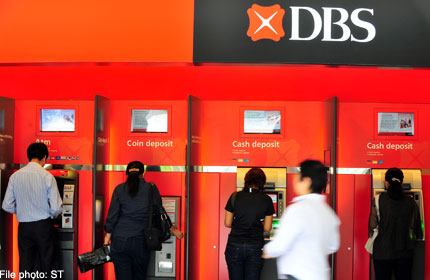
Several DBS, POSB ATMs reportedly "out of service"

SINGAPORE: Several DBS and POSB automated teller machines (ATM) were reported to be out of service on Sunday.

The problem seemed to have started late Sunday morning with the affected ATMs being progressively restored.

A Channel NewsAsia viewer, who wanted to be known as Ms Goh, said she wanted to withdraw some money at Kovan.

She said out of the five ATMs, four were down at about 11:00am. She also added that there was a queue and some people were frustrated.

Ms Goh said she called the bank's customer service hotline and was told that the bank is aware of the situation and was trying to fix the problem.

Another viewer reported that an ATM at Bukit Purmei was out of service at about 1.30pm.

Some ATMs at Suntec were also down.

At this point, DBS is unable to confirm the number of affected ATMs and the cause of the problem.

Monday, June 11, 2012

Investors pick Singapore's top companies

Singapore's top companies were revealed today, as Alpha Southeast Asia revealed the results of its second annual poll to find Southeast Asia's top companies.

The awards by Alpha Southeast Asia, a magazine focused on Southeast Asia's banking and capital markets, are based on tallied votes among 460 investors, pension funds, hedge funds, equity and fixed income brokers and analysts with investment interests in the Southeast Asia region.

Companies in each country were ranked on their financial management, adherence to corporate governance, investor relations' strategy, transparency and disclosure including the alignment of their CSR strategy to business goals.

In Singapore, the eight companies most preferred by institutional investors include regionally diversified telecoms company SingTel and local telecoms player Starhub, global real estate player Capitaland, regional banks' DBS Bank, OCBC, and UOB, aeronautical engineering specialist SIA Engineering, and conglomerate Keppel Corp.

SingTel's Jeann Low was nominated for both Best CFO in Singapore and Southeast Asia.

Across the region, the award for the Best Annual Report in Southeast Asia went to Keppel Corp while the award for the Strongest Commitment to Sustainable Energy in Southeast Asia went to Thai Oil.

Friday, February 24, 2012

3rd ATM found to have been skimmed: DBS

DBS said Friday that they believe that a third ATM machine was compromised at around the same time of the Bugis skimming.

This could have led to the latest spate of unauthorised withdrawals on Sunday.

The bank was alerted to unauthorised ATM withdrawals by 17 customers after they received real-time SMS alerts.

After which, common patterns among the affected customers established through analytics allowed the bank to conclude that a different ATM was compromised in addition to the two Bugis ATMs previously identified.

"We are unable to disclose further details, as this may jeopardise the ongoing investigation," the bank told The Straits Times.

In last Sunday's series of ATM withdrawals, fraudsters stole a total of $23,000 before they were discovered. The previous operation had stolen about $1 million from 700 customers.

The unauthorised withdrawals first began last month, with customers reporting sums of money being withdrawn from Kuala Lumpur when they were not in Malaysia at that time.

DBS initially believed the frauds to be contained to Jan 4 and 5.

To guard against further fraud, DBS had de-activated and replaced 2,726 customer cards deemed high risk, and blocked overseas ATM withdrawals unless requested not to by customers.

However, the fraudsters changed tactic to make the withdrawals locally instead.

Thursday, February 16, 2012

Analysts more upbeat about 2012's outlook

Some private analysts said yesterday that the Government is being overly pessimistic by maintaining an overall growth forecast of 1 to 3 per cent this year amid a stream of positive data.

Analysts from Credit Suisse and DBS said full-year economic growth is more likely to come in at about 3.5 per cent.

The Ministry of Trade and Industry (MTI) said earlier yesterday that the macroeconomic outlook remains "subdued" and "clouded with significant uncertainties".

The United States' recovery will be curtailed by public- spending cuts and continuing weakness in the housing market, said MTI.

It added that European banks have tightened lending, which will weigh on private-demand growth in the economy.

As a result, MTI chose to stick to a cautiously optimistic full-year growth forecast.

The ministry warned that Singapore's full-year growth could be even lower than expected.

It pointed to key risks such as a disorderly default on sovereign debt in the euro zone and an oil-price shock arising from the escalation of tensions in the Middle East.

Credit Suisse economist Wu Kun Lung said: "The euro zone development remains a key risk, but our base-case scenario is that a break-up of the euro zone can be avoided or postponed beyond 2012."

OCBC economist Selena Ling said a global oil-price shock is "only a tail risk for now".

Still, MTI officials said at a media conference yesterday that Singapore needs to be prepared for "more twists and turns" and "greater volatility" in the external environment, and added that they are "comfortable" with the growth forecast of 1 to 3 per cent.

Singapore may avoid a technical recession - defined as two consecutive quarters of contraction - based on near-term economic indicators and the first trade data of the year, said MTI.

"We've started off with quite good trade numbers and it at least gives us a basis to build on," said Dr Thia Jang Ping, director of the economics division at MTI. "We're hopeful that we can do better."

Total trade and non-oil domestic exports (Nodx) growth for the whole of this year is still expected to fall between 3 and 5 per cent.

Singapore's total trade grew 8 per cent last year, while Nodx climbed 2.2 per cent. Latest figures on Singapore's growth in the final quarter of last year showed that the economy shrank less than forecast.

The 2.5 per cent quarter-on-quarter contraction was much lower that a forecast 4.9 per cent contraction, and helped to push up Singapore's full-year growth.

It translated to a year-on-year expansion of 3.6 per cent in the fourth quarter.

For the whole of last year, the economy expanded by 4.9 per cent, marginally higher than the 4.8 per cent forecast.

This was due mainly to a surge in biomedical manufacturing output, which helped offset a contraction in the electronics cluster and slower growth in both the precision-engineering and chemical clusters last year, said MTI.

"Electronics output declined in Q4 because of weak demand from Europe, while the chemicals industry was disrupted by a fire at Singapore's largest refinery," said Mr Leong Wai Ho, an economist with Barclays Capital.

Meanwhile, the finance and insurance sector saw a 9.1 per cent full-year growth on the back of continued expansion in domestic and offshore lending activities, even as stock-trading activities declined.

The accommodation-and- food services and other services industries, grew by 5.8 and 6.7 per cent respectively, on the back of healthy visitor inflows.

Still, last year's 4.9 per cent total growth represents a sharp moderation from the 14.8 per cent growth recorded in 2010.

DBS economist Irvin Seah said that pockets of risk remain in Europe. "We believe that the current poor economic conditions will prevail for a few more months before a more pronounced pickup in growth momentum materialises in the second half of the year," he said.

"The recovery in the US will likely gain momentum and a more solid resolution may be in sight in the euro zone by then.

"As a result, full year GDP growth in 2012 will likely come in at 3.5 per cent."

Tuesday, February 14, 2012

Bank bonuses aren't what they used to be

Bonuses and pay increases for staff at foreign banks here are lower this year - which is not surprising given that most have reported a fall in their 2011 profits.

The picture for those working in local banks could be mixed.

DBS, which last Friday reported record earnings of $3.04 billion, the highest ever for a local bank, will not be paying record bonuses, said chief executive Piyush Gupta. 'The best year was 2006, as it was for other banks,' he noted.

DBS' return on equity (ROE) in 2006 was 12.8 per cent. ROE for 2011 was 11 per cent.

Still, pay for staff rose sharply last year over 2010, up 20 per cent to $1.7 billion as headcount gained 11 per cent to 17,652. This works out to each employee earning an average of $96,986 from $89,733 in 2010.

As DBS staffers started learning of their bonus payouts yesterday, one said that her total payout was the best she had ever got. But she conceded that this may not be the case for others whose basic pay may be relatively higher.

It is uncertain if OCBC Bank and United Overseas Bank - which will be reporting their full-year results later this month - will maintain bonuses at 2010 levels. For the first nine months of 2011, operating profits at the two local banks were slightly down.

The lead could come from US banks like Citi, JP Morgan and Goldman Sachs, and European banks such as Credit Suisse and Deutsche Bank which have already announced their 2011 results.

Still, despite reduced bonuses for their Asian staff, including those here, it is believed that on average, the reduction is less severe than the 30-70 per cent cuts reported for staff in New York, London or Geneva. Zero bonuses are also not uncommon.

Confirming the downtrend, Andre Cheong, chief executive, Global Search Partners, said: 'Typically, foreign banks pay their bonuses around February while local banks pay theirs in March. For the coming bonus payments, both foreign and local banks are expecting a decrease in the amounts this year.'

'In one foreign bank, employees have been informally told that they can expect 25 to 30 per cent less in bonuses this year,' he added.

Concurring, James Rushworth, managing director of Profile Asia, said: 'Bonuses are definitely down for many, some are getting none, even though their appraisals have been strong.'

Some bankers at foreign banks, however, told The Business Times that the expectations of their employees have been 'managed' and that unhappiness with the smaller payouts are not obvious. Some are also said to be relieved to still have their jobs.

'The sense of entitlement is being adjusted,' said one executive of a US bank.

A source at another bank said that bonuses at his bank have been slashed by 10-30 per cent on average. 'The point to note is that bonuses have to reflect the current economic environment, while it is as much a recognition and reward of the work done in the past year. Hence, overall bonuses have come down,' he added.

The exception seems to be Malaysian banks which have practically no exposure to the Western economies. It seems bonuses of four to six months could be the minimum this year at Maybank and CIMB - this is still unlikely to match previous record bonuses.

Global Search Partner's Mr Cheong said 'one candidate (in the middle office) we spoke to recently is expecting about six months' bonus.'

'The front-office people and good performers can probably expect more, but I'm not sure if it will be as much as 12 to 36 months as in the past.'

Foreign banks still pay more than local banks. 'The gap will have narrowed for sure but there is still a gap,' said Mr Rushworth.

Hiring has slowed except in private banking but even there the premium has dropped.

'Candidates hopefully should be more realistic and know that clients don't always follow them,' said Richard Wee, chief executive of private bank Lombard Odier, Singapore. 'What's being offered is less than before, around a 20-30 per cent premium.'
 

Thursday, January 5, 2012

DBS/POSB customers hit by unauthorised ATM withdrawals

SINGAPORE - DBS is investigating several hundred cases of unauthorised withdrawals from POSB/DBS accounts allegedly made from Malaysia in what could be a large scale bank fraud.

A local news source reported that when last checked at 8pm today, about 200 customers had reported unauthorised withdrawals from their bank accounts to DBS.

The average amount withdrawn is believed to be about S$1,000.

The Straits Times reported that the bank is combing through all transactions made in Malaysia to validate them. In the meanwhile, the bank has deactivated cards suspected to have been compromised.

Several Singaporeans have been writing in to citizen journalism website Stomp complaining of unauthorised withdrawals from their bank accounts from Malaysia.

The spate of unauthorised withdrawals appear to have affected just POSB and DBS account holders for now.

One reader, who gave his name as Dennis, said he found out a sum of money had been withdrawn from his account, with the withdrawal done in Malaysia, and made a police report on January 4.

Dennis told Stomp that there has been a number of cases where money was withdrawn suspiciously from DBS and POSB bank accounts over the last few days. Those affected include cardholders with ATM cards as well as those holding debit cards.

He added that he noticed that in all the cases, the ATM cards remained in possession of the owners, who did not leave the country, but the withdrawals took place in Malaysia.

One victim, Ms Lin, told a news channel that she was told by DBS that the unauthorised transaction had been made on a Malaysian ATM machine around the same time she was withdrawing her money.

Facebook user Amanda Goh posted on her profile that her POSB account had been "hacked" into, with four transactions made from overseas ATM machines.

The withdrawals added up to $2,000 over a two day period, she wrote. She added that she has no internet or paypal accounts.

Another reader Ricky Ng wrote in to warn those with DBS and POSB accounts to check their bank accounts for money suspiciously withdrawn.

"Be alert as a few of our fellow Singaporeans have already fallen prey to this," he said.

In response, DBS has launched investigations and will also be alerting customers if any unusual activity is detected on their accounts.

The bank further said all customers will be fully compensated within 24 hours for any false transaction.

In response to media queries, the police confirmed that they have received several reports of unauthorised withdrawals being made from POSB and DBS bank accounts.

The Commercial Affairs Department of the Singapore Police Force is investigating the matter.
The public is advised to check their bank accounts, and if they believe unauthorised withdrawals have been made, to lodge a police report via the Electronic Police Centre (ePC) at http://www.spf.gov.sg/epc/ or at any Neighbourhood Police Centre.

The report should include the date, amount, location and transaction description for each unauthorised withdrawal.

In addition, bank account holders are also advised to report the matter to DBS.

Any customer who suspects their ATM or debit card has been compromised should contact the bank at 1800-220-1111 or visit any bank branch.

A replacement card will be issued on the spot at any of its branches, DBS said.

Friday, September 16, 2011

Investing with your CPF

YOUNG adults already in the workforce will no doubt be familiar with their CPF (Central Provident Fund) accounts, into which a portion of their monthly salary is automatically squirrelled away, along with a percentage contribution from their employers.

Having surveyed the gamut of asset classes and investment vehicles over the last few months, the Young Investors' Forum takes a look this week at how young working adults can think about investing their CPF savings for the future.

While the prospect of retirement may still be far from the minds of energetic go-getters just scaling the lower rungs of their career ladders, it is only prudent to start preparing for that future today.

Know your CPF

The government bills the CPF as a 'comprehensive social security plan'. Meant to provide working Singaporeans financial security in their old age, the scheme covers retirement, healthcare, home ownership, family protection and asset enhancement.

These aims are met by mandatory monthly sums of money working Singaporeans and their employers channel into each individual's three CPF accounts:

  • The Ordinary Account (OA), which is where the bulk of your monthly contribution goes if you're under 35, and stores monies which can be used to buy property and insurance policies, make financial investments or pay for your own or your children's education.

  • The Special Account (SA) is to accumulate funds for old age and contingencies, which can be used to invest in retirement-related financial products.

  • The Medisave Account's (MA) savings are meant for hospitalisation expenses and approved medical insurance plans.
While entrepreneurs and the self-employed need not contribute to the Ordinary and Special Accounts, they must contribute to the Medisave Account if their yearly net trade income exceeds $6,000.

Without you choosing to invest, CPF savings in all these accounts will earn interest. Funds in the OA earn an interest rate based on the 12-month fixed deposit and month-end savings rates at major local banks, but the CPF Act guarantees a minimum risk-free interest of 2.5 per cent.

For the Special, Medisave (SMA) and Retirement Accounts, which earn an interest rate equal to the 12-month average yield of 10-year Singapore Government Securities (10YSGS) plus one per cent, the government announced last September that it would keep an interest rate floor of 4 per cent till this December.

Also, the first $60,000 you have across your CPF accounts - with up to $20,000 coming from your OA - earns an extra one per cent interest.

Hence, one possible way to grow your CPF savings is to transfer monies from your OA into your SA, to take advantage of the higher interest rate that uninvested savings in the SA earn. But such a move is irreversible, as fund transfers in the opposite direction are not allowed.

CPF Investment Scheme

As long as you are at least 18 years old, are not bankrupt and have more than $20,000 in your OA or more than $40,000 in your SA, you can tap the CPF Investment Scheme (CPFIS) to grow that 'retirement nest egg'.

The CPF Board runs two separate investment schemes for the OA and the SA, allowing for your CPF savings to be put to work via a wide range of instruments, in the hope of reaping a return above the prevailing interest rate.

The ultimate aim, of course, is still to accumulate wealth for retirement, so any profits made from these investments are still subject to the standard CPF withdrawal rules.

If losses are incurred on your CPF investments, you need not top up the accounts from which the investments were made, but your retirement savings would have shrunk.

Financial planners posit that, as a rule of thumb, a person needs about 70 per cent of his last annual income to keep up his current lifestyle in retirement. CPF savings are meant to cover basic retirement needs and may not meet a person's other lifestyle needs - one key motivation for private savings and investments.

Also worth considering before you decide to start investing your CPF savings are any financial obligations that would require payment from a CPF account. For instance, whether you need to use your OA to make monthly housing payments will help you decide how much of your savings you are willing to channel into investments.

Getting started
 
The CPFIS's range of investment options include fixed deposits, bonds, annuities, endowment insurance policies, investment-linked insurance products, unit trusts and exchange traded funds (ETFs).

What is available to you under the CPFIS-OA and the CPFIS-SA differ, since the two accounts are meant to help accumulate savings for different purposes.

So, while OA funds can be invested in fund management accounts, shares, property funds, corporate bonds and gold or gold products, SA savings cannot.

Other restrictions you should be aware of before investing your CPF savings include the fact that you may only invest in unit trusts, exchange traded funds and fund management accounts approved by the CPF Board.

And CPF savings can only be used to purchase common shares, Reits and corporate bonds issued by companies incorporated in Singapore and traded on the Singapore Exchange (SGX).

Also, you can put a maximum of only 35 per cent of your investible savings into shares, Reits and corporate bonds, while the cap on gold (including gold ETFs and other gold products) is 10 per cent.


More details on restrictions and possible charges you may incur from the CPFIS and the other financial intermediaries are available at www.cpf.gov.sg, where you can also calculate how much of your investible CPF savings you have at the moment.

If you intend to use funds from your OA, you will need to apply for a CPF Investment Account with any one of the CPFIS agent banks: DBS, OCBC and UOB. Do note that you can have only one CPF Investment Account at any one time.

Such an account is not needed if you intend to invest from your SA, in which case you can approach investment product providers directly.

Naturally, all the usual caution urged with regard to investing in general will apply to investments made using your CPF savings too.

Any investor must consider his investment time horizon, asset allocation, the risks and returns of each product, and diversification across his portfolio, before committing to an investment - even ones made under the CPFIS.

'No one can guarantee that investments under the CPF Investment Scheme will always be profitable,' the CPF Board states on its website.

'CPF members have to decide for themselves how to invest their savings, and what risks to accept, and exercise prudence and care in investing their CPF savings to ensure their financial well-being after retirement.'

'If they are not confident of investing on their own, they should leave their money in their CPF account which earns interest and is risk-free,' it adds.


Related Posts Plugin for WordPress, Blogger...