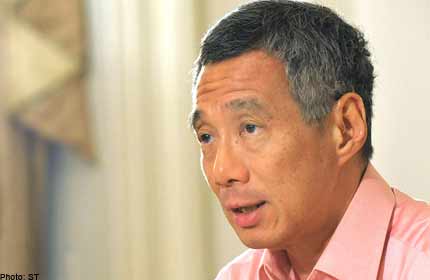
SINGAPORE: Prime
Minister Lee Hsien Loong spoke on some of the concerns of workers and
how the government intends to work with them to tackle these issues.
Addressing
more than 1,500 unionists, workers and employers at the May Day Rally,
Mr Lee said he had lunch with union leaders last week to find out what
concerned them.
One of the issues is the cost of living particularly healthcare costs.
Unions are also worried that CPF savings may not be enough especially with inflation.
Mr
Lee assured those who attended the rally that the government will
continue to monitor inflation very closely to see if more needs to be
done.
Another area of concern is of low wage workers whose wages are not keeping up with the rest.
Mr Lee said the feeling among unionists is that those earning low-wages are stuck no matter how hard they try to upgrade.
Another concern is the ageing workforce.
PM Lee said these are all real issues that the tripartite partners must address together.
He said on its part the government will implement several strategies.
The first is to keep Singapore open, embrace the world, welcome new ideas and explore new opportunities.
Mr Lee said that's how Singapore has become successful and has competed against bigger countries and held its own and more.
The government has also improved the lives of the people and secured a bright future here for their children.
Showing posts with label May Day Rally. Show all posts
Tuesday, May 1, 2012
'Wage shock therapy' will not work: PM Lee
In the latest reaction to a proposal voiced by former Chairman of
National Wages Council Professor Lim Chong Yah, the Prime Minister said
today that the idea will not work.
Refuting Prof Lim's idea on drastically pushing up the wages of low-wage workers by up to 50 per cent in the next three years, Mr Lee said that although he appreciates "his good intentions", he does not agree with this drastic approach.
"The only realistic way to move is a step-by-step with wages and productivity going up in tandem together as fast as we can but as fast as is possible.
"In the early 1980s, we did have one period when we zoomed up and
pushed wages up rapidly. But even then, we ran into problems. Wages shot
up but productivity didn't improve and we lost competitiveness.
"So in 1985, when the winds changed and when conditions turned difficult, we plunged into a very deep recession. It was scary," said Mr Lee, who was speaking to nearly 1,500 unionists, employers and government leaders gathered at the annual May Day Rally.
Mr Lee acknowledged that small-and-medium enterprises may end up passing the cost to consumers should they increase the wages of low-wage workers, which make up a bulk of their workforce.
He also said low-wage workers will be greatly affected if wages go up sharply and are not matched by improvements in productivity.
"(It is) better to aim for what is sustainable and don't take a big risk with short term jumps in wages. I promise you we will always do our best to uplift low wage workers and we have many programmes doing that."
The plight of low-wage workers have been on the minds of unionists who recently also voiced concerns over issues such as the cost of living and healthcare.
In order to upgrade low-wage workers, Mr Lee promised the labour movement that the government will help workers in this category by implementing the Inclusive Growth Programme.
This programme has now been increased to $100 million and aims to upgrade 100,000 low-wage workers in Singapore.
Speaking at the May Day Rally on Tuesday, Mr Lee said over a lifetime low-income households will get more than $500,000 in government subsidies.
On the topic of foreign workers, Mr Lee noted the different point of views of employers and workers.
Employers are not able to find enough Singaporean workers, especially those who will stay on the job, and therefore turn to foreigners, who add to competition, reduces wages and takes away jobs.
He said both arguments are valid but the inflow of foreigner workers has to slow down significantly in the coming years, as Singapore cannot keep bringing in 80,000 foreign workers a year.
There is no "magic number" when it comes to how many foreign workers are needed in Singapore and it depends on economic opportunities, explained Mr Lee.
"In a good year, you want to allow a few more to come in. In a slow year, we can tighten and let some of them go off but it also depends on our own needs."
Mr Lee emphasised that while Singapore must always be open to the world, Singaporeans will be the government's priority.
"This is the purpose of all our policies, including on foreign workers and talent. We are trying to seek the maximum advantage for Singapore and Singaporeans."
Refuting Prof Lim's idea on drastically pushing up the wages of low-wage workers by up to 50 per cent in the next three years, Mr Lee said that although he appreciates "his good intentions", he does not agree with this drastic approach.
"The only realistic way to move is a step-by-step with wages and productivity going up in tandem together as fast as we can but as fast as is possible.
"So in 1985, when the winds changed and when conditions turned difficult, we plunged into a very deep recession. It was scary," said Mr Lee, who was speaking to nearly 1,500 unionists, employers and government leaders gathered at the annual May Day Rally.
Mr Lee acknowledged that small-and-medium enterprises may end up passing the cost to consumers should they increase the wages of low-wage workers, which make up a bulk of their workforce.
He also said low-wage workers will be greatly affected if wages go up sharply and are not matched by improvements in productivity.
"(It is) better to aim for what is sustainable and don't take a big risk with short term jumps in wages. I promise you we will always do our best to uplift low wage workers and we have many programmes doing that."
The plight of low-wage workers have been on the minds of unionists who recently also voiced concerns over issues such as the cost of living and healthcare.
In order to upgrade low-wage workers, Mr Lee promised the labour movement that the government will help workers in this category by implementing the Inclusive Growth Programme.
This programme has now been increased to $100 million and aims to upgrade 100,000 low-wage workers in Singapore.
Speaking at the May Day Rally on Tuesday, Mr Lee said over a lifetime low-income households will get more than $500,000 in government subsidies.
On the topic of foreign workers, Mr Lee noted the different point of views of employers and workers.
Employers are not able to find enough Singaporean workers, especially those who will stay on the job, and therefore turn to foreigners, who add to competition, reduces wages and takes away jobs.
He said both arguments are valid but the inflow of foreigner workers has to slow down significantly in the coming years, as Singapore cannot keep bringing in 80,000 foreign workers a year.
There is no "magic number" when it comes to how many foreign workers are needed in Singapore and it depends on economic opportunities, explained Mr Lee.
"In a good year, you want to allow a few more to come in. In a slow year, we can tighten and let some of them go off but it also depends on our own needs."
Mr Lee emphasised that while Singapore must always be open to the world, Singaporeans will be the government's priority.
"This is the purpose of all our policies, including on foreign workers and talent. We are trying to seek the maximum advantage for Singapore and Singaporeans."
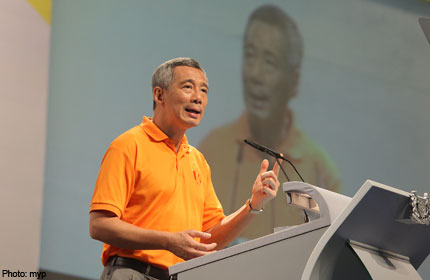
S'poreans will always be top priority: PM Lee
There is no "magic number" to suitably represent the number of
foreign workers needed in Singapore to help the economy prosper, said
Prime Minister Lee Hsien Loong in his May Day Rally speech yesterday.
Addressing about 1,600 unionists, workers and employers at Downtown East, he said this in response to a recent question from a unionist, adding that the number would depend on several factors.
Pursuing economic opportunities and the country's needs across different sectors - such as construction and health care - would bring about a need for more workers, he said.
"In a good year, we want to allow a few more to come in, (while) in a slow year, we can tighten and let some of them go off," he explained.
For instance, the construction of more Housing Board flats, the building of infrastructure such as MRT lines, and the manpower needs of hospitals and nursing homes will also raise foreign-labour demand.
Mr Lee said: "If you want to have more hospitals and nursing homes, then I think it's unavoidable as you will need some extra nurses, allied professionals and even extra doctors from wherever you can find and who can serve us well."
Even as he laid out the circumstances behind the need for foreign labour here, Mr Lee said it would be essential to significantly reduce the number of foreigners who come here in search of jobs.
"We can't just keep on bringing in 80,000 more foreign workers a year. There's just not (enough) space and it's not sustainable to keep on going up and up," he explained.
Against a backdrop of economic instability in developed countries such as the United States and Spain, Mr Lee identified three strategies that would stand Singapore in good stead to tackle any problems.
These are: to keep Singapore open; to grow the economy on a sustainable basis; and to translate growth into higher wages and better lives.
Singapore must remain open and "embrace the world" to attract a wide range of foreign professionals and skilled workers.
"The reality is we need a mix, companies need a mix and we must strike the right balance," he said.
Mr Lee reiterated that "Singaporeans will always be our priority", and that this is the purpose of all government policies.
"We are trying to seek the maximum advantage for Singapore and Singaporeans," he said.
Subscribe to:
Posts (Atom)