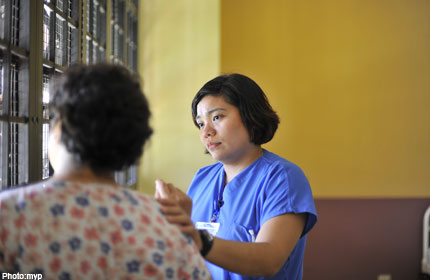
For families who face difficulties in coaxing seniors with mental
illnesses to seek help, a pilot programme launched yesterday could help
these seniors get the required support services in the comfort of their
homes.
Called the Temasek Cares- iCommunity@North programme, the
$1.1-million initiative offers mental-health services for residents in
Admiralty, Marsiling, Sembawang, Woodlands and Yishun.
The services include counselling and referring residents to health-care partners for follow-up.
Dedicated teams will be offering these services to residents.
Residents can come under the programme through referrals by
polyclinics, general practitioners, hospitals and community service
providers in the northern part of Singapore.
The programme - run by Khoo Teck Puat Hospital, O'Joy Care Services,
Thye Hua Kwan Moral Society and the Agency for Integrated Care - also
allows patients with mental illnesses to seek follow-up care in their
homes.
Weekly meetings will be held at Khoo Teck Puat Hospital to discuss
the treatment and course of action most appropriate for patients.
As it is still a pilot, the initiative will be fully subsidised by
Temasek Cares, an institution set up by Temasek Holdings that looks into
the needs of underprivileged people. When the subsidies will end has
not been decided yet.
There are plans to roll out the initiative to the entire country,
with the central region to adopt the programme within the next year.
Dr Amy Khor, Minister of State for Health, said yesterday that the
programme will improve the integration of the mentally ill into the
community.
"The health-care landscape in Singapore needs to transform to meet
the challenges of our ageing population," she said at the programme's
official launch at Khoo Teck Puat Hospital.
By 2030, one in five Singaporeans will be aged 65 or older.
The number of seniors with dementia - a mental disorder - is expected
to increase to 80,000, more than two times the current number of
28,000.
Dr Philip Yap, senior geriatrician consultant of Khoo Teck Puat
Hospital, said that delivering mental-health-care services to the
patient's home is more effective than having patients make trips to the
hospital.
He explained that going into the homes of patients "will help us
fully understand the situation and meet the patient's needs where they
really need them".
Showing posts with label Dr Amy Khor. Show all posts
Monday, July 23, 2012
Monday, April 2, 2012
NKF steps up public health education programme
SINGAPORE: The
National Kidney Foundation is stepping up its public health education
programme with the launch of the NKF Kidney Discovery Centre.
Visitors to the centre can learn more about the functions of the kidneys, kidney disease and the plight of kidney patients through interactive, hands-on exhibits.
The centre was officially opened by Minister of State for Health, Dr Amy Khor on Tuesday morning.
Occupying about 300 sqm at NKF's headquarters in Kim Keat, the S$1.1 million centre is the first-of-its-kind in Southeast Asia.
NKF said it strongly believes that early education on kidney diseases and their treatments should be instituted from a young age so that these conditions can be clarified early.
In the long-term, it is hoped that the general public as well as potential patients and their families would be better informed of kidney diseases and treatment options so that they can help to prevent kidney failure as well as support those who develop kidney failure.
Over 70 per cent of kidney failure cases in Singapore are due to diabetes, ageing, hypertension and chronic inflammation of the kidneys.
About 5,000 primary, upper secondary, tertiary students, teachers and organisations have visited the centre since it opened in January last year.
Sunday, February 26, 2012
Pay boost seen for health-care professionals
Good news for health- care workers - the Ministry of Health will be
looking into a salary review for doctors, nurses and allied health
professionals.
Speaking on the sidelines of a health-care career fair yesterday, Dr Amy Khor, Minister of State for Health, said the review is "to attract more people to the profession".
She added that more details will be revealed in the upcoming Committee of Supply debate. Dr Khor also revealed that the ministry is looking to hire 6,400 more nurses, and 1,800 more allied health professionals and support staff, by 2020.
Currently, there are about 32,000 nurses and 2,000 allied health professionals here.
The additional manpower is to help staff an increase in the number of hospital beds - 1,900 acute-hospital beds and 1,800 community-hospital beds, to be added by 2020.
Dr Khor said: "Because of the rapidly ageing population and the increase in chronic- disease burden, there will be increasing demand for health- care services."
The Healthcare - You Make A Difference Careers Fair, held at *Scape, saw 50 nurses and allied health professionals, including those from the National Healthcare Group (NHG), sharing information about their jobs.
At the fair, eight allied health professions were showcased, including medical social work, respiratory therapy and speech therapy.
Organisers said that the eight professions were chosen as there was greatest demand for manpower in these professions. They also wanted to raise awareness about some of the lesser- known careers.
"A health-care career is not just nursing. If you ask a lot of people, they may not know much about the allied health professions," said Ms Olivia Tay, NHG's chief human-resource officer.
She added that NHG intends to hire another 110 allied health professionals this year.
Ms Tan Herng Lee, president of the Association of Respiratory Therapists (Singapore), said: "Our profession is rather niche, not so mainstream, so not many are aware of it."
She estimates that respiratory therapists, who help patients with breathing problems, number only about 60 here.
Besides being relatively unknown, some professions also suffer from misconceptions.
Ms Kang Xinyi, 24, a medical social worker at the Institute of Mental Health, said: "People equate medical social workers with volunteers who are not paid. But, in fact, this is a recognised profession."
Among the more than 1,100 jobseekers who attended, there were those interested in a mid- career switch, such as Ms Leng Xiuying, 28.
Said Ms Leng, an education training consultant: "Health care is a real concern of the future and there looks to be many job opportunities. I'm looking for a viable career option for the long term."
Speaking on the sidelines of a health-care career fair yesterday, Dr Amy Khor, Minister of State for Health, said the review is "to attract more people to the profession".
She added that more details will be revealed in the upcoming Committee of Supply debate. Dr Khor also revealed that the ministry is looking to hire 6,400 more nurses, and 1,800 more allied health professionals and support staff, by 2020.
The additional manpower is to help staff an increase in the number of hospital beds - 1,900 acute-hospital beds and 1,800 community-hospital beds, to be added by 2020.
Dr Khor said: "Because of the rapidly ageing population and the increase in chronic- disease burden, there will be increasing demand for health- care services."
The Healthcare - You Make A Difference Careers Fair, held at *Scape, saw 50 nurses and allied health professionals, including those from the National Healthcare Group (NHG), sharing information about their jobs.
At the fair, eight allied health professions were showcased, including medical social work, respiratory therapy and speech therapy.
Organisers said that the eight professions were chosen as there was greatest demand for manpower in these professions. They also wanted to raise awareness about some of the lesser- known careers.
"A health-care career is not just nursing. If you ask a lot of people, they may not know much about the allied health professions," said Ms Olivia Tay, NHG's chief human-resource officer.
She added that NHG intends to hire another 110 allied health professionals this year.
Ms Tan Herng Lee, president of the Association of Respiratory Therapists (Singapore), said: "Our profession is rather niche, not so mainstream, so not many are aware of it."
She estimates that respiratory therapists, who help patients with breathing problems, number only about 60 here.
Besides being relatively unknown, some professions also suffer from misconceptions.
Ms Kang Xinyi, 24, a medical social worker at the Institute of Mental Health, said: "People equate medical social workers with volunteers who are not paid. But, in fact, this is a recognised profession."
Among the more than 1,100 jobseekers who attended, there were those interested in a mid- career switch, such as Ms Leng Xiuying, 28.
Said Ms Leng, an education training consultant: "Health care is a real concern of the future and there looks to be many job opportunities. I'm looking for a viable career option for the long term."
Wednesday, November 23, 2011
Govt looking at allowing Medisave for home care services
SINGAPORE : The
government is looking at allowing the use Medisave for home care
services and reviewing current subsidies to make home care options more
affordable.
This was announced by Minister of State for Health, Dr Amy Khor, at the opening of the TOUCH Home Care Centre in Jurong on Wednesday.
78-year-old Sapri Amat suffers from hypertension and cataract, and some months ago, a gout attack left him almost bed-bound.
His wife Madam Piah has cancer.
Their only caregiver - son Mohamad Sapri - left his job about two years ago to care for his elderly parents.
The new TOUCH Home Care Centre in Jurong now provides transport for Madam Piah for her hospital appointment visits.
A nurse and therapist also visit Mr Sapri to monitor his condition and provide home-rehabilitation.
After subsidies, the family pays about S$60 a month for the services - 10 per cent of the total cost.
Madam Piah said: "I feel better. There are now people to look after me. If not, there is only me taking care of my husband, along with my son."
TOUCH Home Care is only the second voluntary welfare organisation (VWO) to provide home care services in the West, an area it said has been under-served, till now. But in just two months, its staff of 10 are now catering to the needs of 30 clients, a number it hopes to expand to some 300 within the next two years.
Besides VWOs providing these services, needy Singaporeans can soon also tap on Medifund for home care services. Some 1,000 Singaporeans are expected to benefit.
But the government acknowledges that cost is still a big factor, and it may also allow the use of Medisave for such services.
Dr Khor said: "Home care will play a substantive role in future as one of the care options for the elderly. The issue of accessibility and affordability of elder care services is critical and we need to address that, so we are looking at ways to grow the home care sector.
"Some of the areas we are looking at include reviewing our subsidies as well as the use of Medisave."
The government is also looking at leave options to alleviate the stress faced by caregivers.
The Agency for Integrated Care and the Centre for Enabled Living will provide TOUCH with a funding of S$700,000 over two years.
Subscribe to:
Posts (Atom)


