SINGAPORE - Just 15 minutes after the 19 full-time national servicemen (NSFs) got off the bus, it exploded.
But the driver of the CNG-fuelled bus died from complications arising
from his burns four days later, a coroner's inquiry into his death in
the August 2010 incident heard on Wednesday.
Mr Chan Beng San, then 56, had picked up the group of NSFs from Jurong Camp 1 at 6.45am on Aug 13, 2010.
He had ferried them to the Poyang Range at Old Lim ChuKang Road and the group alighted at 7.05am.
The group had smelled something similar to petrol or fuel when they boarded the bus earlier.
They alerted Mr Chan but he dismissed it and even suggested that some
previous passengers could have brought durians onto the bus.
He then drove the bus away from the range. About 15 minutes later,
the group, which had left some items behind in the bus, called Mr Chan's
mobile phone for help.
It was answered by someone who told them that the bus had exploded.
Investigations also revealed that the explosion could have happened
while Mr Chan was still in his driver's seat and the bus was on the
move.
The explosion, which started at the front of the bus, was so great that all the seats in the bus were pushed backwards.
The windscreens were completely shattered and the roof above the door and the driver's seat were completely burned.
A witness who was driving along the same stretch of Old Lim Chu Kang
Road spotted Mr Chan sitting on the road, a short distance away from the
front of the burning bus.
The witness pulled him away from the bus to the side of the road and called the police.
When they arrived at the scene, officers found that Mr Chan could not speak and was disorientated.
He was rushed to the Singapore General Hospital by ambulance for treatment.
Complications
Mr Chan suffered burns on 39 per cent of his total body surface area.
He underwent burns excision and skin grafting the next day.
But he faced complications such as acute renal failure and acute respiratory distress, in his recovery post-operation.
He died of broncho pneumonia on Aug 17.
Investigators later found a gas leak at a joint between the nut and
the valve of some black tubing recovered from the rear left compartment
of the bus.
There was also a part missing and this meant gas could have leaked out from the joint between the nut and the connector.
The gas had seeped into the passenger cabin of the bus and accumulated at the front of the bus, investigations showed.
An inspection of the bus also found a dashboard- mounted cigarette lighter near the driver's seat.
The court heard that the dashboard-mounted cigarette lighter wasn't
part of the bus and that Mr Chan may have mounted it himself.
He was the only driver of the bus since its registration.
The eight CNG cylinders mounted on the roof of the bus were found intact.
The investigation report did not specify what sparked the ignition.
Design lapses
State Coroner Eddy Tham concluded that it was likely that CNG fuel
had leaked at the joint of the tubing and had accumulated inside the
bus.
An ignition of the leaked CNG fuel into the interior of the bus had
resulted in the explosion at the front of the bus, followed by fire that
went through the bus, he said.
He also said that the missing part on the tubing could have resulted in the gas leak.
The bus, owned by Sun-Gee Travel (SGT), was still under its one-year warranty.
Though its remaining 22 buses did not have missing parts,
investigations by the Land Transport Authority (LTA) revealed that there
were other several non-compliances to LTA's pre-registration approval
standard in the design of the CNG buses.
The buses were impounded on Aug 24.
The bus manufacturer, Xiamen King Long, acknowledged that there were indeed lapses in their CNG bus design.
The 22 impounded buses were returned to SGT to be converted into
diesel-powered ones in January last year. The licences for the buses
were reinstated on July 25 last year.
Mr Chan's family members were not present in court during the inquiry.
They also declined to comment when The New Paper visited them at their home yesterday evening.
Showing posts with label death. Show all posts
Saturday, November 24, 2012
Thursday, August 16, 2012
Hoarding problem difficult to eradicate
The death of a 76-year-old man, whose body was found among heaps of junk
accumulated in his four-room-flat, has again sparked concern over the
issue of hoarding.
Hoarding is a common problem in rental homes which often goes unnoticed, welfare organisations told The Straits Times (ST) in an article published on August 17.
According to one such organisation, there is a hoarder found in two out of every 10 households visited by welfare workers.
The problem is not restricted to rental flats.
Mr Quek, whose body was found in the rubbish-filled flat on Wednesday, had been previously advised by HDB to remove unwanted items from the Bedok Reservoir flat.
According to reports, his wife had told the Housing Board that he was hoarding rubbish in his flat.
The items were piled from floor to ceiling when he was found dead in his home.
HDB told ST that its officers conduct investigations when it receives feedback that residents are hoarding and causing fire hazards.
The authority will also help to dispose of them if needed.
It is also common for residents' committees and grassroots leaders to help persuade hoarders to throw away unwanted items.
However, town councils do not have the power to regulate the items residents keep within their flats.
The problem remains difficult to eradicate even if it is not widespread.
People who know the hoarder could suffer, and as a consequence, relationships could deteriorate and worsen the problem.
The problem also often goes unnoticed because there is usually no trouble posed to neighbours. Hoarders also tend to be reclusive and do not interact with their neighbours.
In its report, MP Lily Neo, whose Tanjong Pagar ward has more than 5,000 rental flats, said the hoarding problem has improved gradually over the years.
"Those who are clear-minded do listen to me when I tell them about bed bugs, and that they may develop a cough living in that kind of air, but some are stubborn," she said.
Difficulty of eradicating the problem is also exacerbated because it could be caused by mental illnesses like obsessive compulsive disorder, schizophrenia and dementia.
Dr Lee Cheng, chief of the Department of Community Psychiatry at the Institute of Mental Health, told ST that hoarders are often isolated and have come from the low-income segment of society.
But not all hoarders have mental illnesses, health professionals said. Some keep items for sentimental reasons, or because they believe that the items have value high enough to be kept and sold at a later date.
Hoarding is a common problem in rental homes which often goes unnoticed, welfare organisations told The Straits Times (ST) in an article published on August 17.
According to one such organisation, there is a hoarder found in two out of every 10 households visited by welfare workers.
The problem is not restricted to rental flats.
Mr Quek, whose body was found in the rubbish-filled flat on Wednesday, had been previously advised by HDB to remove unwanted items from the Bedok Reservoir flat.
According to reports, his wife had told the Housing Board that he was hoarding rubbish in his flat.
The items were piled from floor to ceiling when he was found dead in his home.
HDB told ST that its officers conduct investigations when it receives feedback that residents are hoarding and causing fire hazards.
The authority will also help to dispose of them if needed.
It is also common for residents' committees and grassroots leaders to help persuade hoarders to throw away unwanted items.
However, town councils do not have the power to regulate the items residents keep within their flats.
The problem remains difficult to eradicate even if it is not widespread.
People who know the hoarder could suffer, and as a consequence, relationships could deteriorate and worsen the problem.
The problem also often goes unnoticed because there is usually no trouble posed to neighbours. Hoarders also tend to be reclusive and do not interact with their neighbours.
In its report, MP Lily Neo, whose Tanjong Pagar ward has more than 5,000 rental flats, said the hoarding problem has improved gradually over the years.
"Those who are clear-minded do listen to me when I tell them about bed bugs, and that they may develop a cough living in that kind of air, but some are stubborn," she said.
Difficulty of eradicating the problem is also exacerbated because it could be caused by mental illnesses like obsessive compulsive disorder, schizophrenia and dementia.
Dr Lee Cheng, chief of the Department of Community Psychiatry at the Institute of Mental Health, told ST that hoarders are often isolated and have come from the low-income segment of society.
But not all hoarders have mental illnesses, health professionals said. Some keep items for sentimental reasons, or because they believe that the items have value high enough to be kept and sold at a later date.
Wednesday, June 13, 2012
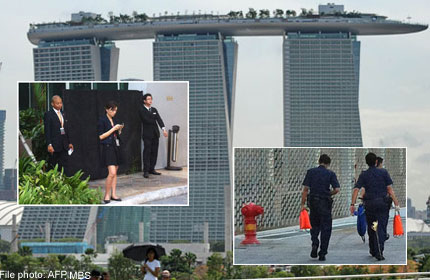
Dutch tourist falls to death from MBS SkyPark
A 46-year-old Dutch tourist fell to his death from Marina Bay Sands Skypark on Tuesday afternoon.
This is the first time such an incident has happened since the SkyPark's June 2010 opening.
Chinese daily Shin Min Daily News said the man was found on a grass patch in front of the integrated resort and that he was already dead when police officers and Singapore Civil Defence Force responders arrived.
MBS deployed more than 10 staff to seal up the area and prevent passers-by from gathering.
A black screen was erected in front of the scene. Security officials were also posted to prevent unauthorised access.
The officials said renovation works were going on when questioned by the Chinese daily's reporter.
It is understood that the deceased is not a hotel guest, but one from another nearby hotel.
Two Dutch embassy officials who were at the mortuary declined to comment.
The police have classified this incident as a case of "unnatural death" and are investigating.
The Marina Bay Sands SkyPark is 57 storeys high and sits at more than 200m above ground level.
This is the first time such an incident has happened since the SkyPark's June 2010 opening.
Chinese daily Shin Min Daily News said the man was found on a grass patch in front of the integrated resort and that he was already dead when police officers and Singapore Civil Defence Force responders arrived.
MBS deployed more than 10 staff to seal up the area and prevent passers-by from gathering.
A black screen was erected in front of the scene. Security officials were also posted to prevent unauthorised access.
The officials said renovation works were going on when questioned by the Chinese daily's reporter.
It is understood that the deceased is not a hotel guest, but one from another nearby hotel.
Two Dutch embassy officials who were at the mortuary declined to comment.
The police have classified this incident as a case of "unnatural death" and are investigating.
The Marina Bay Sands SkyPark is 57 storeys high and sits at more than 200m above ground level.
Sunday, April 8, 2012
S'pore-based study identifies critical genes mutated in stomach cancer
SINGAPORE: An
international team of scientists, led by researchers from Duke-NUS
Graduate Medical School (Duke-NUS) in Singapore and the National Cancer Center Singapore (NCCS), has identified more than 600 genes that are
mutated in stomach cancer, the second-most lethal cancer worldwide.
The study, which appears online on April 8, 2012 in Nature Genetics, paves the way for treatments tailored to the genetic make-up of individual stomach tumours.
Stomach cancer is the second leading cause of cancer death globally with more than 700,000 deaths each year, and is particularly common in East Asia.
Using state-of-the-art DNA sequencing technology, the research team analyzed tumour and normal tissue from stomach cancer patients, which led to the discovery of the novel gene mutations.
The study showed two of the 600 stomach cancer-associated genes identified, FAT4 and ARID1A, proved to be particularly interesting.
With more than 100,000 new cases of stomach cancer each year likely to be caused by mutations in FAT4 or ARID1A, drugs against these targets may lead to more effective treatment of stomach tumours and other cancers.
In addition to Duke-NUS and the National Cancer Center Singapore, the study also involved collaborators from the Cancer Science Institute of Singapore; Genome Institute of Singapore; National University of Singapore; Singapore General Hospital; Van Andel Research Institute, Michigan, USA; Northwestern University, Chicago, USA; Yonsei Cancer Center, Seoul, South Korea; Queen's University, Belfast, UK; and Welcome Trust Sanger Institute, Hinxton, UK.
Support for this study was provided by the National Medical Research Council (Ministry of Health, Singapore), as part of the Singapore Gastric Cancer Consortium.
Funding was also received from the Cancer Science Institute of Singapore, Duke-NUS Graduate Medical School, Genome Institute of Singapore (Agency for Science, Technology and Research), and the Lee Foundation.
The study, which appears online on April 8, 2012 in Nature Genetics, paves the way for treatments tailored to the genetic make-up of individual stomach tumours.
Stomach cancer is the second leading cause of cancer death globally with more than 700,000 deaths each year, and is particularly common in East Asia.
Using state-of-the-art DNA sequencing technology, the research team analyzed tumour and normal tissue from stomach cancer patients, which led to the discovery of the novel gene mutations.
The study showed two of the 600 stomach cancer-associated genes identified, FAT4 and ARID1A, proved to be particularly interesting.
With more than 100,000 new cases of stomach cancer each year likely to be caused by mutations in FAT4 or ARID1A, drugs against these targets may lead to more effective treatment of stomach tumours and other cancers.
In addition to Duke-NUS and the National Cancer Center Singapore, the study also involved collaborators from the Cancer Science Institute of Singapore; Genome Institute of Singapore; National University of Singapore; Singapore General Hospital; Van Andel Research Institute, Michigan, USA; Northwestern University, Chicago, USA; Yonsei Cancer Center, Seoul, South Korea; Queen's University, Belfast, UK; and Welcome Trust Sanger Institute, Hinxton, UK.
Support for this study was provided by the National Medical Research Council (Ministry of Health, Singapore), as part of the Singapore Gastric Cancer Consortium.
Funding was also received from the Cancer Science Institute of Singapore, Duke-NUS Graduate Medical School, Genome Institute of Singapore (Agency for Science, Technology and Research), and the Lee Foundation.
Tuesday, October 11, 2011
Cancer patient prized sex more than life
He prized his love life more than his life. To his detriment.
He had prostate cancer and could have been cured if he had had the cancer surgically removed at an early stage.
But because that carries a risk of his losing his ability to have sexual intercourse, he decided to gamble with his life.
He had been married only recently.
Impotence would have meant an end to sex with his 28-year-old wife and the possibility of children.
So he ignored his doctor's advice.
He died six months later at 30.
Prostate cancer is the third most common cancer among men in Singapore. It develops in the prostate, a gland in the male reproductive system.
On average, there are 534 new cases a year and 105 deaths from prostate cancer.
Speaking to The New Paper on Sunday, leading urologist Peter Lim recalled his youngest patient: "His prostate cancer was detected by biopsy and it was still at an early stage.
"I told him to remove it urgently or he will die. He asked me, 'Any danger?' I said, 'Yes, you have a high chance of impotency.' And he ran away.
"At that time, we did not have the robots and it was an open operation. The chance of his being impotent was high, at 80 per cent," Professor Lim explained.
"Sex is very important to most men. Even though they can still have a penile implant to get back their erections, many do not want to take the risk.
"They would run away and it is usually their wives who would encourage them and get them to return to the hospital for treatments."
Last month, The Journal Of The American Medical Association published a study that found that a high percentage of men could not have a normal sex life after being treated for prostate cancer.
Fewer than half of the 1,027 patients involved in the study and who had reported good sexual function before cancer had managed to regain it two years after treatment.
Those involved in the study were aged between 38 and 84. Overall, just 35 per cent of men in the surgery group, 37 per cent who were in the radiation group and 43 per cent of those in the brachytherapy group could have sexual intercourse two years after treatment.
Alternative treatments like radiotherapy may not necessarily lower the risk of impotency. It's just that the effect could be delayed, said Dr Lewis Liew, a urologist and laparoscopic surgeon.
Prostate cancer tends to develop in men older than 50. But Prof Lim has treated patients as young as 41. In the last 10 years, he had two patients, both aged 30, hit by prostate cancer.
He said: "The younger you are, the more aggressive the tumour will be. You must remove the tumour urgently or you will die.
"The minute you know that you have cancer, you cannot be so stupid to go shopping around for another doctor. They are going to say the same thing to you."
He added: "Some patients hope to find one doctor who would say to them, 'Oh, don't worry! I can give you this medicine and you will be okay.'
"Men should know that if you are not that young and you get prostate cancer, it is not a bad cancer to have, provided you quickly treat it."
He recalled another patient, a 52-year-old Caucasian, who refused to have the tumour surgically removed because he was newly married.
Prof Lim said: "He told me, 'Why should I go for the operation and be impotent?' I told him, 'It's about your life, you know'."
Within 18 months, the cancer spread to his liver and, even though he started chemotheraphy, he died three months later.
"We have a few robots here that can perform the surgery accurately. With robotic surgery, the risk of impotency is low, at 25 per cent.
"In fact, I just operated on a patient from Mauritius. He was in hospital for three to four days and after he returned to Mauritius, he called to tell me that he had an erection!"
What women say...
"Most men define their masculinity through sex and to some, especially those still in their prime, sex is a big part of their lives. Losing the ability to perform is like losing sight of who they are, thus the feeling that life is not worth living." - Miss Cheryl Lim, 27, business owner
"While sex may be crucial in a marriage, it is not the only thing. When you lose your life, you lose everything, not just sex." - Ms Shino Yee, 37, a beautician
"Men need to know that women want more than just sex. If they can't even take care of themselves, how are they capable of taking care of their loved ones?" - Miss Fei Wong, 32, regional assistant director of sales
"While I can understand how men value their 'manhood', it is stupid to put health and life at such a risk." - Miss Deborah Dayani Nanayakara, 26, public relations manager
He had prostate cancer and could have been cured if he had had the cancer surgically removed at an early stage.
But because that carries a risk of his losing his ability to have sexual intercourse, he decided to gamble with his life.
He had been married only recently.
Impotence would have meant an end to sex with his 28-year-old wife and the possibility of children.
So he ignored his doctor's advice.
He died six months later at 30.
Prostate cancer is the third most common cancer among men in Singapore. It develops in the prostate, a gland in the male reproductive system.
On average, there are 534 new cases a year and 105 deaths from prostate cancer.
Speaking to The New Paper on Sunday, leading urologist Peter Lim recalled his youngest patient: "His prostate cancer was detected by biopsy and it was still at an early stage.
"I told him to remove it urgently or he will die. He asked me, 'Any danger?' I said, 'Yes, you have a high chance of impotency.' And he ran away.
"At that time, we did not have the robots and it was an open operation. The chance of his being impotent was high, at 80 per cent," Professor Lim explained.
Death preferable to impotency?
He said 10 to 15 per cent of his patients "disappeared" at the very mention of "impotence"."Sex is very important to most men. Even though they can still have a penile implant to get back their erections, many do not want to take the risk.
"They would run away and it is usually their wives who would encourage them and get them to return to the hospital for treatments."
Last month, The Journal Of The American Medical Association published a study that found that a high percentage of men could not have a normal sex life after being treated for prostate cancer.
Fewer than half of the 1,027 patients involved in the study and who had reported good sexual function before cancer had managed to regain it two years after treatment.
Those involved in the study were aged between 38 and 84. Overall, just 35 per cent of men in the surgery group, 37 per cent who were in the radiation group and 43 per cent of those in the brachytherapy group could have sexual intercourse two years after treatment.
Sex life still possible after surgery
Still, it is possible for men who have had surgery to experience an improved sex life two years later.Alternative treatments like radiotherapy may not necessarily lower the risk of impotency. It's just that the effect could be delayed, said Dr Lewis Liew, a urologist and laparoscopic surgeon.
Prostate cancer tends to develop in men older than 50. But Prof Lim has treated patients as young as 41. In the last 10 years, he had two patients, both aged 30, hit by prostate cancer.
He said: "The younger you are, the more aggressive the tumour will be. You must remove the tumour urgently or you will die.
"The minute you know that you have cancer, you cannot be so stupid to go shopping around for another doctor. They are going to say the same thing to you."
He added: "Some patients hope to find one doctor who would say to them, 'Oh, don't worry! I can give you this medicine and you will be okay.'
"Men should know that if you are not that young and you get prostate cancer, it is not a bad cancer to have, provided you quickly treat it."
He recalled another patient, a 52-year-old Caucasian, who refused to have the tumour surgically removed because he was newly married.
Prof Lim said: "He told me, 'Why should I go for the operation and be impotent?' I told him, 'It's about your life, you know'."
Within 18 months, the cancer spread to his liver and, even though he started chemotheraphy, he died three months later.
Best chance for recovery
Prof Lim, who sees five times more foreigners than Singaporeans seeking treatment for prostate cancer, added: "We have the best treatment in Asia."We have a few robots here that can perform the surgery accurately. With robotic surgery, the risk of impotency is low, at 25 per cent.
"In fact, I just operated on a patient from Mauritius. He was in hospital for three to four days and after he returned to Mauritius, he called to tell me that he had an erection!"
What women say...
"Most men define their masculinity through sex and to some, especially those still in their prime, sex is a big part of their lives. Losing the ability to perform is like losing sight of who they are, thus the feeling that life is not worth living." - Miss Cheryl Lim, 27, business owner
"While sex may be crucial in a marriage, it is not the only thing. When you lose your life, you lose everything, not just sex." - Ms Shino Yee, 37, a beautician
"Men need to know that women want more than just sex. If they can't even take care of themselves, how are they capable of taking care of their loved ones?" - Miss Fei Wong, 32, regional assistant director of sales
"While I can understand how men value their 'manhood', it is stupid to put health and life at such a risk." - Miss Deborah Dayani Nanayakara, 26, public relations manager
Subscribe to:
Posts (Atom)