SINGAPORE - Mr Robert Tan found the right fit when he took on a job as a financial adviser late last year.
It suited his personality as he spends long hours each day meeting and chatting with clients.
"It appeals to me because it is who I am. I am very comfortable when I
speak with people and it doesn't really count as work," the 25-year-old
told My Paper.
And, as long as he meets his sales targets - he makes about $2,500 a
month selling unit trusts and insurance - he feels secure in his role.
Employees in the sector of finance, insurance and real estate can look forward to brighter times.
The sector is the most optimistic when it comes to employment
prospects in the first three months of next year, according to results
of a survey conducted by workforce-solutions firm Manpower Singapore.
Results of the Manpower Employment Outlook Survey released yesterday
show that while employers may be cautious in their expansion plans,
there are signs of stability in the labour market.
A sample of 654 employers here was interviewed for the survey.
The country's overall employment outlook for the first three months
of next year is good, with a "respectable" increase of 11 per cent and
employers in all seven industry sectors expected to raise staffing
levels.
Even the services sector, the weakest, is expected to increase staffing by 3 per cent.
A separate report released yesterday by global management consultancy
Hay Group said that, despite the continuing uncertainty in the global
economy, "hiring seems to have picked up in Singapore".
According to the report, 58 per cent of more than 505 Singapore-based
companies from both the private and public sectors are planning to
increase staffing levels. This is compared to 50 per cent this time last
year.
The companies were polled on their business sentiments, and salary and bonus projections for the next 12 months.
The report showed that the top five areas of recruitment are in
engineering, sales, finance and accounting, IT and telecommunications,
and marketing.
It also said that Generation Y talent, typically those born between
1981 and 2000, are most attracted and motivated by measures such as
financial assistance in education and training, job rotations and
overseas-attachment opportunities.
Showing posts with label insurance. Show all posts
Monday, December 10, 2012
Saturday, November 24, 2012
Early retirement: Calling it quits early
Retirement is not only a privilege for the elderly anymore.
Retirees are no longer only old people in their sixties with grey hair and frail bodies. Members of a younger generation have become part of this group with their own reasons and purposes that have deconstructed the meaning of retirement itself.
The thought of being able to say goodbye to the daily grind may have made retirement appealing for the young generation. But retirement is more than just about freedom for corporate slaves.
It is also about the chance for young people to pursue a passion that may have been forgotten due to workloads.
Therefore, it is no surprise to find that a number of young individuals are planning to retire early, leaving their established careers along with their comfortable lives so that they can concentrate in their pursuit of passion.
Maudini Virtriana is one of those people. At 30, she has become a senior brand manager for a big multinational company in Jakarta. Having a prestigious position at such a young age, the woman definitely has a bright career ahead of her. Yet Virtri, as her friends call her, plans to leave her job at 35 to follow her passion.
"My passion is not in corporate work. I work only for money so that I can make something out of it," she said.
Virtri hopes that her savings could eventually help her realise her dreams to run a coffee shop and open a school in Yogyakarta.
Passion was the same reason that drove Muadzin Furqanul Jihad to leave his career at a French company a year ago. At 41, the former senior engineer resigned from the company so that he could follow his passion in entrepreneurship.
"I always wanted to retire early ever since I started working. My aspiration is to have my own business," Muadzin explains.
Beyond passion, psychologist Adriana S. Ginanjar sees that there is some kind of "revenge" in these young retirees when they made their decisions, as if they wanted to redeem those long working hours with much more productive activities for their own life satisfaction.
Whatever their motives, according to Adriana, the most important thing for early retirement is to make it as sustainable and enjoyable as possible.
To do that, good preparation and strong plans are needed, because being a retiree also means less income.
Having a pension fund is another way to ensure the lifestyle of young retirees. People nowadays are given a wide array of options to save money for pensions. These early retirees can choose from conventional bank savings to sophisticated investment tools, like mutual funds, among other things.
An NGO worker, Risnauli Simalango, 32, and her husband are aware of the importance of pension savings to support their decision for early retirement.
Therefore, instead of targeting a certain age, the couple aims for Rp 5 billion (US$522,055) in savings before they can retire.
"I imagine that we can still live with that money, even though we won't have a monthly salary anymore," she said.
It is quite a huge amount of money but the couple is optimistic that they can do it in the next 10 years.
Not only that, the mother of one said they had also prepared insurance to ensure the education of their only son in the future.
In relation to preparing money for retirement, financial planner Eko Endarto has shared his formula on how big this fund should be. He said that before deciding to retire, a person must have a reserve capital three times bigger than their monthly spending so they can still enjoy their life.
"But for retirees who want to set up a business, the amount should be six times bigger than their monthly expenses, excluding business capital," he said.
Even though there are no statistics mentioning the exact number of young retirees in Indonesia, Eko believes that most of young people in Indonesia retire because they want to run their own business.
The financial expert referred to a recent survey carried out by himself, mentioning that eight out of 10 people are ready to leave their current jobs and become entrepreneurs.
Adriana adds that this mushrooming entrepreneurial spirit is encouraged by the conducive business environment in Indonesia.
"The current business world is so vast. It is possible to do any kind business now. If you don't have enough start-up capital, you can just use the Internet," she said.
The existence of these so-called young entrepreneurial retirees have no doubt changed the public's perception about retiring. People used to think that retirees only meant those who were no longer working and now spent their days doing nothing.
But, in the hands of these young retirees, retirement days may be as busy as daily office work, only this time they will work to build their own dreams.
That's why even though it may sound cool, early retirement may not be as easy as people think and can be more stressful than office work due to the pressures on individuals for success.
Muadzin said that he experienced that when he tried to start a business after retiring. It was not a smooth start, as he had to close down his business and suffered hundred millions of rupiah in losses.
The same thing happened to Iwan Agustian, 42, Muadzin's business partner. The guy's story was even more extreme than Muadzin, as he decided to retire at 33 after resigning from an underwear company.
"I tried to sell everything from clothes to meatballs, and they all went bankrupt," he said.
Things changes after he met Muadzin and they established a coffee franchise that took them to success. Starting in 2009, the franchise now has more than 420 outlets in 80 cities in Indonesia.
Through all the ups and downs in business world, one thing remains for Iwan, and that is his family.
He said that his wife had disapproved of his decision to retire at first but she finally backed him up in the end.
Adriana said that the support of family and friends is important for retirees so their positive spirit can be bolstered throughout retirement.
Apart from the support of family and friends, passion seems to be another success key to early retirement.
Eko suggested that young retirees to do things passionately - either a business or a hobby - as they will have higher success rate.
"At least, it will make you enjoy everything you do," Muadzin said of his experience.
Planning for early retirement? Finding your passion seems to be a good start.
Retirees are no longer only old people in their sixties with grey hair and frail bodies. Members of a younger generation have become part of this group with their own reasons and purposes that have deconstructed the meaning of retirement itself.
The thought of being able to say goodbye to the daily grind may have made retirement appealing for the young generation. But retirement is more than just about freedom for corporate slaves.
It is also about the chance for young people to pursue a passion that may have been forgotten due to workloads.
Therefore, it is no surprise to find that a number of young individuals are planning to retire early, leaving their established careers along with their comfortable lives so that they can concentrate in their pursuit of passion.
Maudini Virtriana is one of those people. At 30, she has become a senior brand manager for a big multinational company in Jakarta. Having a prestigious position at such a young age, the woman definitely has a bright career ahead of her. Yet Virtri, as her friends call her, plans to leave her job at 35 to follow her passion.
"My passion is not in corporate work. I work only for money so that I can make something out of it," she said.
Virtri hopes that her savings could eventually help her realise her dreams to run a coffee shop and open a school in Yogyakarta.
Passion was the same reason that drove Muadzin Furqanul Jihad to leave his career at a French company a year ago. At 41, the former senior engineer resigned from the company so that he could follow his passion in entrepreneurship.
"I always wanted to retire early ever since I started working. My aspiration is to have my own business," Muadzin explains.
Beyond passion, psychologist Adriana S. Ginanjar sees that there is some kind of "revenge" in these young retirees when they made their decisions, as if they wanted to redeem those long working hours with much more productive activities for their own life satisfaction.
Whatever their motives, according to Adriana, the most important thing for early retirement is to make it as sustainable and enjoyable as possible.
To do that, good preparation and strong plans are needed, because being a retiree also means less income.
Having a pension fund is another way to ensure the lifestyle of young retirees. People nowadays are given a wide array of options to save money for pensions. These early retirees can choose from conventional bank savings to sophisticated investment tools, like mutual funds, among other things.
An NGO worker, Risnauli Simalango, 32, and her husband are aware of the importance of pension savings to support their decision for early retirement.
Therefore, instead of targeting a certain age, the couple aims for Rp 5 billion (US$522,055) in savings before they can retire.
"I imagine that we can still live with that money, even though we won't have a monthly salary anymore," she said.
It is quite a huge amount of money but the couple is optimistic that they can do it in the next 10 years.
Not only that, the mother of one said they had also prepared insurance to ensure the education of their only son in the future.
In relation to preparing money for retirement, financial planner Eko Endarto has shared his formula on how big this fund should be. He said that before deciding to retire, a person must have a reserve capital three times bigger than their monthly spending so they can still enjoy their life.
"But for retirees who want to set up a business, the amount should be six times bigger than their monthly expenses, excluding business capital," he said.
Even though there are no statistics mentioning the exact number of young retirees in Indonesia, Eko believes that most of young people in Indonesia retire because they want to run their own business.
The financial expert referred to a recent survey carried out by himself, mentioning that eight out of 10 people are ready to leave their current jobs and become entrepreneurs.
Adriana adds that this mushrooming entrepreneurial spirit is encouraged by the conducive business environment in Indonesia.
"The current business world is so vast. It is possible to do any kind business now. If you don't have enough start-up capital, you can just use the Internet," she said.
The existence of these so-called young entrepreneurial retirees have no doubt changed the public's perception about retiring. People used to think that retirees only meant those who were no longer working and now spent their days doing nothing.
But, in the hands of these young retirees, retirement days may be as busy as daily office work, only this time they will work to build their own dreams.
That's why even though it may sound cool, early retirement may not be as easy as people think and can be more stressful than office work due to the pressures on individuals for success.
Muadzin said that he experienced that when he tried to start a business after retiring. It was not a smooth start, as he had to close down his business and suffered hundred millions of rupiah in losses.
The same thing happened to Iwan Agustian, 42, Muadzin's business partner. The guy's story was even more extreme than Muadzin, as he decided to retire at 33 after resigning from an underwear company.
"I tried to sell everything from clothes to meatballs, and they all went bankrupt," he said.
Things changes after he met Muadzin and they established a coffee franchise that took them to success. Starting in 2009, the franchise now has more than 420 outlets in 80 cities in Indonesia.
Through all the ups and downs in business world, one thing remains for Iwan, and that is his family.
He said that his wife had disapproved of his decision to retire at first but she finally backed him up in the end.
Adriana said that the support of family and friends is important for retirees so their positive spirit can be bolstered throughout retirement.
Apart from the support of family and friends, passion seems to be another success key to early retirement.
Eko suggested that young retirees to do things passionately - either a business or a hobby - as they will have higher success rate.
"At least, it will make you enjoy everything you do," Muadzin said of his experience.
Planning for early retirement? Finding your passion seems to be a good start.
Tuesday, September 11, 2012
MOE abolishes secondary school banding system and cuts awards
SINGAPORE: The
Education Ministry has abolished the secondary school banding system, as
part of efforts to ensure that "every school is a good school".
The banding system, which was introduced in 2004, categorises secondary schools into nine bands.
Band one consists of top schools, with a cut-off point of below 11 for the average aggregate grades in the GCE O' Level examination.
The Ministry of Education will also reduce the number of awards it gives out to schools.
It will also remove the Masterplan of Awards from 2014.
Instead, it will focus on recognising best practices in niche areas, such as teaching and learning, as well as students' all-round development.
Education Minister Heng Swee Keat announced the changes at the ministry's annual Work Plan Seminar on Wednesday.
The banding system, which was introduced in 2004, categorises secondary schools into nine bands.
Band one consists of top schools, with a cut-off point of below 11 for the average aggregate grades in the GCE O' Level examination.
The Ministry of Education will also reduce the number of awards it gives out to schools.
It will also remove the Masterplan of Awards from 2014.
Instead, it will focus on recognising best practices in niche areas, such as teaching and learning, as well as students' all-round development.
Education Minister Heng Swee Keat announced the changes at the ministry's annual Work Plan Seminar on Wednesday.
Thursday, August 30, 2012
New committee set up to enhance pre-school education
SINGAPORE:
Singapore's Education and Community Development ministries have set up a
committee to oversee enhancements to pre-school education.
The enhancements will include updating the Kindergarten Curriculum Framework.
The Implementation Committee for Enhancing Pre-School Education (ICEPE) will be co-chaired by Education Minister Heng Swee Keat and Acting Minister for Community Development, Youth and Sports, Chan Chun Sing.
Members of the committee include Madam Halimah Yacob, Minister of State for MCYS, Ms Indranee Rajah, Senior Minister of State (designate) for Law and Education, and senior officials from MOE and MCYS.
MOE and MCYS said this in a joint statement, days after Prime Minister Lee Hsien Loong announced that the government would play a more active role in early childhood education.
The Kindergarten Curriculum Framework first came about in 2003, and acts as a guide for kindergarten teachers to follow.
In revising it, the Education Ministry said the framework will incorporate latest research on early childhood education.
It will include learning goals at the end of Kindergarten 2 in a bid to facilitate better transition from pre-school to primary one.
It will be completed by end of 2012.
The framework will also include a teachers' guide and learning resources.
These will be available by the first half of next year.
Some kindergarten teachers Channel NewsAsia spoke with welcomed the changes.
Janice Foo, a kindergarten teacher, said: "Right now the framework is quite vague, because it just points out different factors, like aesthetic approach... or physical development. But it doesn't really go into what kind.
"Having a learning goal allows the teacher to make sure that whatever is necessary for the kid to know, he or she at least knows it."
The Committee will also look at developing a detailed role for the statutory board to improve policy coordination and regulation.
The Committee will bring in new anchor operators in a bid to improve quality and affordability of pre-school education.
Currently, there are two anchor operators - the PAP Community Foundation (PCF) and NTUC My First Skool.
It will also facilitate the government's setting up of pilot pre-school centres over the next few years.
The pilot pre-school centres are part of the government's move to play a more active role in raising the quality of pre-school education.
MOE said these centres will enable the ministry to incorporate findings on effective teaching and learning in pre-schools, and develop best practices.
These ideas will then be shared with other operators.
The shake-up of the pre-school sector also comes at a time when the government is cautioning against "over-teaching" pre-schoolers.
Adjunct Professor at SIM University, Professor S Gopinathan said parents also have an important role to play in ensuring the intrinsic love for learning and discovery remains a focus at this age.
"They have to make choices, they have to look at how children are coping. If children appear to be stressed, appear to be disinclined to learn, then that's a signal that they should heed. So it's something parents have to think seriously about," he said.
Prof Gopinathan said pre-school education must remain a time for children to learn through play, and pick up social skills.
The enhancements will include updating the Kindergarten Curriculum Framework.
The Implementation Committee for Enhancing Pre-School Education (ICEPE) will be co-chaired by Education Minister Heng Swee Keat and Acting Minister for Community Development, Youth and Sports, Chan Chun Sing.
Members of the committee include Madam Halimah Yacob, Minister of State for MCYS, Ms Indranee Rajah, Senior Minister of State (designate) for Law and Education, and senior officials from MOE and MCYS.
MOE and MCYS said this in a joint statement, days after Prime Minister Lee Hsien Loong announced that the government would play a more active role in early childhood education.
The Kindergarten Curriculum Framework first came about in 2003, and acts as a guide for kindergarten teachers to follow.
In revising it, the Education Ministry said the framework will incorporate latest research on early childhood education.
It will include learning goals at the end of Kindergarten 2 in a bid to facilitate better transition from pre-school to primary one.
It will be completed by end of 2012.
The framework will also include a teachers' guide and learning resources.
These will be available by the first half of next year.
Some kindergarten teachers Channel NewsAsia spoke with welcomed the changes.
Janice Foo, a kindergarten teacher, said: "Right now the framework is quite vague, because it just points out different factors, like aesthetic approach... or physical development. But it doesn't really go into what kind.
"Having a learning goal allows the teacher to make sure that whatever is necessary for the kid to know, he or she at least knows it."
The Committee will also look at developing a detailed role for the statutory board to improve policy coordination and regulation.
The Committee will bring in new anchor operators in a bid to improve quality and affordability of pre-school education.
Currently, there are two anchor operators - the PAP Community Foundation (PCF) and NTUC My First Skool.
It will also facilitate the government's setting up of pilot pre-school centres over the next few years.
The pilot pre-school centres are part of the government's move to play a more active role in raising the quality of pre-school education.
MOE said these centres will enable the ministry to incorporate findings on effective teaching and learning in pre-schools, and develop best practices.
These ideas will then be shared with other operators.
The shake-up of the pre-school sector also comes at a time when the government is cautioning against "over-teaching" pre-schoolers.
Adjunct Professor at SIM University, Professor S Gopinathan said parents also have an important role to play in ensuring the intrinsic love for learning and discovery remains a focus at this age.
"They have to make choices, they have to look at how children are coping. If children appear to be stressed, appear to be disinclined to learn, then that's a signal that they should heed. So it's something parents have to think seriously about," he said.
Prof Gopinathan said pre-school education must remain a time for children to learn through play, and pick up social skills.
Wednesday, July 4, 2012
S'porean crash victims in Melbourne facing financial difficulties
SINGAPORE: The Fauzi
family who met with the horrific accident in Melbourne is receiving
kind support from other Singaporeans living in the city.
But according to friends, they are still facing financial hardship.
Friends of the family said living expenses will cost them about S$6,500 (A$5,000) a month for food, accommodation and travel to and from hospitals.
And they are expected to remain in Melbourne for three months until they are fit enough to take the flight home.
The 12-year-old son is still in hospital, while the other family members require regular medical checkups.
A friend of the family, Thomas Lim, told Channel NewsAsia that the parents are still weak from their injuries.
Taking public transport has been difficult, forcing the family to take expensive taxi trips to and from the hospital.
The Muslim community has been providing them with packed meals.
And informal groups on Facebook - 'Sg Kongsi in Australia' and 'Melbourne SG Kampong' - have raised A$1,300 to help.
But group members said the funds are far from sufficient.
According to Felix Choo, a Singaporean living in Melbourne who has been in contact with the family, the insurance company has now confirmed that it is in the process of helping the family.
"The parents are extremely distressed. They've had to deal with loss of a child. Money problems don't help at all. We've only been able to help them probably for a couple of weeks with the amount of money we've raised, and that's running out as well. What they really need is for their insurance company to start helping them with some of the expenses."
But according to friends, they are still facing financial hardship.
Friends of the family said living expenses will cost them about S$6,500 (A$5,000) a month for food, accommodation and travel to and from hospitals.
And they are expected to remain in Melbourne for three months until they are fit enough to take the flight home.
The 12-year-old son is still in hospital, while the other family members require regular medical checkups.
A friend of the family, Thomas Lim, told Channel NewsAsia that the parents are still weak from their injuries.
Taking public transport has been difficult, forcing the family to take expensive taxi trips to and from the hospital.
The Muslim community has been providing them with packed meals.
And informal groups on Facebook - 'Sg Kongsi in Australia' and 'Melbourne SG Kampong' - have raised A$1,300 to help.
But group members said the funds are far from sufficient.
According to Felix Choo, a Singaporean living in Melbourne who has been in contact with the family, the insurance company has now confirmed that it is in the process of helping the family.
"The parents are extremely distressed. They've had to deal with loss of a child. Money problems don't help at all. We've only been able to help them probably for a couple of weeks with the amount of money we've raised, and that's running out as well. What they really need is for their insurance company to start helping them with some of the expenses."
Wednesday, June 13, 2012
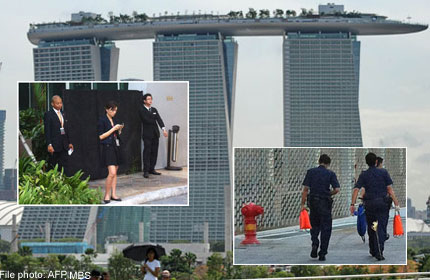
Dutch tourist falls to death from MBS SkyPark
A 46-year-old Dutch tourist fell to his death from Marina Bay Sands Skypark on Tuesday afternoon.
This is the first time such an incident has happened since the SkyPark's June 2010 opening.
Chinese daily Shin Min Daily News said the man was found on a grass patch in front of the integrated resort and that he was already dead when police officers and Singapore Civil Defence Force responders arrived.
MBS deployed more than 10 staff to seal up the area and prevent passers-by from gathering.
A black screen was erected in front of the scene. Security officials were also posted to prevent unauthorised access.
The officials said renovation works were going on when questioned by the Chinese daily's reporter.
It is understood that the deceased is not a hotel guest, but one from another nearby hotel.
Two Dutch embassy officials who were at the mortuary declined to comment.
The police have classified this incident as a case of "unnatural death" and are investigating.
The Marina Bay Sands SkyPark is 57 storeys high and sits at more than 200m above ground level.
This is the first time such an incident has happened since the SkyPark's June 2010 opening.
Chinese daily Shin Min Daily News said the man was found on a grass patch in front of the integrated resort and that he was already dead when police officers and Singapore Civil Defence Force responders arrived.
MBS deployed more than 10 staff to seal up the area and prevent passers-by from gathering.
A black screen was erected in front of the scene. Security officials were also posted to prevent unauthorised access.
The officials said renovation works were going on when questioned by the Chinese daily's reporter.
It is understood that the deceased is not a hotel guest, but one from another nearby hotel.
Two Dutch embassy officials who were at the mortuary declined to comment.
The police have classified this incident as a case of "unnatural death" and are investigating.
The Marina Bay Sands SkyPark is 57 storeys high and sits at more than 200m above ground level.
Monday, May 28, 2012
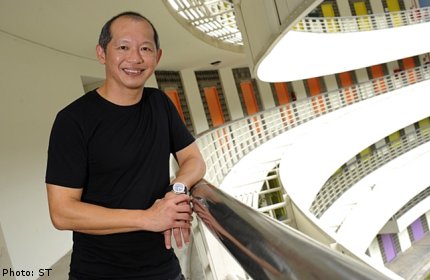
National Arts Council CEO Benson Puah diagnosed with cancer
SINGAPORE - The Chief Executive Officer for the National Arts Council and the Esplanade has been diagnosed with lymphoma.
The illness is a type of cancer that begins in the immune system cells.
The 54-year-old, dubbed as the most powerful man in the Singapore art scene, was diagnosed with the condition last Thursday.
A joint statement released by both organisations on Monday said that Mr Puah begins a 16-week-long treatment today.
He will continue with his duties at the Esplanade and NAC as normally as his condition will allow him to and operations at both organisation will function as usual.
What causes lymphoma?
Non-Hodgkin's lymphoma (also called NHL) is cancer that begins in the lymphatic system. The lymphatic system is part of the body's immune system. The immune system fights infection and other diseases.
A person with certain risk factors may be more likely than others to develop lymphoma. Studies reveal that individuals who have a weak immune system (such as autoimmune disorder), or suffering from certain types of infections (such as Human immunodeficiency virus, HIV) are at higher risk of developing non-Hodgkin's lymphoma.
Although non-Hodgkin's lymphoma can occur in young people, the chances of developing this disease go up with age. Most people with non-Hodgkin's lymphoma are older than 60 years of age.
Symptoms
- Swollen, painless lymph nodes in the neck, armpits, or groin
- Unexplained weight loss
- Fever
- Soaking night sweats
- Coughing, trouble breathing, or chest pain
- Weakness and tiredness that don’t go away
- Pain, swelling, or a feeling of fullness in the abdomen
Types of treatment available
Chemotherapy, Biological Therapy, Radiation Therapy and Stem Cell Transplantation.
Information provided by Parkway Cancer Centre. To find out more, click here
The illness is a type of cancer that begins in the immune system cells.
The 54-year-old, dubbed as the most powerful man in the Singapore art scene, was diagnosed with the condition last Thursday.
A joint statement released by both organisations on Monday said that Mr Puah begins a 16-week-long treatment today.
He will continue with his duties at the Esplanade and NAC as normally as his condition will allow him to and operations at both organisation will function as usual.
What causes lymphoma?
Non-Hodgkin's lymphoma (also called NHL) is cancer that begins in the lymphatic system. The lymphatic system is part of the body's immune system. The immune system fights infection and other diseases.
A person with certain risk factors may be more likely than others to develop lymphoma. Studies reveal that individuals who have a weak immune system (such as autoimmune disorder), or suffering from certain types of infections (such as Human immunodeficiency virus, HIV) are at higher risk of developing non-Hodgkin's lymphoma.
Although non-Hodgkin's lymphoma can occur in young people, the chances of developing this disease go up with age. Most people with non-Hodgkin's lymphoma are older than 60 years of age.
Symptoms
- Swollen, painless lymph nodes in the neck, armpits, or groin
- Unexplained weight loss
- Fever
- Soaking night sweats
- Coughing, trouble breathing, or chest pain
- Weakness and tiredness that don’t go away
- Pain, swelling, or a feeling of fullness in the abdomen
Types of treatment available
Chemotherapy, Biological Therapy, Radiation Therapy and Stem Cell Transplantation.
Information provided by Parkway Cancer Centre. To find out more, click here
Wednesday, May 23, 2012
Ferrari crash junction, red light rogues still beat light
The junction where the accident occurred is notorious for motorists running the red light.
Netizens have claimed that, as a result, there have been countless near misses at the junction of Victoria Street and Rochor Road.
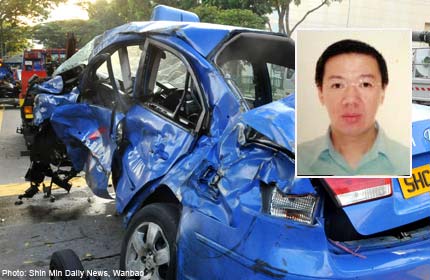
Just two Saturdays ago, three people were killed after a Ferrari driver allegedly ignored a red light there before crashing into a taxi.
The Ferrari driver, Mr Ma Chi, 31, a Chinese national, died at the scene.
The taxi driver, Mr Cheng Teck Hock, 52, and his Japanese passenger, Ms Shigemi Ito, 41, died in hospital.
The situation is worse on Fridays and Saturdays, netizens said, as revellers leave watering holes at places like Boat Quay and Orchard Road and head down Victoria Street towards Kallang.
Two weeks after the accident, The New Paper waited at the same junction from 1am to 4am on Saturday. How bad was it?
Despite the accident, some motorists still blatantly beat the red lights at the junction.
Three cars, two taxis and a motorcycle ran the light when TNP was at the junction.
The first offender, a motorcyclist, was spotted at 1.30am.
He rode down Victoria Street and turned left into Rochor Road even though the light had turned red.
Traffic at the junction became less heavy soon after.
But between 3am and 4am, as clubbers left from a night of partying, the roads became crowded again with cars revving their engines.
Most of the vehicles were travelling from the city down Victoria Street towards Kallang.
A dark-coloured car beat the red light at 3am about five seconds after it changed from green.
About 15 minutes later, another car and a taxi were seen doing the same.
A light-coloured car, this time travelling from the East Coast Parkway down Rochor Road, beat the red light soon after at 3.25am.
About five minutes after this, another taxi travelling down Victoria Street was spotted doing likewise as it turned into Rochor Road.
No camera
The junction isn't fitted with a red-light camera.
The offence of jumping a red light carries a six- month jail term.
But first offenders are usually fined up to $1,000 and given 12 demerit points. Any motorist who accumulates 24 or more demerit points within two years will be barred from driving for a year.
Motorists whom TNP spoke to said that another accident at the junction is imminent if fellow road users continue beating the red light there.
One motorist, Mr Trevor Chan, 36, who works in the sales line, said: "Maybe it's time that the authorities install a red-light camera at the junction. Only then would motorists stop breaking the law there."
A primary school teacher, who declined to be named, felt the same way.
"This is the only way to stop these irresponsible motorists from breaking the law," she said.
Netizens have claimed that, as a result, there have been countless near misses at the junction of Victoria Street and Rochor Road.
Just two Saturdays ago, three people were killed after a Ferrari driver allegedly ignored a red light there before crashing into a taxi.
The Ferrari driver, Mr Ma Chi, 31, a Chinese national, died at the scene.
The taxi driver, Mr Cheng Teck Hock, 52, and his Japanese passenger, Ms Shigemi Ito, 41, died in hospital.
The situation is worse on Fridays and Saturdays, netizens said, as revellers leave watering holes at places like Boat Quay and Orchard Road and head down Victoria Street towards Kallang.
Two weeks after the accident, The New Paper waited at the same junction from 1am to 4am on Saturday. How bad was it?
Despite the accident, some motorists still blatantly beat the red lights at the junction.
Three cars, two taxis and a motorcycle ran the light when TNP was at the junction.
The first offender, a motorcyclist, was spotted at 1.30am.
He rode down Victoria Street and turned left into Rochor Road even though the light had turned red.
Traffic at the junction became less heavy soon after.
But between 3am and 4am, as clubbers left from a night of partying, the roads became crowded again with cars revving their engines.
Most of the vehicles were travelling from the city down Victoria Street towards Kallang.
A dark-coloured car beat the red light at 3am about five seconds after it changed from green.
About 15 minutes later, another car and a taxi were seen doing the same.
A light-coloured car, this time travelling from the East Coast Parkway down Rochor Road, beat the red light soon after at 3.25am.
About five minutes after this, another taxi travelling down Victoria Street was spotted doing likewise as it turned into Rochor Road.
No camera
The junction isn't fitted with a red-light camera.
The offence of jumping a red light carries a six- month jail term.
But first offenders are usually fined up to $1,000 and given 12 demerit points. Any motorist who accumulates 24 or more demerit points within two years will be barred from driving for a year.
Motorists whom TNP spoke to said that another accident at the junction is imminent if fellow road users continue beating the red light there.
One motorist, Mr Trevor Chan, 36, who works in the sales line, said: "Maybe it's time that the authorities install a red-light camera at the junction. Only then would motorists stop breaking the law there."
A primary school teacher, who declined to be named, felt the same way.
"This is the only way to stop these irresponsible motorists from breaking the law," she said.
Monday, May 21, 2012
Ferrari accident: Cabby's family receives $170,000 in donations
SINGAPORE - Donations have been pouring in for late cabby Cheng Teck Hock's family.
According to mypaper, ComfortDelGro had collected about $170,000, as of Friday.
Tammy Tan, ComfortDelGro's group corporate communications officer told mypaper that staff, cabbies and the public have been generous, and the highest amount for a single donation was $30,000 from an anonymous donor.
Mr Cheng, 52, died in an accident on May 12. He had been driving his taxi past the junction of Rochor Road and Victoria Street when his car was hit by a Ferrari.
Both the Ferrari driver, Mr Ma Chi, and the taxi's passenger, Ms Shigemi Ito, also died in the accident.
Mr Cheng was the sole breadwinner for the family, and his family faced financial difficulties. His three children need help with school fees.
The National Taxi Association (NTA) was also working closely with ComfortDelGro to help the family financially, according to reports.
NTA said that fellow taxi drivers and the public have made donations, with two cabbies making a $5,000 donation each.
A group of staff and merchants at Sim Lim Square have also pooled together a combined donation amount of $10,000.
Minister of Foreign Affairs and MP for Nee Soon GRC, Mr K Shanmugan said in a Facebook post on Friday that he has spoken to several government agencies, a Foundation and grassroots leaders.
They are trying to help the family in a "structured and sustained way", but will speak with the family to assess their needs when they are ready.
Mr Shanmugan said in a Facebook post on Wednesday that he told Cheng's 21-year-old daughter not to worry about university fees as long as she qualifies for a local university. He also reassured Mdm Lim that he and his grassroots leaders will help ease her family's financial problems.
ComfortDelGro is still collecting donations until the end of the month.
Cheque donations can be dropped off at the general service counter on level 1 of the ComfortDelGro office located at 383 Sin Ming Drive.
Cheques should be made payable to his wife, Mdm Lim Choo Eng.
They can also be mailed to:
THE CHENG FAMILY c/o Comfort Transportation Pte Ltd 383 Sin Ming Drive Singapore 575717 Attn: Customer Service Centre
Cash donations can be made at the cashier next to the general service counter. The office is open from 8am to 5.30pm from Monday to Friday.
THE CHENG FAMILY c/o Comfort Transportation Pte Ltd 383 Sin Ming Drive Singapore 575717 Attn: Customer Service Centre
Cash donations can be made at the cashier next to the general service counter. The office is open from 8am to 5.30pm from Monday to Friday.
According to mypaper, ComfortDelGro had collected about $170,000, as of Friday.
Tammy Tan, ComfortDelGro's group corporate communications officer told mypaper that staff, cabbies and the public have been generous, and the highest amount for a single donation was $30,000 from an anonymous donor.
Mr Cheng, 52, died in an accident on May 12. He had been driving his taxi past the junction of Rochor Road and Victoria Street when his car was hit by a Ferrari.
Both the Ferrari driver, Mr Ma Chi, and the taxi's passenger, Ms Shigemi Ito, also died in the accident.
Mr Cheng was the sole breadwinner for the family, and his family faced financial difficulties. His three children need help with school fees.
The National Taxi Association (NTA) was also working closely with ComfortDelGro to help the family financially, according to reports.
NTA said that fellow taxi drivers and the public have made donations, with two cabbies making a $5,000 donation each.
A group of staff and merchants at Sim Lim Square have also pooled together a combined donation amount of $10,000.
Minister of Foreign Affairs and MP for Nee Soon GRC, Mr K Shanmugan said in a Facebook post on Friday that he has spoken to several government agencies, a Foundation and grassroots leaders.
They are trying to help the family in a "structured and sustained way", but will speak with the family to assess their needs when they are ready.
Mr Shanmugan said in a Facebook post on Wednesday that he told Cheng's 21-year-old daughter not to worry about university fees as long as she qualifies for a local university. He also reassured Mdm Lim that he and his grassroots leaders will help ease her family's financial problems.
ComfortDelGro is still collecting donations until the end of the month.
Cheque donations can be dropped off at the general service counter on level 1 of the ComfortDelGro office located at 383 Sin Ming Drive.
Cheques should be made payable to his wife, Mdm Lim Choo Eng.
They can also be mailed to:
THE CHENG FAMILY c/o Comfort Transportation Pte Ltd 383 Sin Ming Drive Singapore 575717 Attn: Customer Service Centre
Cash donations can be made at the cashier next to the general service counter. The office is open from 8am to 5.30pm from Monday to Friday.
THE CHENG FAMILY c/o Comfort Transportation Pte Ltd 383 Sin Ming Drive Singapore 575717 Attn: Customer Service Centre
Cash donations can be made at the cashier next to the general service counter. The office is open from 8am to 5.30pm from Monday to Friday.
Saturday, May 19, 2012
Motorcyclist dies after being pinned under taxi
SINGAPORE - An accident along Bedok Reservoir Road that occurred around 10pm on Friday, May 18 claimed one life.
The accident was between a motorbike and a taxi according to a report on local citizen journalism site, Stomp.
The New Paper also reported that the motorcyclist, 24, was killed after he was pinned under the taxi. The taxi driver and his two passengers were unharmed.
The motorbike had been 'reduced to scrap metal and the taxi had its door dented,' claimed netizen Akunameless on Stomp.
The netizen who was on his way home in bus 66, said that all the passengers alighted as the Singapore Civil Defence force and the Traffic Police had blocked off the road.
SCDF told The New Paper that they had received the call at 10.32pm and that the man was pronounced dead by paramedics at 11.05pm.
He suffered head and abdominal injuries.
A witness, Mr Shaidin, 24, who spoke to The New Paper said that the motorcyclist was initially moving and he spoken words of encouragement to him.
But by the time help arrived the victim was motionless.
He had also helped to direct traffic away from the accident site.
The accident was between a motorbike and a taxi according to a report on local citizen journalism site, Stomp.
The New Paper also reported that the motorcyclist, 24, was killed after he was pinned under the taxi. The taxi driver and his two passengers were unharmed.
The netizen who was on his way home in bus 66, said that all the passengers alighted as the Singapore Civil Defence force and the Traffic Police had blocked off the road.
SCDF told The New Paper that they had received the call at 10.32pm and that the man was pronounced dead by paramedics at 11.05pm.
He suffered head and abdominal injuries.
A witness, Mr Shaidin, 24, who spoke to The New Paper said that the motorcyclist was initially moving and he spoken words of encouragement to him.
But by the time help arrived the victim was motionless.
He had also helped to direct traffic away from the accident site.
Wednesday, May 16, 2012
Cabby's daughter in Ferrari accident to receive varsity aid: Shanmugam
SINGAPORE - Law and Foreign Minister, K. Shanmugam, who is the Member
of Parliament representative for the Nee Soon GRC, was at the wake of
Mr Cheng Teck Hock, 52, the taxi driver who was killed in Saturday's accident involving a Ferrari.
The minister met with the family of the victim and assured the cabby's daughter, Stephanie Cheng, that she no longer has to worry about paying for her university education, reported The Straits Times.
The minister said that the 21-year-old girl will not have to
worry about her planned university education as long as she qualifies
for a local university.
He posted on his Facebook saying: "I assured them that the eldest daughter can go to University if she qualifies and need not worry about money.
"I also assured Mrs Cheng that we will help them by raising funds and that they don't need to worry about their HDB flat. In addition I intend to get a lawyer to help them make a claim."
Stephanie had previously told The New Paper that she has to put her university dreams on hold while she supports the family. She is the eldest of three children and her father was the family's sole breadwinner.
She had recently graduated from Nanyang Polytechnic with a Diploma in Food Science and Nutrition.
She has two younger brothers, Dao Han, 19, a second year student in Anderson Junior College and Dao Long, 17, a Secondary 5 student in Yishun Town Secondary School.
He also told The Straits Times that he and his grassroots leaders will do everything they can to help the family.
He added that an aid package is being put together to help with the needs of the family for the long-run, including their HDB flat. The details will be worked out with the family.
The wake is being held at Block 306, Canberra Road.
On Saturday, a Ferrari that was driven by 31-year-old Chinese businessman Ma Chi crashed into the taxi that was driven by Mr Cheng when it ran a red light, causing the taxi to hit a passing motorcycle.
The accident claimed the lives of Mr Ma, Mr Cheng and his passenger Ms Shigemi Ito. The motorcyclist, Mr Muhammad Najib and the passenger in the Ferrari, Ms Wu Wei Wei survived the accident.
Cabby's death dashes daughter's uni hopes
She dreamt of going to university and graduating with a degree.
Now it seems the hopes of Stephanie Cheng, 21, might have been abruptly dashed - at least for the foreseeable future.
Her cabby father's sudden death in a horrific traffic accident at Bugis last Saturday morning has left the family without a breadwinner.
As the eldest of three children, Miss Cheng, who had just graduated from polytechnic, may now have to put her dreams on hold to find a job to support the family.
Video footage of the accident showed that Mr Cheng Teck Hock, 52, was pulling out of Rochor Road after the lights turned green when a Ferrari moving along Victoria Street slammed into his taxi.
The Ferrari driver died on the spot, and Mr Cheng's female Japanese passenger died soon after.
The cabby, who was warded in the Intensive Care Unit of Tan Tock Seng Hospital, died at 7pm on Sunday.
Miss Cheng, who had just graduated from Nanyang Polytechnic with a Diploma in Food Science And Nutrition, had wanted to further her education.
"Stephanie used to pay her own school fees by being a part-time tutor," said her cousin, Miss Stella Tan, 23.
"She would have liked to proceed to university. But given the current situation, we'll need to see how."
The family of five lives in a five-room flat in Sembawang and Mr Cheng was the sole breadwinner.
Another of Miss Cheng's cousins, who is in his 30s and wanted to be known only as Mr Lim, said that Mr Cheng and his wife, Madam Lim Choo Eng, 49, used to own a seafood business in a wet market more than a decade ago.
They would work from early in the morning till late at night daily.
Exhaustion
It eventually led to an episode when Madam Lim fainted and was hospitalised for exhaustion.
The minister met with the family of the victim and assured the cabby's daughter, Stephanie Cheng, that she no longer has to worry about paying for her university education, reported The Straits Times.
He posted on his Facebook saying: "I assured them that the eldest daughter can go to University if she qualifies and need not worry about money.
"I also assured Mrs Cheng that we will help them by raising funds and that they don't need to worry about their HDB flat. In addition I intend to get a lawyer to help them make a claim."
Stephanie had previously told The New Paper that she has to put her university dreams on hold while she supports the family. She is the eldest of three children and her father was the family's sole breadwinner.
She had recently graduated from Nanyang Polytechnic with a Diploma in Food Science and Nutrition.
She has two younger brothers, Dao Han, 19, a second year student in Anderson Junior College and Dao Long, 17, a Secondary 5 student in Yishun Town Secondary School.
He also told The Straits Times that he and his grassroots leaders will do everything they can to help the family.
He added that an aid package is being put together to help with the needs of the family for the long-run, including their HDB flat. The details will be worked out with the family.
The wake is being held at Block 306, Canberra Road.
On Saturday, a Ferrari that was driven by 31-year-old Chinese businessman Ma Chi crashed into the taxi that was driven by Mr Cheng when it ran a red light, causing the taxi to hit a passing motorcycle.
The accident claimed the lives of Mr Ma, Mr Cheng and his passenger Ms Shigemi Ito. The motorcyclist, Mr Muhammad Najib and the passenger in the Ferrari, Ms Wu Wei Wei survived the accident.
Cabby's death dashes daughter's uni hopes
She dreamt of going to university and graduating with a degree.
Now it seems the hopes of Stephanie Cheng, 21, might have been abruptly dashed - at least for the foreseeable future.
Her cabby father's sudden death in a horrific traffic accident at Bugis last Saturday morning has left the family without a breadwinner.
As the eldest of three children, Miss Cheng, who had just graduated from polytechnic, may now have to put her dreams on hold to find a job to support the family.
Video footage of the accident showed that Mr Cheng Teck Hock, 52, was pulling out of Rochor Road after the lights turned green when a Ferrari moving along Victoria Street slammed into his taxi.
The Ferrari driver died on the spot, and Mr Cheng's female Japanese passenger died soon after.
The cabby, who was warded in the Intensive Care Unit of Tan Tock Seng Hospital, died at 7pm on Sunday.
Miss Cheng, who had just graduated from Nanyang Polytechnic with a Diploma in Food Science And Nutrition, had wanted to further her education.
"Stephanie used to pay her own school fees by being a part-time tutor," said her cousin, Miss Stella Tan, 23.
"She would have liked to proceed to university. But given the current situation, we'll need to see how."
The family of five lives in a five-room flat in Sembawang and Mr Cheng was the sole breadwinner.
Another of Miss Cheng's cousins, who is in his 30s and wanted to be known only as Mr Lim, said that Mr Cheng and his wife, Madam Lim Choo Eng, 49, used to own a seafood business in a wet market more than a decade ago.
They would work from early in the morning till late at night daily.
Exhaustion
It eventually led to an episode when Madam Lim fainted and was hospitalised for exhaustion.
"Times were hard, and the business was not doing well, so she became a housewife and he became a taxi driver," Mr Lim explained.
To help Miss Cheng achieve her dream of going to university, Mr Cheng would even work on his rest days and take up longer hours, he added.
"But he was a very careful driver. Despite wanting to earn more, he would take a break whenever he was tired," Mr Lim said.
Miss Tan added that the couple had wanted a good upbringing for their kids, to watch them grow up and to stand by them always.
Now that Mr Cheng has passed on, the burden of being the sole breadwinner will almost certainly fall on Miss Cheng's shoulders.
"With this sort of financial situation, it might be a bit hard for them to proceed with their studies," said Mr Lim.
"It might be heavier on Stephanie, since her brothers are still schooling, but she has graduated."
The close-knit family has been together since Saturday, after they got the grim news at 1pm that Mr Cheng had been admitted to hospital.
"We called all our relatives from both our paternal and maternal sides to go to the hospital," said Miss Cheng's brother, Dao Han, 19.
Dao Han is a Year 2 student in Anderson Junior College and Dao Long, 17, a Secondary 5 student at Yishun Town Secondary School. (See report on facing page.)
"I will miss his caring nature the most. He never really expressed it in words, but more in terms of actions," said Dao Han of his father.
"When he came back from work, he would watch us when we were sleeping.
"My father only got an O-level certificate, so he can't really help us with our (home)work. But he's Chinese-educated, so if we have problems with Chinese, we could seek his help."
Miss Tan said that since her uncle worked the night shift, he was always out at work when his children came home from school.
They would see him only on weekends.
She said: "They were all busy with exams, and the focus on bonding was minimal. So they are really very sad."
She said Mr Cheng showed a strong will to live, despite his injuries.
"He was supposed to go on the first day, but the nurses told us, 'Your uncle's will is too strong, he doesn't want to leave too early,'" she said.
She felt that his desire to make up for lost time was what kept him alive that bit longer.
"Before he was admitted, he never saw his children, so no last words were said," said Miss Tan.
Dao Han added: "On the day before the accident, none of us actually saw him. The next time we saw him was when he was lying in the hospital."
The family is coping for now, with support from their kin.
"My mother broke down at times, but now she's staying calm. We told her to stay strong and that we would all support each other," said Dao Han.
He said that his sister was very emotional and would cry when she recalled how their father had cared for her.
Quiet person
"My younger brother (Dao Long) never shows anything, as he's a naturally quiet person. I've recommended him to see his school counsellors if he needs to," said Dao Han.
The family has received many anonymous calls and messages of condolences, with some people offering to send money electronically to their bank account.
Dao Han said that while the family appreciates the offers, "it is hard to track down who contributed through electronic transfers".
"We would really like to acknowledge them personally," he said.
Miss Tan added: "We also want anyone who can give an account of the accident to give us the truth, and give us some closure."
The police are investigating the cause of the accident. Witnesses are helping with the investigation, and any person with additional information which might be relevant to the case can call 1800-547-1818.
All evidence, including CCTV footage, will be thoroughly reviewed.
To help Miss Cheng achieve her dream of going to university, Mr Cheng would even work on his rest days and take up longer hours, he added.
"But he was a very careful driver. Despite wanting to earn more, he would take a break whenever he was tired," Mr Lim said.
Miss Tan added that the couple had wanted a good upbringing for their kids, to watch them grow up and to stand by them always.
Now that Mr Cheng has passed on, the burden of being the sole breadwinner will almost certainly fall on Miss Cheng's shoulders.
"With this sort of financial situation, it might be a bit hard for them to proceed with their studies," said Mr Lim.
"It might be heavier on Stephanie, since her brothers are still schooling, but she has graduated."
The close-knit family has been together since Saturday, after they got the grim news at 1pm that Mr Cheng had been admitted to hospital.
"We called all our relatives from both our paternal and maternal sides to go to the hospital," said Miss Cheng's brother, Dao Han, 19.
Dao Han is a Year 2 student in Anderson Junior College and Dao Long, 17, a Secondary 5 student at Yishun Town Secondary School. (See report on facing page.)
"I will miss his caring nature the most. He never really expressed it in words, but more in terms of actions," said Dao Han of his father.
"When he came back from work, he would watch us when we were sleeping.
"My father only got an O-level certificate, so he can't really help us with our (home)work. But he's Chinese-educated, so if we have problems with Chinese, we could seek his help."
Miss Tan said that since her uncle worked the night shift, he was always out at work when his children came home from school.
They would see him only on weekends.
She said: "They were all busy with exams, and the focus on bonding was minimal. So they are really very sad."
She said Mr Cheng showed a strong will to live, despite his injuries.
"He was supposed to go on the first day, but the nurses told us, 'Your uncle's will is too strong, he doesn't want to leave too early,'" she said.
She felt that his desire to make up for lost time was what kept him alive that bit longer.
"Before he was admitted, he never saw his children, so no last words were said," said Miss Tan.
Dao Han added: "On the day before the accident, none of us actually saw him. The next time we saw him was when he was lying in the hospital."
The family is coping for now, with support from their kin.
"My mother broke down at times, but now she's staying calm. We told her to stay strong and that we would all support each other," said Dao Han.
He said that his sister was very emotional and would cry when she recalled how their father had cared for her.
Quiet person
"My younger brother (Dao Long) never shows anything, as he's a naturally quiet person. I've recommended him to see his school counsellors if he needs to," said Dao Han.
The family has received many anonymous calls and messages of condolences, with some people offering to send money electronically to their bank account.
Dao Han said that while the family appreciates the offers, "it is hard to track down who contributed through electronic transfers".
"We would really like to acknowledge them personally," he said.
Miss Tan added: "We also want anyone who can give an account of the accident to give us the truth, and give us some closure."
The police are investigating the cause of the accident. Witnesses are helping with the investigation, and any person with additional information which might be relevant to the case can call 1800-547-1818.
All evidence, including CCTV footage, will be thoroughly reviewed.
Wednesday, May 9, 2012
Buying insurance: Start early, don’t procrastinate
YOUNG adults should consider buying insurance early in
the light of the recent discussion on pre-existing conditions. Serious illnesses can strike at any time, leading to hefty medical bills and the
likelihood of not being able to work for a significant period.
What's more, buying insurance as a young adult is
generally affordable, with monthly premiums costing as little as what
one would spend on a night out with friends.
Some can even be paid using Medisave, thereby saving a
person from forking out cash. Medical conditions and risk factors
typically increase with age, resulting in decreased insurability.
Many Singaporeans do not know how secondary health
care is provided and paid for, and perceive insurance agents as people
who are out to fleece their clients by selling expensive policies they
do not need.
Many young people often overlook the long-term implications of being uninsurable when they grow older.
Conversely, purchasing hospitalisation insurance when
one is young gives peace of mind for the long term, as many policies
guarantee renewal even if illness strikes subsequently.
While the old may already be uninsurable, young adults have no excuse not to insure themselves and their future.
Thursday, March 29, 2012
Slower growth in new credit card accounts
0.26% increase seen last year but existing card holders spending more
The growth in new credit card accounts slowed last year, but existing consumers have been spending more.
Last year, 606,844 existing and first-time credit card holders obtained one or more new credit cards, up from 605,248 in 2010, according to the Credit Bureau of Singapore on Thursday.
This is a 0.26 per cent increase, but a sharp slowdown from the 7.32 per cent increase in 2010.
The fall stemmed from a 0.41 per cent drop in the number of existing credit card holders who obtained new credit cards.
The growth in new credit card accounts slowed last year, but existing consumers have been spending more.
Last year, 606,844 existing and first-time credit card holders obtained one or more new credit cards, up from 605,248 in 2010, according to the Credit Bureau of Singapore on Thursday.
This is a 0.26 per cent increase, but a sharp slowdown from the 7.32 per cent increase in 2010.
The fall stemmed from a 0.41 per cent drop in the number of existing credit card holders who obtained new credit cards.
Tuesday, March 6, 2012
Strong balance sheets for Singapore households
SO how rich have the aggregate Singapore households grown in the last
decade or so? Data from the Singapore Yearbook of Statistics shows that
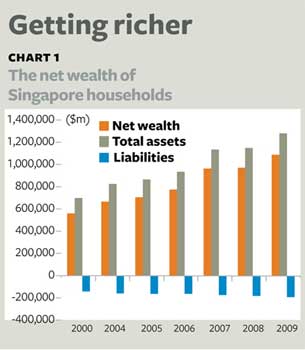
household net wealth grew from $560 billion in 2000 to $1.09 trillion
in 2009 - the latest available number. That is compounded growth of 7.7
per cent a year.
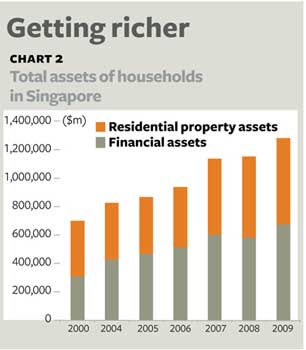
Other numbers given were total assets, the split of the assets between financial assets and residential properties, and how much of the total asset holding was funded by loans.
I decided to plot the charts for these numbers so as to get a picture of how strong or weak the Singapore household balance sheets are, and where do most Singapore residents put their money.
Table 1 shows the total assets and total liabilities of households, and the net wealth from year 2000 until 2009. Total assets grew from $699.5 billion to $1.28 trillion - a rise of 7 per cent a year. That's slower than the growth of net assets.
In other words, debt in the household balance sheet has been growing at a slower pace than total assets.
In that same period, total liabilities of households which include mortgage loans from financial institutions and the Housing & Development Board (HDB), and personal loans such as car loans and credit/charge cards expanded from $139 billion to $191.5 billion. That is a growth of 3.6 per cent a year.
However, the proportion of total assets financed by loans fell from 20 per cent to 15 per cent.
So the household balance sheet of Singapore residents is on the whole pretty strong.
Of the mortgage loans, the financing of private properties by financial institutions registered the fastest expansion. It rose by 9.1 per cent a year, from $43 billion to $94 billion. Loans provided by HDB actually fell - from $59 billion to $46 billion.
As for personal loans, credit and charge card loans grew the speediest. They climbed from $2.6 billion to $6.2 billion - or 10.4 per cent a year.
Now, let's take a look at the composition of assets in the Singapore households.
Again, contrary to the general perception, the data showed that the proportion of residential property in the households' balance sheet has fallen from 56 per cent in 2000 to 47 per cent in 2009.
Conversely, the holdings of financial assets expanded from 44 per cent to 53 per cent during that same period.
Of the holdings in residential properties, HDB made up 52 per cent in 2000, and private properties 48 per cent. The balance swung sharply towards private housing - to 54 per cent - in 2007.
The global financial crisis in 2008 brought the value of private housing lower. As at 2009, the numbers were equally split between public and private housing. Today's numbers might actually show a bigger proportion of assets in HDB, given the strong run-up in public housing prices in the last two to three years.
Meanwhile, how have the holdings in financial assets changed over the last decade or so?
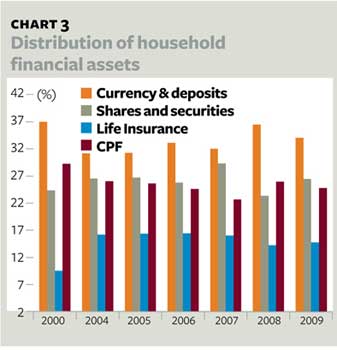
The financial assets are classified into four classes: currency & deposits, shares and securities, life insurance and Central Provident Fund (CPF).
From Chart 3, you can see that currency and deposits have always formed a big chunk of Singapore households' asset holdings. As a percentage of total assets, it was 16 per cent back in 2000 and grew to 18 per cent by end of 2009.
Despite the numerous investor education programmes run by the Singapore Exchange (SGX), the percentage of household assets in shares and securities amounts only to 14 per cent in 2009. Still that's an improvement from 11 per cent in 2000.
Of the four classes of financial assets, insurance grew the fastest. Its share doubled from a mere 4 per cent at the start of the millennium to 8 per cent in 2009.
The percentage of cash held in CPF has been pretty constant in the last decade. It fluctuated between 12 and 14 per cent.
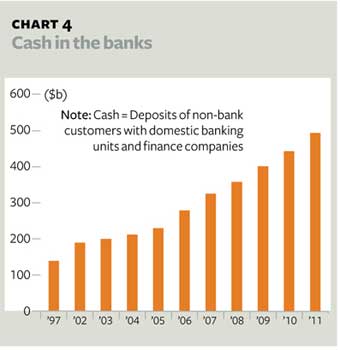
So how much cash is there in the banks? If we totalled up the deposits in the banks and finance companies, the numbers came to $493 billion as at end 2011.
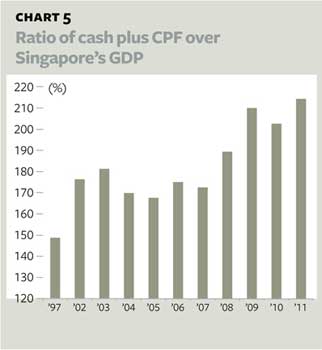
But relative to the size of Singapore's economy, how much cash is there in the system? I tallied up the deposits in the banks and finance companies, and added in the CPF sums due to members.
From Chart 5, you can see that as at end last year, the total amount of cash is more than 210 per cent that of Singapore's 2011 GDP!
The cash levels shot up distinctly in 2008, and they continued to grow in 2009 until 2011. Either Singapore residents have become more risk averse following the global financial crisis of 2008, or Singapore's reputation as a safe haven attracted a lot more cash from overseas into our local banking system.
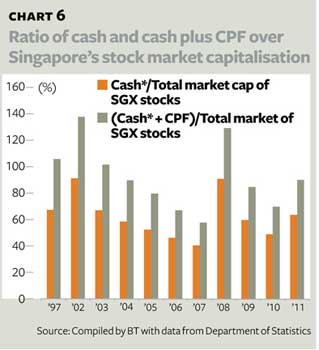
Finally, let's look at the cash on the sidelines relative to the aggregate market capitalisation on SGX.
From Chart 6, you can see that as the stock-market prices climbed between 2002 and 2007, cash relative to market cap gradually fell. That reversed sharply in 2008, due primarily to the fact that total market cap on SGX plunged from $797.8 billion in 2007 to just $393 billion by end-2008.
Since then, the total market cap has risen to $669 billion in 2009, $901.9 billion in 2010 and $775.8 billion in 2011.
From 91 per cent in 2008, the cash-to-market-cap ratio has fallen to 64 per cent by the end of last year. Meanwhile, the cash plus CPF ratio has gone from 129 per cent to 90 per cent.
The ratio as at end of last year approximated that of 2003. Some market watchers use this ratio to gauge the under or overvaluation of the stock market. By that reasoning then, we are at valuation levels that are similar to 2003.
Other numbers given were total assets, the split of the assets between financial assets and residential properties, and how much of the total asset holding was funded by loans.
I decided to plot the charts for these numbers so as to get a picture of how strong or weak the Singapore household balance sheets are, and where do most Singapore residents put their money.
Table 1 shows the total assets and total liabilities of households, and the net wealth from year 2000 until 2009. Total assets grew from $699.5 billion to $1.28 trillion - a rise of 7 per cent a year. That's slower than the growth of net assets.
In other words, debt in the household balance sheet has been growing at a slower pace than total assets.
In that same period, total liabilities of households which include mortgage loans from financial institutions and the Housing & Development Board (HDB), and personal loans such as car loans and credit/charge cards expanded from $139 billion to $191.5 billion. That is a growth of 3.6 per cent a year.
However, the proportion of total assets financed by loans fell from 20 per cent to 15 per cent.
So the household balance sheet of Singapore residents is on the whole pretty strong.
Of the mortgage loans, the financing of private properties by financial institutions registered the fastest expansion. It rose by 9.1 per cent a year, from $43 billion to $94 billion. Loans provided by HDB actually fell - from $59 billion to $46 billion.
As for personal loans, credit and charge card loans grew the speediest. They climbed from $2.6 billion to $6.2 billion - or 10.4 per cent a year.
Now, let's take a look at the composition of assets in the Singapore households.
Again, contrary to the general perception, the data showed that the proportion of residential property in the households' balance sheet has fallen from 56 per cent in 2000 to 47 per cent in 2009.
Conversely, the holdings of financial assets expanded from 44 per cent to 53 per cent during that same period.
Of the holdings in residential properties, HDB made up 52 per cent in 2000, and private properties 48 per cent. The balance swung sharply towards private housing - to 54 per cent - in 2007.
The global financial crisis in 2008 brought the value of private housing lower. As at 2009, the numbers were equally split between public and private housing. Today's numbers might actually show a bigger proportion of assets in HDB, given the strong run-up in public housing prices in the last two to three years.
Meanwhile, how have the holdings in financial assets changed over the last decade or so?
The financial assets are classified into four classes: currency & deposits, shares and securities, life insurance and Central Provident Fund (CPF).
From Chart 3, you can see that currency and deposits have always formed a big chunk of Singapore households' asset holdings. As a percentage of total assets, it was 16 per cent back in 2000 and grew to 18 per cent by end of 2009.
Despite the numerous investor education programmes run by the Singapore Exchange (SGX), the percentage of household assets in shares and securities amounts only to 14 per cent in 2009. Still that's an improvement from 11 per cent in 2000.
Of the four classes of financial assets, insurance grew the fastest. Its share doubled from a mere 4 per cent at the start of the millennium to 8 per cent in 2009.
The percentage of cash held in CPF has been pretty constant in the last decade. It fluctuated between 12 and 14 per cent.
So how much cash is there in the banks? If we totalled up the deposits in the banks and finance companies, the numbers came to $493 billion as at end 2011.
But relative to the size of Singapore's economy, how much cash is there in the system? I tallied up the deposits in the banks and finance companies, and added in the CPF sums due to members.
From Chart 5, you can see that as at end last year, the total amount of cash is more than 210 per cent that of Singapore's 2011 GDP!
The cash levels shot up distinctly in 2008, and they continued to grow in 2009 until 2011. Either Singapore residents have become more risk averse following the global financial crisis of 2008, or Singapore's reputation as a safe haven attracted a lot more cash from overseas into our local banking system.
Finally, let's look at the cash on the sidelines relative to the aggregate market capitalisation on SGX.
From Chart 6, you can see that as the stock-market prices climbed between 2002 and 2007, cash relative to market cap gradually fell. That reversed sharply in 2008, due primarily to the fact that total market cap on SGX plunged from $797.8 billion in 2007 to just $393 billion by end-2008.
Since then, the total market cap has risen to $669 billion in 2009, $901.9 billion in 2010 and $775.8 billion in 2011.
From 91 per cent in 2008, the cash-to-market-cap ratio has fallen to 64 per cent by the end of last year. Meanwhile, the cash plus CPF ratio has gone from 129 per cent to 90 per cent.
The ratio as at end of last year approximated that of 2003. Some market watchers use this ratio to gauge the under or overvaluation of the stock market. By that reasoning then, we are at valuation levels that are similar to 2003.
Sunday, November 6, 2011
Insurance a crucial building block
With markets swinging about as they do these days, it is natural for
some investors to focus on spotting winners and try to pick the perfect
entry and exit points. But growing your wealth is more than just a
function of maximising stock returns in the shortest time possible.
Managing outflows, especially unexpected ones, and steady wealth
accumulation over the long term, are equally important to the planning
and pursuit of any significant financial goal.
The increased market volatility that we are experiencing is reason for many investors to fret over their portfolios. Yet, while prudent management of these monies is essential, it would be a mistake to overlook a more basic building block for growing wealth. As much as you would hate to see the value of your portfolio fall by 20 per cent, the hospital bill resulting from an unexpected major illness or the loss of income due to an accident-caused disability can severely disrupt your financial goals.
For instance, you may have to liquidate your investments to pay for treatment and other basic needs. This is why it is critical to ensure that you have some basic insurance in place, which will allow you to continue working towards your investment goals even if something catastrophic happens to you.
Strengthen the backline
A simple term policy is an affordable way to begin. Those in their 20s, who have just started work, may find this option most palatable as desired cover can be obtained inexpensively. For some, a term plan may act as a liability cancellation policy so that the family is not saddled with the burden of repaying the outstanding mortgage on the family home in the case of the policyholder's demise.
While term plans can be bought with additional cover for critical and terminal illnesses, conventional whole life policies provide greater flexibility, offering optional protection for eventualities like disability and loss of income. These additional covers, called riders, can be added and removed at will.
Whole life plans may be constructed so that payments are accelerated during your working life to allow you to enjoy premium-free cover after retirement. Perhaps, the biggest advantage that whole life plans have over term plans is that they can serve also as a tool for wealth accumulation. Part of the higher premiums collected in whole life plans are invested in the insurer's participation fund, resulting in steady returns that can be cashed out as needed.
Consumers should note that whole life policies are designed to accumulate value over the long-term, so the cost of surrendering the policy early, particularly in the first few years, is very high as premiums mostly go towards paying for the cost of insurance.
Sure and steady progress
There are insurance products that go further towards the goal of wealth accumulation. Endowment policies may not be new, but unlike the 30-year tenures of old, durations these days can be much shorter if you haven't the patience or if you have started your retirement planning late.
Endowment plans are gaining wider acceptance here as more Singaporeans realise the place of steady, low-risk investments when it comes to their retirement savings. In deciding on an endowment plan, it is usually helpful to link it to an objective, which will help determine what the most appropriate tenure is. For example, a 25-year-old executive may find a 10-year plan appropriate if he is planning to use the payout to help pay for a condominium at age 35.
For investors who prefer the convenience of an all-in-one solution, investment-linked policies cover both wealth protection and accumulation needs. You get to decide the balance between protection and investment, and you get more say about how your money is invested. Potential returns are higher, as you may choose to invest in unit trusts that adopt a more aggressive stance than the insurer's typically conservative participation fund. But along with that is a higher chance of incurring losses should your investment strategy prove unsound or unbalanced.
Pass it on
Finally, insurance can help in legacy planning. A universal life plan is a single premium policy that can help you pass on wealth to your children, with a guaranteed rate of return on the money invested. If you plan to leave S$3 million to your children, you can take out a universal life plan with a sum assured of S$3 million for a fraction of the amount. The sum assured of the universal life plan is guaranteed, so you can be assured that your children will receive the bequest you intended for them even if you pass on early.
If you choose to manage and invest your funds on your own instead of buying a universal life plan, there is a risk that your bequest to your loved ones will fall short of the S$3 million you intended for them, as the amount will be dependent on the market value of your investments when the bequest is made.
There is no denying the allure of taking a punt on the market, but neglect not the basic foundations of financial planning. Insurance is a crucial building block in achieving your financial goals and with recent innovations, it can even offer solutions for more advanced needs.
Shrikant Bhat is head of wealth management at Citibank Singapore.
The increased market volatility that we are experiencing is reason for many investors to fret over their portfolios. Yet, while prudent management of these monies is essential, it would be a mistake to overlook a more basic building block for growing wealth. As much as you would hate to see the value of your portfolio fall by 20 per cent, the hospital bill resulting from an unexpected major illness or the loss of income due to an accident-caused disability can severely disrupt your financial goals.
For instance, you may have to liquidate your investments to pay for treatment and other basic needs. This is why it is critical to ensure that you have some basic insurance in place, which will allow you to continue working towards your investment goals even if something catastrophic happens to you.
Strengthen the backline
A simple term policy is an affordable way to begin. Those in their 20s, who have just started work, may find this option most palatable as desired cover can be obtained inexpensively. For some, a term plan may act as a liability cancellation policy so that the family is not saddled with the burden of repaying the outstanding mortgage on the family home in the case of the policyholder's demise.
While term plans can be bought with additional cover for critical and terminal illnesses, conventional whole life policies provide greater flexibility, offering optional protection for eventualities like disability and loss of income. These additional covers, called riders, can be added and removed at will.
Whole life plans may be constructed so that payments are accelerated during your working life to allow you to enjoy premium-free cover after retirement. Perhaps, the biggest advantage that whole life plans have over term plans is that they can serve also as a tool for wealth accumulation. Part of the higher premiums collected in whole life plans are invested in the insurer's participation fund, resulting in steady returns that can be cashed out as needed.
Consumers should note that whole life policies are designed to accumulate value over the long-term, so the cost of surrendering the policy early, particularly in the first few years, is very high as premiums mostly go towards paying for the cost of insurance.
Sure and steady progress
There are insurance products that go further towards the goal of wealth accumulation. Endowment policies may not be new, but unlike the 30-year tenures of old, durations these days can be much shorter if you haven't the patience or if you have started your retirement planning late.
Endowment plans are gaining wider acceptance here as more Singaporeans realise the place of steady, low-risk investments when it comes to their retirement savings. In deciding on an endowment plan, it is usually helpful to link it to an objective, which will help determine what the most appropriate tenure is. For example, a 25-year-old executive may find a 10-year plan appropriate if he is planning to use the payout to help pay for a condominium at age 35.
For investors who prefer the convenience of an all-in-one solution, investment-linked policies cover both wealth protection and accumulation needs. You get to decide the balance between protection and investment, and you get more say about how your money is invested. Potential returns are higher, as you may choose to invest in unit trusts that adopt a more aggressive stance than the insurer's typically conservative participation fund. But along with that is a higher chance of incurring losses should your investment strategy prove unsound or unbalanced.
Pass it on
Finally, insurance can help in legacy planning. A universal life plan is a single premium policy that can help you pass on wealth to your children, with a guaranteed rate of return on the money invested. If you plan to leave S$3 million to your children, you can take out a universal life plan with a sum assured of S$3 million for a fraction of the amount. The sum assured of the universal life plan is guaranteed, so you can be assured that your children will receive the bequest you intended for them even if you pass on early.
If you choose to manage and invest your funds on your own instead of buying a universal life plan, there is a risk that your bequest to your loved ones will fall short of the S$3 million you intended for them, as the amount will be dependent on the market value of your investments when the bequest is made.
There is no denying the allure of taking a punt on the market, but neglect not the basic foundations of financial planning. Insurance is a crucial building block in achieving your financial goals and with recent innovations, it can even offer solutions for more advanced needs.
Shrikant Bhat is head of wealth management at Citibank Singapore.
Monday, August 22, 2011
10 cancer signals
FOR some women, cancer comes hand-in-hand with another syndrome:
denial. They may not want to face the reality that they have cancer, or
may not want to go through treatment because they think they are doomed
to death anyway.
In some cases, denial starts early on at the symptom stage, because they may not even want to consider that it could be cancer at all.
When women neglect to pay attention to cancer symptoms out of denial, fear or ignorance, they could be missing out on a valuable opportunity to detect cancer and treat it early.
Since there are so many different types of cancers that could affect us, the symptoms vary widely between different conditions and different people as well. There are also many instances where cancers do not produce symptoms at all, or symptoms only appear at late stages.
However, we can easily identify about 10 symptoms that should immediately send up warning flags in our minds and prompt us to seek medical advice. These symptoms can be easily mistaken for other conditions or as benign symptoms, but you shouldn't be so quick to shrug them off without proper medical advice.
I will explain each of these 10 symptoms below.
This kind of unexplained weight loss is not necessarily a reason to be happy. It could be a sign of cancer, especially cancer of the colon or other parts of the digestive system.
You should see your doctor and provide as much details as possible about when you began losing weight and how much you have lost. Your doctor will conduct some tests to rule out an overactive thyroid and ask you to undergo CT scans to look at your internal organs.
If you start to experience bloating that is unusual and not related to your menstrual cycle, you should start to pay close attention to what's happening. Are you so bloated that your jeans, trousers or skirts can't fit? Did it appear suddenly and is now occurring regularly over a few weeks?
Is the bloating accompanied by pain or tenderness in the abdomen or pelvis? Do you constantly feel full and unable to eat, even though you haven't eaten much?
All these signs have been known to occur in women with ovarian cancer. If you experience any of the above, it would be wise to see a doctor to check your ovaries because this type of cancer is difficult to detect in the early stages.
If you are able to catch it early, your chances of a better outcome are higher.
Basically, you should not ignore any bleeding that is abnormal from what you normally have. If you have very regular cycles, but suddenly experience bleeding or spotting between periods, then it is abnormal.
If you usually have light flows, but suddenly have heavy and painful periods, then you should also have it checked out.
Other symptoms that may accompany unusual bleeding are unpleasant odours or discharge, bleeding after intercourse or blood in the urine. All these types of unusual bleeding should be checked out because they could be signs of cervical or uterine cancers.
Bleeding may also originate from the gastrointestinal tract or parts of the urinary system, such as the bladder or kidney.
If you discover blood in your urine or your stool, it could be due to a number of things, such as haemorrhoids, or blood from the vagina. But it could also be a sign of bladder, kidney or colorectal cancer, so you should see a doctor to rule these out.
Bladder, kidney or colon cancer can also trigger symptoms like changes in bowel and bladder habits. You should be concerned if you develop unusual bowel and bladder movements, such as continual constipation, diarrhoea or stomach aches. More frequent urination, or pain during urination or during a bowel movement, are also worrying signs.
Finally, if you cough up blood more than once, you should also get medical advice.
Redness and thickening of the skin on the breasts should be looked at immediately as this could indicate inflammatory breast cancer, which is a very rare but aggressive form of breast cancer. A rash, flaking of the skin, or itchiness that persists over weeks should also be examined.
Changes to the skin surface may also include swelling, dimples, puckerings or rough spots.
Observe your nipples as well and look for changes in appearance that are not normal. If your nipples suddenly start producing discharge (if you aren't breastfeeding), become flattened, or turn in or out (contrary to what it usually is), it is best to see your doctor or gynaecologist.
Melanoma is a common type of skin cancer and has symptoms like spots on your skin that have unusual changes in colour, size, shape or border. If certain spots on your skin appear to be funny-looking or different from your usual skin pigmentation, get it checked out.
Look out for moles or warts that change, such as growing excessively, sprouting hair, or changing colour or shape. Be wary if you suddenly develop bleeding on your skin or excessive scaling too.
Observe the changes for one or two weeks, and if they persist, see your family doctor or a skin specialist.
Repetitive indigestion, not linked to pregnancy or any other apparent reason, is also a red flag. If you constantly feel nauseous, discomfort or a burning feeling in your upper abdomen, or vomit blood, you could be showing early signs of oesophageal, stomach or throat cancer.
Unexplained pain, in any part of the body, may point to some cancers. If it persists over a period of time, and cannot be attributed to any obvious physical wounds or conditions, then you should see your doctor and describe it in as much detail as possible.
Take note of when the pain arises, what kind of pain it is, and what exacerbates it.
A fever is often a sign of an infection, like influenza or some other viral or bacterial infection, but it can also point to certain types of cancer. The American Cancer Society says that fever is one of the symptoms that occur with early blood cancers such as leukaemia or lymphoma.
Of course, you do not have to run to your doctor in fear every time you have a fever. The point is that unexplained and prolonged fever needs to be examined, not ignored.
A very prolonged cough (one that lasts more than three or four weeks) that is unrelated to a cold or influenza, should also be noted. If lung cancer is suspected, especially if you are a smoker, your doctor should examine your throat, check your lung functioning and ask for X-rays.
However, if the lymph nodes get progressively larger for more than a month, or develop lumps that do not go away, and are not related to a treatable infection, then the concern may be that it is linked to cancer, such as blood and lymphatic cancers.
Other sores on the skin and genital area that won't heal, or cause excessive bruising or bleeding, should also be examined by a doctor.
However, fatigue caused by cancer will probably be unlike the usual tiredness that you experience after a long day at work. It may plague you even when you have had sufficient rest or have not exerted yourself. It will be prolonged, unabated by rest, and may be accompanied by unexplained weakness.
You will realise that the 10 signs and symptoms described above are very subtle and vague indications of a problem. It is not easy to distinguish symptoms of cancer, and you should not work yourself up into a panic just because you suddenly have a mole on your arm or you are feeling a little tired.
Just keep in mind that if these symptoms persist, or appear without due cause, then it is a good idea to discuss your concerns with your doctor. It could be nothing, but it could also save your life.
Datuk Dr Nor Ashikin Mokhtar is a consultant obstetrician & gynaecologist (FRCOG, UK). The information provided is for educational and communication purposes only and it should not be construed as personal medical advice.
In some cases, denial starts early on at the symptom stage, because they may not even want to consider that it could be cancer at all.
When women neglect to pay attention to cancer symptoms out of denial, fear or ignorance, they could be missing out on a valuable opportunity to detect cancer and treat it early.
Since there are so many different types of cancers that could affect us, the symptoms vary widely between different conditions and different people as well. There are also many instances where cancers do not produce symptoms at all, or symptoms only appear at late stages.
However, we can easily identify about 10 symptoms that should immediately send up warning flags in our minds and prompt us to seek medical advice. These symptoms can be easily mistaken for other conditions or as benign symptoms, but you shouldn't be so quick to shrug them off without proper medical advice.
I will explain each of these 10 symptoms below.
#1: Unexplained weight loss
Say you haven't been exercising more than usual lately, or have not even been exercising at all. Or you haven't gone on a diet and have been eating the amounts that you usually do. Yet you've been steadily losing a significant amount of weight, for instance 4kg or 5kg within a month.This kind of unexplained weight loss is not necessarily a reason to be happy. It could be a sign of cancer, especially cancer of the colon or other parts of the digestive system.
You should see your doctor and provide as much details as possible about when you began losing weight and how much you have lost. Your doctor will conduct some tests to rule out an overactive thyroid and ask you to undergo CT scans to look at your internal organs.
#2: Bloating
Bloating is something that most women have become used to. We experience bloating at some point or other in our lives, whether due to PMS, water retention, or indigestion.If you start to experience bloating that is unusual and not related to your menstrual cycle, you should start to pay close attention to what's happening. Are you so bloated that your jeans, trousers or skirts can't fit? Did it appear suddenly and is now occurring regularly over a few weeks?
Is the bloating accompanied by pain or tenderness in the abdomen or pelvis? Do you constantly feel full and unable to eat, even though you haven't eaten much?
All these signs have been known to occur in women with ovarian cancer. If you experience any of the above, it would be wise to see a doctor to check your ovaries because this type of cancer is difficult to detect in the early stages.
If you are able to catch it early, your chances of a better outcome are higher.
#3: Unusual bleeding
Any instance of vaginal bleeding that is out of the ordinary should be cause for concern. As a woman, you should know your body and your monthly cycle well enough to be familiar with when you should bleed, how much bleeding you experience, and how you feel.Basically, you should not ignore any bleeding that is abnormal from what you normally have. If you have very regular cycles, but suddenly experience bleeding or spotting between periods, then it is abnormal.
If you usually have light flows, but suddenly have heavy and painful periods, then you should also have it checked out.
Other symptoms that may accompany unusual bleeding are unpleasant odours or discharge, bleeding after intercourse or blood in the urine. All these types of unusual bleeding should be checked out because they could be signs of cervical or uterine cancers.
Bleeding may also originate from the gastrointestinal tract or parts of the urinary system, such as the bladder or kidney.
If you discover blood in your urine or your stool, it could be due to a number of things, such as haemorrhoids, or blood from the vagina. But it could also be a sign of bladder, kidney or colorectal cancer, so you should see a doctor to rule these out.
Bladder, kidney or colon cancer can also trigger symptoms like changes in bowel and bladder habits. You should be concerned if you develop unusual bowel and bladder movements, such as continual constipation, diarrhoea or stomach aches. More frequent urination, or pain during urination or during a bowel movement, are also worrying signs.
Finally, if you cough up blood more than once, you should also get medical advice.
#4: Breast changes
The breasts hold a lot of clues for women. We've been told countless times that we need to know our breasts intimately and examine them once a month for lumps and other changes within the breasts, on the surface of the skin, as well as on and around the nipples.Redness and thickening of the skin on the breasts should be looked at immediately as this could indicate inflammatory breast cancer, which is a very rare but aggressive form of breast cancer. A rash, flaking of the skin, or itchiness that persists over weeks should also be examined.
Changes to the skin surface may also include swelling, dimples, puckerings or rough spots.
Observe your nipples as well and look for changes in appearance that are not normal. If your nipples suddenly start producing discharge (if you aren't breastfeeding), become flattened, or turn in or out (contrary to what it usually is), it is best to see your doctor or gynaecologist.
#5: Skin changes
Changes in your skin texture, warts, moles or pigmentation, are well-known signs of skin cancer.Melanoma is a common type of skin cancer and has symptoms like spots on your skin that have unusual changes in colour, size, shape or border. If certain spots on your skin appear to be funny-looking or different from your usual skin pigmentation, get it checked out.
Look out for moles or warts that change, such as growing excessively, sprouting hair, or changing colour or shape. Be wary if you suddenly develop bleeding on your skin or excessive scaling too.
Observe the changes for one or two weeks, and if they persist, see your family doctor or a skin specialist.
#6: Difficulty swallowing and constant indigestion
Have you found it difficult to swallow your food lately? If you feel as if food is always caught in your throat when you eat, take note of this, as it could be a symptom of oesophageal or throat cancer.Repetitive indigestion, not linked to pregnancy or any other apparent reason, is also a red flag. If you constantly feel nauseous, discomfort or a burning feeling in your upper abdomen, or vomit blood, you could be showing early signs of oesophageal, stomach or throat cancer.
#7: Persistent pain, fever or cough
These are three of the most vague and common symptoms that accompany many illnesses. It is extremely difficult to pinpoint them to cancer or any particular condition, but they are also not to be ignored or neglected.Unexplained pain, in any part of the body, may point to some cancers. If it persists over a period of time, and cannot be attributed to any obvious physical wounds or conditions, then you should see your doctor and describe it in as much detail as possible.
Take note of when the pain arises, what kind of pain it is, and what exacerbates it.
A fever is often a sign of an infection, like influenza or some other viral or bacterial infection, but it can also point to certain types of cancer. The American Cancer Society says that fever is one of the symptoms that occur with early blood cancers such as leukaemia or lymphoma.
Of course, you do not have to run to your doctor in fear every time you have a fever. The point is that unexplained and prolonged fever needs to be examined, not ignored.
A very prolonged cough (one that lasts more than three or four weeks) that is unrelated to a cold or influenza, should also be noted. If lung cancer is suspected, especially if you are a smoker, your doctor should examine your throat, check your lung functioning and ask for X-rays.
#8: Swollen lymph nodes
Your lymph nodes are found in the sides of your neck, under your armpits, and around the groin area. Usually, they may become mildly swollen if you have an infection, and will subside once the infection has been treated or healed.However, if the lymph nodes get progressively larger for more than a month, or develop lumps that do not go away, and are not related to a treatable infection, then the concern may be that it is linked to cancer, such as blood and lymphatic cancers.
#9: Mouth changes and sores
If you smoke or used to, you should look out for signs of oral cancer. Symptoms include white patches in the mucosa of the mouth, white spots on the tongue, or sores on the lips or in the mouth.Other sores on the skin and genital area that won't heal, or cause excessive bruising or bleeding, should also be examined by a doctor.
#10: Fatigue and weakness
Finally, we come to the last potential symptom of cancer that is most commonly ignored - fatigue. Obviously, fatigue is such an everyday symptom of so many conditions that we cannot jump to the conclusion that it must be caused by cancer.However, fatigue caused by cancer will probably be unlike the usual tiredness that you experience after a long day at work. It may plague you even when you have had sufficient rest or have not exerted yourself. It will be prolonged, unabated by rest, and may be accompanied by unexplained weakness.
You will realise that the 10 signs and symptoms described above are very subtle and vague indications of a problem. It is not easy to distinguish symptoms of cancer, and you should not work yourself up into a panic just because you suddenly have a mole on your arm or you are feeling a little tired.
Just keep in mind that if these symptoms persist, or appear without due cause, then it is a good idea to discuss your concerns with your doctor. It could be nothing, but it could also save your life.
Datuk Dr Nor Ashikin Mokhtar is a consultant obstetrician & gynaecologist (FRCOG, UK). The information provided is for educational and communication purposes only and it should not be construed as personal medical advice.
Subscribe to:
Comments (Atom)